Why hadn’t I run the whole distance several times in training?
But I was still hopeful that I’d break four hours—not a bad time
for a 33-year-old female beginner in this running game. So I
kept cranking along.
But when the road finally leveled out at the top of the hill, I
could suddenly see way out over the vast city of Boston to the
distant tower of the Prudential Building, where the finish line
was. The building was half lost in a rainy mist, looking a thou-
sand miles away, and it hit me like a sledge hammer that I was
done for. I would never get there, unless I stopped running and
walked. Such a temptation... so tired. I was freezing, getting
blisters, and my knees were turning to mush.
But the training habit, learned way back on the
reader’s di-
gest
grounds, now kicked in. If you keep going, if you keep
pushing, wonderful things can happen. Down the long hill I
went, then along the relentless straightaway of Commonwealth
Avenue (“Comm. Ave.” to locals), disappearing into that dread-
ful distance. The “loser’s bus” pulled up beside me. Its job was
to pick up stragglers who had broken down on the course. The
driver opened the door. “Get in, doll,” he said. “you’ve had it.”
Refusing to throw in the towel, I finally turned the corner at the
Prudential. That’s when I actually picked up my death-rattle
pace a little so that I could cross the finish line looking good. A
few other stragglers crossed it with me. They’d keep coming
for an hour yet.
The timekeeper wasn’t supposed to tell me my time, but he
did—4:20. Not bad, considering how close I’d come to quit-
ting. But the men’s winner, yoshiaki Unetani, had finished in
2:13.49, which was twice as fast as me. Six of the twelve
women would finish. Sara Berman had been the first in. I was
fourth. The next day, our colleagues rolled their eyes as my
training buddy and I dragged ourselves from the
digest
parking
lot to our offices. The cold had seared chilblains on my thighs.
A week later, both my big toenails turned blue and fell off.
F
AST FORWARD to a couple of years later. I was
now a veteran of various distances. Our group of
women activists was making progress, as more
and more race directors pressured the AAU to
change the eligibility rules.
At this time I had finally reached another mo-
ment, at the top of another long hill, suddenly seeing the vista
of denial where I’d been living: the searing clarity that I had to
get out of my hetero marriage and be honest with myself. The
fact was, I’d been running into other people like myself at the
races, and we acknowledged each other quietly, subtly. There
were even guarded conversations with a coach or two. I kept
thinking to myself, “There are other people like me out here.
There must be hundreds of us in sports. Why has nobody ever
talked about this?”
In 1971, the AAU finally allowed women to run officially in
the New york City Marathon. I got to wear one of those cher-
ished numbers, and came in fourth again in the women’s divi-
sion. At an RRC holiday party in 1972, I found myself in a
corner talking to a former college miler, the second-best in the
country. He came out to me, just like that, over two styrofoam
cups of carrot juice, told me that he’d decided to give up his
shot at the Olympic 1500 meter because he was tired of lying.
This way, at the open amateur races, he could be out and him-
January–February 2014
25
self. He was happy.
For days after that, I couldn’t get his confession out of my
mind. Then my imagination made the next step. What if there
were a runner who was determined to have it all—to be out
and
a gold medalist too? What if the coach was a cranky conserva-
tive, as deep in denial as I had been, and finally fell in love with
that runner? What if...
I had already published my first novel,
The last Centennial,
in 1971. My agent, John Hawkins, was wondering what I would
do next. Four months later, in April 1973, John and I had lunch.
My heart pounding, I handed him the box of typescript written in
secret, in fear and terror, on my lunch hours at work, keeping it
locked in my desk at night. If I had written it at home and the ho-
mophobic husband found it, there would have been hell to pay!
So far, the only other person who’d seen the manuscript was
RRC president Vince Chiappetta. I’d taken a deep breath and
asked him for his opinion. He thought that in real life, it could
happen just as I’d written it. “What’s it about?” my agent asked,
reaching over his drink to take the box. He looked at the title,
The Front runner.
“Politics?” he asked.
“Uh, sports,” I said. I didn’t have enough courage to say the
word “gay.” What if my agent read it and hated it?
“I should have known,” John said, rolling his eyes.
A few days later, he called me at my
digest
office. He’d read
it. Heart pounding, I braced myself for possible rejection. “This
is a subject whose time has come,” he said. “I don’t think I’ll
have any trouble finding a publisher.”
A week later, editor Jim Landis at William Morrow offered
us a contract. Shortly thereafter, I left the husband and came
Available at
Independent Bookstores
For keynotes, contact Dr Hillman:
S
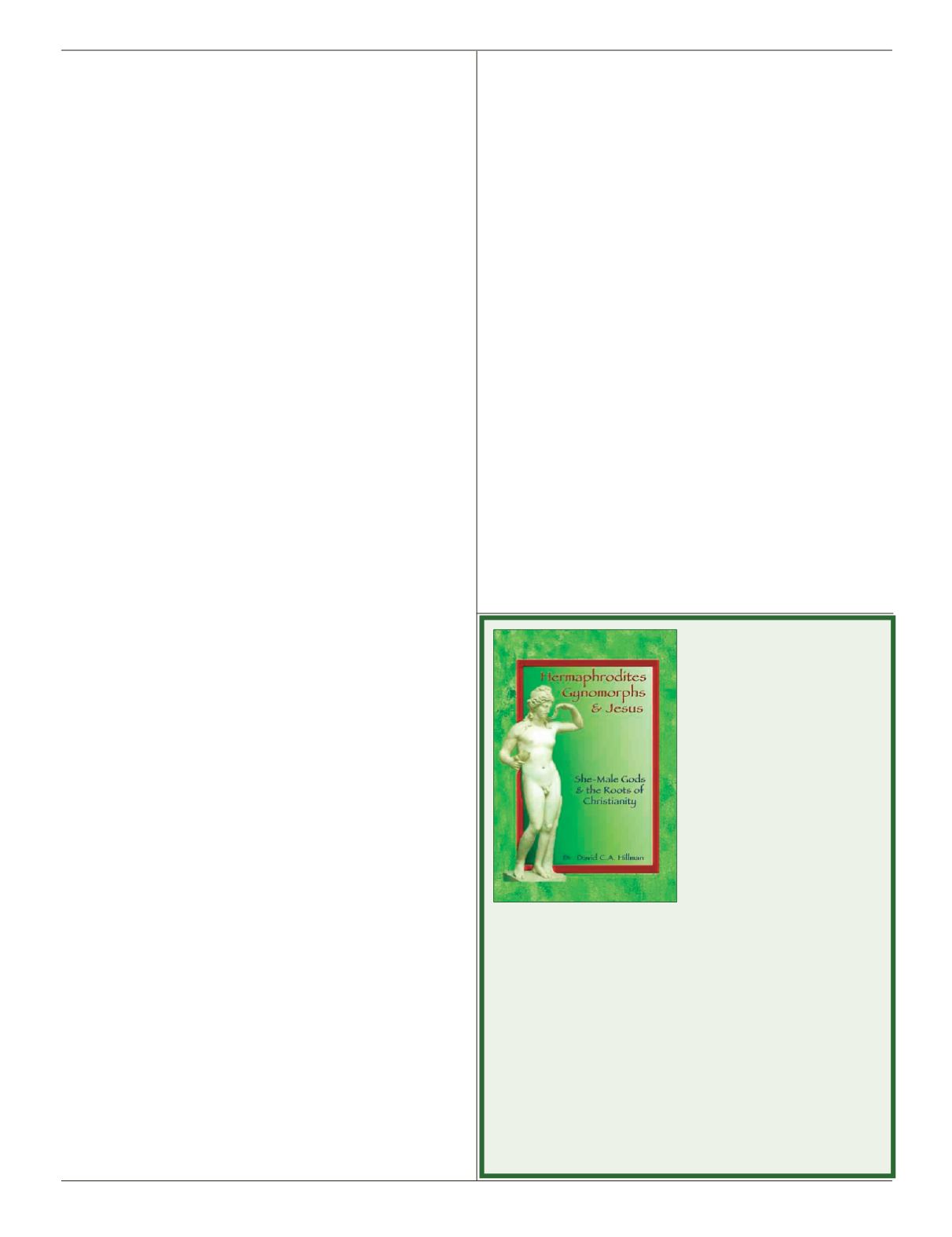
EXUALITY WAS FLUID
in the ancient world, with no word
for “gender” or for “homo-” or “heterosexual.” Dual-gendered
gynomorphs were powerful gods. The ancient's great prophet,
Teiresias, was bi-gendered, as was Dionysus, who was charged
with returning Justice to the world.
I
N
H
ERMAPHRODITES
and keynote speeches to GLBT groups,
Dr. Hillman explores such stories to show their deep influence
on the roots of Christianity. Carefully researched, he exposes
the intense arguments between the church and pagan reli-
gions that led to self-castration by Church fathers and a deep
anti-feminine, anti-homosexual bias.
Hermaphrodites,
Gynomorphs
& Jesus
She-Male Gods & the
Roots of Christianity
by Dr. David C. A. Hillman
174 pages, $16.95
,
roninpub.com/gynmor.htm
l


