
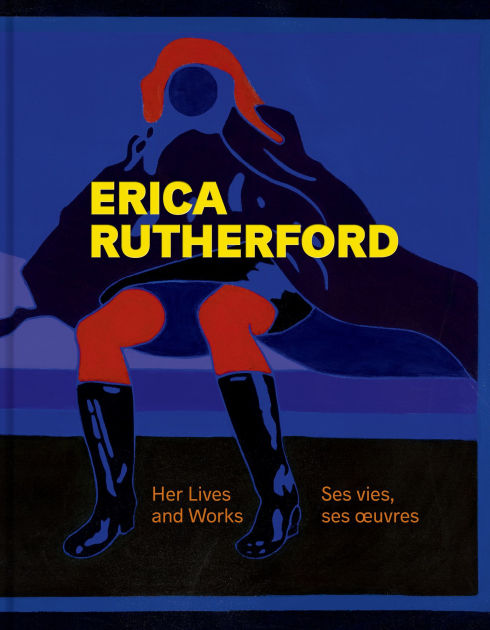
 ERICA RUTHERFORD
Her Lives and Works
Edited by Pan Wendt
Goose Lane Editions. 176 pages, $50.
TRANSITION is a tricky theme to explore within the lives of transgender creatives. The concept is essential to understanding many aspects of trans identity, but it’s easy for such an analysis to fall into tired tropes, too dependent upon notions of being “born in the wrong body” to offer anything new about a person or their experiences. In the case of interdisciplinary Canadian artist Erica Rutherford, this process becomes even more complex. Not only did Rutherford’s visual style change several times over the course of her career, but her sense of identity was in near-constant flux. To the end of her life, Rutherford continued documenting her relationship to gender, a question that by all accounts remained inconclusive. As such, the catalogue for Erica Rutherford: Her Lives and Works, an exhibition held at the Confederation Centre of the Arts on Prince Edward Island, had a difficult path ahead of it.
The six essays included in the catalog, which was edited by exhibition curator Pan Wendt, are largely disconnected, a sometimes jarring but ultimately ideal framework for capturing Rutherford’s remarkably nonlinear life and career. The first essay, a biography written by Wendt, provides a brief yet sweeping view of Rutherford’s life. Wendt demonstrates a thorough familiarity with Rutherford’s journey, using her many international moves, relationships, and stylistic changes to foreground the theme of transformation within the artist’s life. Throughout the essay, Wendt also highlights the inextricable connection between Rutherford’s art and her struggle with gender identity. While dysphoria-centered constructions of transgender life can risk exaggerating the role of suffering, Wendt’s retelling of Rutherford’s struggles—in large part derived from her autobiography Nine Lives—is sensitive and nuanced, exploring how themes of dysphoria and transformation were reflected in her works and various formal approaches.
The catalog’s second essay, by film historian Peter Davis, zooms in further on Rutherford’s personal history, particularly her brief time as a filmmaker in South Africa during the early Apartheid era. Davis makes the odd choice of presenting a pre-transition Rutherford solely as a male. However, the story he tells is an indispensable chapter in her biography. Faced with the authoritarian restrictions of Apartheid, Rutherford, along with then-wife Gloria Green and Donald Swanson, set out to make a Black-centered film within a white industrial monopoly. As Davis puts it: “[T]he established all-white South African film industry, which controlled the money, the equipment, the studios, and the technicians, was not interested in Black subjects—and that is precisely what Rutherford, Green, and Swanson wanted to put on film.” While their film, African Jim (1949), was marred by paternalistic and colonial attitudes, it became a hit with Black South Africans who were seeing themselves and their world represented in film for the first time. Consequently, African Jim had political resonance, becoming a cultural gathering point for Black South Africans and an early site of organized resistance. While the film’s political aspects were unintentional, they speak to Rutherford’s willingness to experiment in her art, as well as the subsequent power of that art to resist repressive social orders, both personal and global.
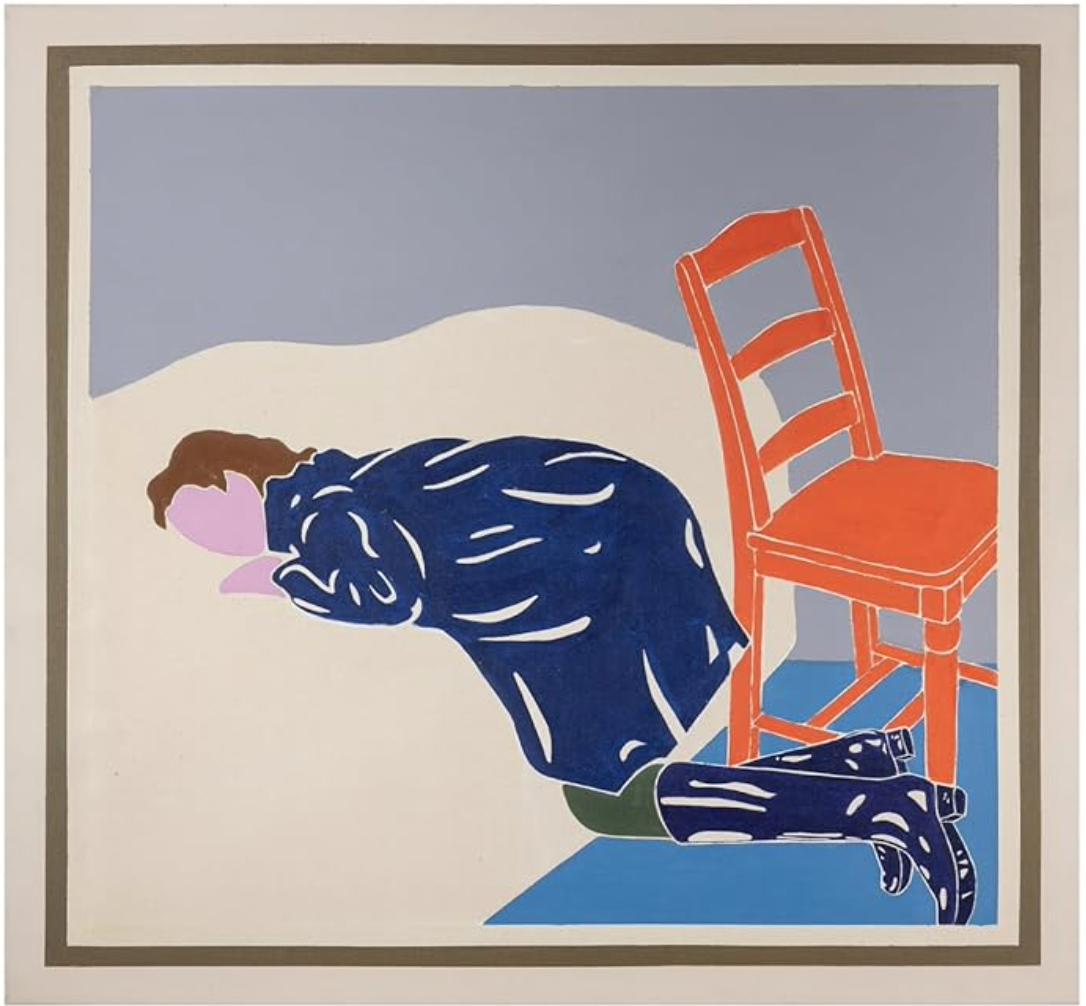
The next three essays, titled “The Diver,” “A Foreigner Everywhere,” and “She Want,” move away from a strictly historical lens to explore Rutherford’s experiences with transition and gender. Each draws on a different aspect of Rutherford’s experience and is grounded in the progression of her art. In “The Diver,” curator John Geoghegan uses a series of three portraits—The Diver (1968), The Green Chair (1974), and The Startled Model (1977)—to track Rutherford’s shifting formal practices as a function of her gender transition. Using the work of theorist Jay Prosser, Geoghegan illuminates how Rutherford gradually shifted from obscuring her features to representing the details of her face, a change that—in conjunction with the dissolution of the borders she often placed around her subjects—indicated that Rutherford may have finally been able to see herself “not as a blank cipher or sphinx but as a living woman looking out from the picture plane.”
Similarly, gender studies scholar Eva Hayward’s essay “She Want” explores Rutherford’s existential grappling with gender through her final series, The Human Comedy. Comprised of more than fifty largescale oil paintings, the series presents a wide range of humanoid and animalistic figures placed within a wasteland inspired by bombed-out remnants of post-war Germany. Hayward centers her analysis on The Infant Offering, a piece she interprets as symbolic of the process by which young children are assigned their “correct” gender. The Infant Offering, like the rest of The Human Comedy, depicts a motley crew. One figure, presumably male, offers a gender-ambiguous baby to a small crowd of animal-human hybrids.
I could recommend Erica Rutherford based solely for the book’s wealth of vibrant photos. However, it’s the story of Rutherford’s life and the analysis of her works that make the book so worthwhile. I suspect this will hold true for anyone interested in the intersections between queer experience and art. An unusual feature of the book is that it is written in both French and English, making it a fascinating meta-textual experience for bilingual readers. The essays tread a treacherous line, exploring the plurality of meanings that transformation held during Rutherford’s life and career. Through a diverse collection spanning interviews, biography, art criticism, film history, and gender theory, the contributors offer a holistic view of Rutherford, not only as a multidisciplinary artist but as a transgender woman searching for herself in a hostile world.
Casper Byrne is a freelance writer and peer support specialist based in Portland, Oregon.