
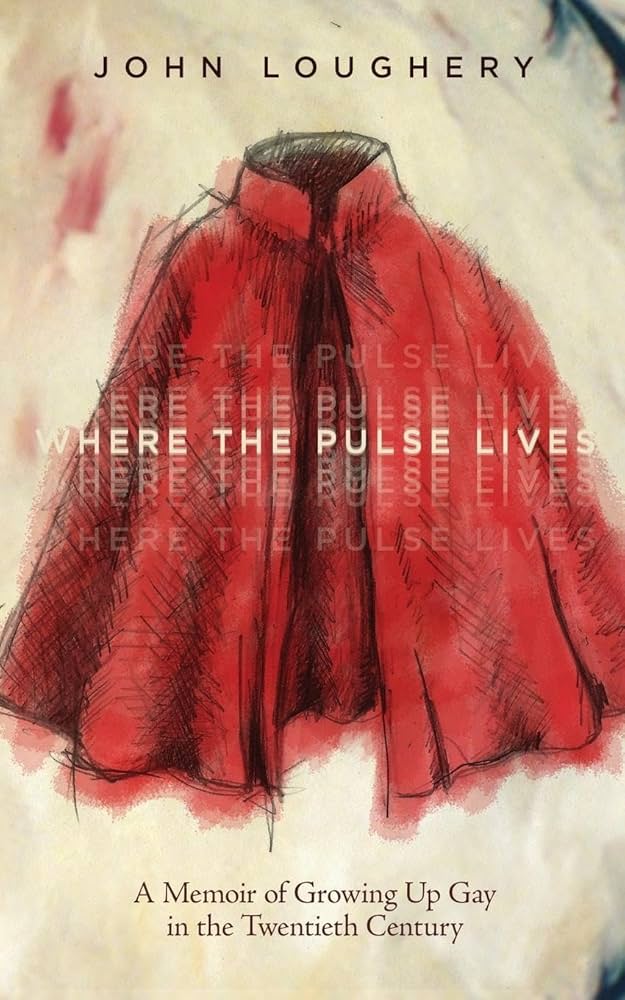
 WHERE THE PULSE LIVES
A Memoir of Growing Up Gay in the Twentieth Century
by John Loughery
Independently published. 244 pages, $17.95
JOHN LOUGHERY chronicled how closeted men managed to be gay during oppressive and dangerous times in his 1998 book The Other Side of Silence. In his new memoir, Where the Pulse Lives, he has captured what it was like for him to come out just as the Stonewall riots cracked open the oppression of LGBT people. Unlike many memoirs that focus on the angst of exploring the author’s sexuality, Loughery’s book is refreshingly coy about sex. Instead of graphic descriptions of furtive fumblings, he explores how he—as a boy, as an adolescent, and as an adult—had to decipher the puzzle of being gay in a world that ignored and hid any hint of homosexuality.
Loughery’s quest to find himself reads like a mystery novel. As its detective, he has to discover his truth by investigating leads. His curiosity leads him to musicals, plays, novels, and movies in which, buried deep in their plots, gay themes emerge. As a child growing up in Ohio, trying to be a “good boy,” he yearns to be more rebellious, and later he moves to New York City, where he finds like-minded men. He discovers bathhouses, meets men who recognize his talent as a writer, and finds himself enmeshed in the thriving gay literary life of the late 1970s.
For me, the book takes a vivid turn when he recounts in gripping detail the AIDS crisis. It’s as if his voice as a raconteur of other lives shifts to the graphic, moment-by-moment intimacy of someone who had to face the devastation of a disease that was killing off his friends one by one and that threatened to kill his life partner. He narrates how at first no one in the gay community knew what had happened, and then how few had any reliable treatments for AIDS, and, finally, how by chance someone offered a therapy that could preserve his lover’s life. Outraged by the inaction of the Reagan administration and national press, he presents his equivocation about the activist group ACT UP, which challenged the silence surrounding AIDS and, finally, his resolve to speak out.
As a teacher, Loughery explores the tightrope he had to walk with students in the late 1970s when Anita Bryant was alleging that gay educators were recruiting their pupils—a suspicion that, as late as 2010, I was still experiencing. In the latter part of the book, he talks about his research for The Other Side of Silence. He traveled across the U.S., meeting people who had managed to create havens that allowed them to be gay many decades earlier. He distinguishes between those who wanted to be out, to be known as gay, and those who didn’t want to be called gay but who, in their private lives, associated with other same-sex-loving men.
Throughout the book, he wrestles with his sense of being gay, of wanting to be seen as masculine, to prove himself worthy as a man to his family and father. His struggles to find himself mirror the struggles of the gay community to find legitimacy in American culture, where, even with all the headway we have achieved, we still are stigmatized. Yet, as his memoir vividly demonstrates, we can grow up and find our truth, despite what the larger society may think and feel. _________________________________________________________________
Bruce Spang is a poet and writer living in Chandler, NC.