When I was in grade school, my mother bought me a sweatshirt that read: “Dirty air makes you pick your nose!” On the front were many different people and some animals (I specifically remember a crow) in a cloud of gray pollution, all picking their noses (the crow picked its beak with its wing). She thought it was funny. She probably said it “tickled” her. Maybe because of that, I instinctively felt wary. Wary in the way that makes many kids assholes to their parents for seemingly no reason. I think it has something to do with the kid finding their own identity, which often involves being dismissive of Mom and Dad. Or they’re just asshole kids. I probably existed in the intersection of those two theories. Either way, I was embarrassed by the shirt. And my mother. But I wore it to school anyway, to appease her.
Well, it may have made her happy but not the school. My shirt caused a bit of a stir and I was quickly sent home to change. I lived close to the school, so walking home wasn’t a problem. But that day it was. I felt humiliated; it was my first walk of shame.
When I got home, my mother was furious. How dare the school treat me like that! she said. We marched right back to Chestnut Hill Elementary. Well, she marched—I was pulled along in her angry wake. I don’t know what she said to the principal, but she came out of his office triumphant. I could stay in school wearing my controversial sweatshirt.
It was a victory for her, but not so much for me. I wanted to disappear. My armpits were sweating buckets and what felt like my first bout of body odor was suddenly presented to the world.
Growing up, I just didn’t think my mom was funny. Sometimes she would jokingly give people the finger, and they always laughed, but I found it mortifying. I thought of her humor as crass and pedestrian.
I did, however, think my aunt Alice was funny. And even though she wasn’t young and into current music or anything like that, I thought she was cool.
Alice was married to my mom’s older brother, Ralph. She smoked long thin, brown cigarettes—the kind that made her look “liberated.” And she was. I loved it when we drove from Syracuse to Buffalo to visit them. And how she’d put on a record and pull me into a dance in the super-cool bar she and Ralph made in their basement, her Manhattan splashing everywhere. I always got to eat the cherry.
Alice loved the British pop star Engelbert Humperdinck, a “sexy” singer from the ’60s and ’70s—sort of a less dangerous Tom Jones. She was the president of his fan club and would follow him around the country, dragging my mom to his shows whenever he played in Upstate New York. My mom even got to meet The Dinck (that’s what his fans called him) because of the high office my aunt held. I was delighted when I heard that Alice had flirted with Engelbert: “I threw my bra at you! It was the black one!”
When I eventually moved to New York City to pursue acting, my mom and I talked, but not often. For some reason, I kept my distance. One winter day she called me with bad news: “Well, your Aunt Alice had a breast off,” she said in her “blurty” way that I never understood. Then she went on to tell me how “slickery” the roads were. “It’s slippery and slick. That’s what I say.” She couldn’t see my eyes roll, but I’m sure she could feel them.
I never did come out to her. Well, not really. When my boyfriend Luis died, the first thing I did was call from the hospital to tell her. I needed my mother. And thankfully, she supported me on that horrible, horrible night. But I never actually said the words “I’m gay.” After all, being gay was not the headline of the call.
Only much later did I consider that I’d denied her (and myself, too) the actual “coming out” moment. The one in which I told her my truth and allowed her to have her feelings about it, whatever they were, in her own time.
I had robbed her of that. And it felt wrong.
Then Alzheimer’s robbed me of the time we had left. Time for her to know me better, for me to know her better. That was taken from us and I felt like it was my fault; I had waited too long.
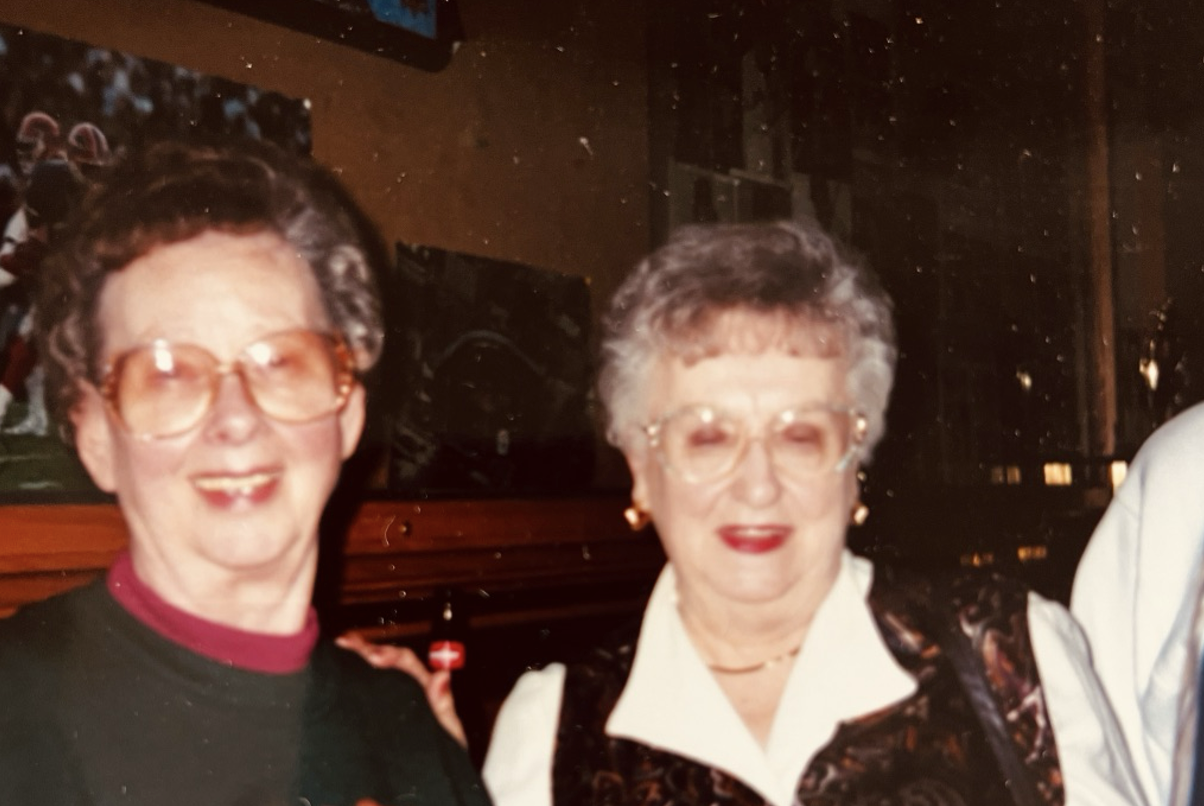
Several years ago, I had dinner with my aunt Alice, who by then was eighty and sharp as a tack. She had lost Ralph years earlier, also to Alzheimer’s, but had not slowed down a bit. She had just flown from Buffalo to Los Angeles, where I lived, to meet up with her daughter—my cousin Chris—and her husband Bob, so they could whisk her off to Hawaii, where they lived. She couldn’t wait to show us all the different bathing suits she bought. She said she couldn’t be bothered with a prosthetic; it wasn’t her style.
My husband, Chris, and I had fun escorting them around L.A. We had gimlets at the Ivy. We went shopping on Rodeo Drive. We found Engelbert’s star on Hollywood Boulevard. But none of us would let her get down to kiss it. At that point she couldn’t do it without help. She was a little mad, but I placated her by scraping some gum off it with a key.
She just had one wish before they left for Hawaii, and that was to find Engelbert’s house. Fortunately (and unfortunately) that’s not so hard to do in this age of (too much) information. I almost didn’t give her the address I’d found, briefly worrying that I might see a headline in the morning that read: “Fanatic Eighty-Year-Old with One Boob Shoots ‘The Dinck!’” But then again, I kind of wanted to see that headline. I decided to take them to the address. We drove around Sunset Boulevard until we figured out how the house numbers worked, and eventually she was able to get some pictures from the street.
The night before they left, we had wine at our house and Aunt Alice began to reminisce about my mother. “We were like sisters!” She told me my mother was very witty, always making people laugh. It made her feel good to do that. Sometimes when my mother got off her shift at Allied Chemical, they would go see a movie and my mother would make Alice laugh until they were shushed and sometimes even asked to leave. This shouldn’t have been surprising to hear since I had been told by others—and my mother herself—that she was funny. But this time, maybe because I was grown up and hopefully less of an asshole, I really took it in.
My aunt Alice said she suspected my mom used humor to cover the pain she felt from her unhappy childhood. Apparently, her family was so poor that Mom only had one dress and one pair of shoes to wear all year round, even in the freezing Pennsylvania winters. And her hateful mother only loved one of her children—my uncle Paul—and repeatedly told the others this cruel fact.
It made me profoundly sad to think about how badly my mother was treated. By her own mother. And by me.
I learned from Alice that Mom and I had a lot more in common than I’d known. We were both thought of as funny by others, and we both used humor to help us through our pain. A humor that, I was beginning to realize, was very similar. I’d started writing for TV and found I had a talent for making people laugh, a lot of which was wordplay. Thanks, Mom.
Then I got emotional and, well, blurty. I confessed to my aunt Alice that I never really “came out” to my mom, and I very much regretted that. Alice took a big sip of wine. “When you went away to college, Ellie told me that she thought you might be gay. It was hard for her and she cried. She said she always kind of knew. And when she told me, I pretended I didn’t know.” Alice said my mom felt much better after getting it off her chest. She even made a joke: “Well, at least that’s one wedding I won’t have to buy a dress for! I can borrow his!” She and Alice laughed. And now I was laughing with Alice about something my mom said decades earlier. It was funny.
So I didn’t have that moment with my mother, but she got to have it with my aunt. And maybe that makes up for it just a tiny bit.
I do think a sweatshirt that read “Dirty air makes you pick your nose!” with images of several people and animals picking their noses or beaks is hilarious. It was totally my style back then. And now. Although now it wouldn’t be on a sweatshirt; it would be on a too-expensive T-shirt worn under a blazer. And I would wear deodorant.
As I dropped them off at the airport for their Hawaiian trip the next day, a cop yelled that I couldn’t stop at the curb and started walking toward my car. But as my aunt Alice waved goodbye, I took just enough time to give her the finger before I jumped back in. Chris and Bob seemed taken aback, but Alice laughed and hurried into the terminal, anxious to start her new adventure.
 Jon Kinnally (@jonkinnally, @jonkinnally.bsky.social) who along with his writing partner, Tracy Poust, has written for such TV shows as: Will & Grace, Ugly Betty, 2 Broke Girls and many others. He currently lives in Spain with his husband Chris and their cats, Howard Bannister and Elliott. This is his first book.