

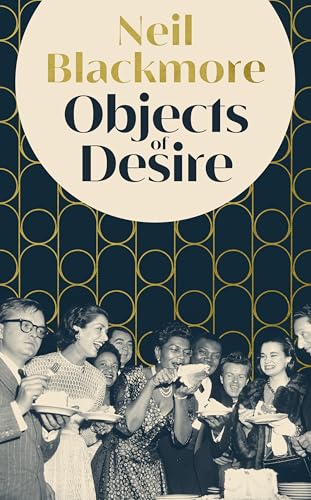
 OBJECTS OF DESIRE
by Neil Blackmore
Hutchinson Heinemann. 368 pages, £18.99
TO STEAL SOMEONE’S WORK and pass it off as one’s own—even to kill for it—is not a new idea. It lies behind R. F. Kuang’s novel Yellowface and the films A Murder of Crows and Deathtrap (based on the Ira Levin play). Of course, with the development of generative artificial intelligence it could become the rule rather than the exception, though perhaps without actual violence.
Such plagiarism is the underlying premise of British novelist Neil Blackmore’s Objects of Desire, though the book offers much more than a simple story of literary deception. Blackmore is one of the most interesting contemporary gay writers and deserves to be better known than I suspect he is in the U.S. Start with his The Intoxicating Mr Lavelle and then move on to his others.
Objects of Desire is a meditation on the conflict between love and fame and the extraordinary lengths to which we will go in pursuit of them. Hugo Hunter—not, of course, his real name—has achieved extraordinary fame on the basis of two novels, neither of which, it appears, he actually wrote. Coming from a poor and mean-spirited Welsh background, he stormed the literary world of London in the 1950s and ’60s, then fled to New York, where, again, he met everyone who mattered in late 20th century literature.
At this point Blackmore taxes our credulity. Yes, it’s possible that an eager young man from the provinces might find support in establishing a career from people such as Angus Wilson and Sonia Blair (aka Sonia Orwell). With sufficient self-promotion and chutzpah, he also conceivably could encounter virtually every significant American gay writer of the time, with the striking exception of Tennessee Williams.
Much of Objects of Desire is devoted to his friendships with the lions of the period, above all Gore Vidal, James Baldwin, and Christopher Isherwood. As someone who knew all three, though certainly not as intimately as Hugo, I found Blackmore’s depictions of them somewhat jarring. In particular, the conversations with Vidal struck me as implausible, portraying Vidal as more sentimental than he was. There are also memorable encounters with George Orwell, Truman Capote, and a very drunk Norman Mailer who—in contrast to Vidal, Isherwood, and Baldwin—come across as vicious and unappealing, as I suspect they often were. Possibly it is easier to satirize the famous than to capture them as genuine human beings.
The book stretches across sixty years, from Hugo’s birth in 1926 to a final encounter with Muriel Spark in 1986, and straddles a time when to be homosexual was to live a life marked by constant fear and deception. But given that much of the action takes place in the first half of the 1980s, it’s odd that Hugo seems totally unaware of the explosion of gay politics over the previous decade, although he encounters the first stages of the AIDS epidemic, which adds to his own sense of persecution and paranoia.
Along the way, Hugo has relations with several young men, one of whom appears to have seduced him as a move into literary success, to be followed in time by drug addict who’s also an aspiring writer. In both cases, things end badly, though more for the lovers than for Hugo. Unbelievable as many of the literary encounters are, Blackmore is such an engaging writer that I devoured the book, laughed, was moved, and was exasperated. What more can one ask of a novel?
_________________________________________________________________
Dennis Altman, professorial fellow at La Trobe Univ. in Australia, is the author of Righting My World: Essays from the Past Half-century (2025).