
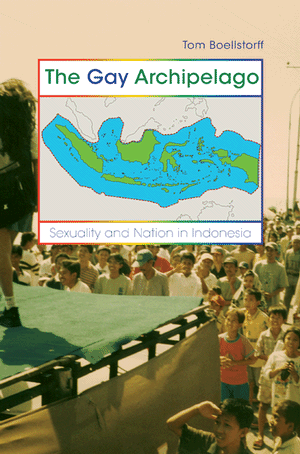

 The Gay Archipelago
by Tom Boellstorff
Princeton University Press. 282 pages, $24.95
IN THE GAY ARCHIPELAGO, anthropologist Tom Boellstorff of the University of California, Irvine, sets out to define, interpret, and reflect upon what it means to be gay in Indonesia. Considering the tapestry of nationalism, family, history, language, profession, sexuality, and gender that constitute that country, the challenge is enormous. To Boellstorff’s credit as a scholar and writer, his book is a cogent and well-argued examination, and one that may remain applicable to Indonesian social life for many years.
While most anthropological studies of sex and sexuality in Southeast Asia and Oceania focus on the microscopic analysis of one or another institution found in specific ethnic communities (the bissu of Sulawesi, warok-gemblak of Java, ritualized homosexual rites of passage among the Sambia of New Guinea, or the Kimam of Irian Java), Boellstorff dares to cast his net much wider. He suggests that there are complexes of interconnected attitudes and national policies that make for archipelago-wide “similitudes.” This is a bold stance, since Indonesia is the fourth most populous nation in the world and is known for its defiance of simple generalizations. With over 6,000 inhabited islands, the reality of Indonesian cultural and historic particularism is overwhelming in every way. Boellstorff’s concept of a “gay archipelago” is central to his book’s thesis, while unity in diversity is the rallying cry of Indonesian nationalism. Since homosexuals in Indonesia cannot be ethnolocalized by island, “no discourse appears to correlate their existence.” Taking an approach that owes much to philosopher Michel Foucault’s notion of sexual identity as socially constructed, Boellstorff argues that gay and lesbian identities in Indonesia should not be mistaken for easy reflections of those in the West. Most are people with little wealth who have never traveled outside Indonesia, do not know non-Indonesian homosexuals, and haven’t read literature written by other gay and lesbian people. Gay and lesbian Indonesians “are not just ‘gay’ and ‘lesbian’ with a foreign accent,” he observes. In Indonesia, the masculine lesbian is the “tomboi,” while her feminine counterpart is the “cewek.” One of each is the norm for lesbian couples; two tombois or ceweks together in a romantic relationship is considered strange. A similar binarism is not found among gay men. Male-to-female transvestites are known by both banci and waria and are highly visible though not widely accepted: their work choices are often limited to entertainer, beautician, or prostitute. They do not generally form romantic unions with gay men. Perhaps the most dramatic point of disarticulation between “us” and “them” is in marriage customs. It is common, even expected, that gay and lesbian Indonesians will marry heterosexually. Marriage and parenting are ennobled and prescribed as part of a national ideology known as “family principle,” and few escape its web. The man who has male lovers or tricks periodically is called orang sakit (“sick man”), a term that reeks of patronizing tolerance. A man’s homosexuality is a misfortune to be endured for the sake of family, with the wife sometimes allowing the cohabitation of her husband’s boyfriend as a means of maintaining domestic harmony. A man may join the gay demimonde by entering any tempat ngebers (“hangouts”), while a woman’s options are more limited. A female lover for a married woman is hard to find; she does not have ready social networks due to limitations on personal mobility. The cewek and masculine gay man threaten national identity politics more than the waria or the tomboi, since their sexual orientation is not apparent from their “normal” social gender roles. For people in all these categories, the fact that same-sex love receives no recognition is a source of “incredible pain and desperation” in a country in which such love is said to be “ubiquitous.” Matthew Kennedy teaches anthropology at City College of San Francisco.
____________________________________________________________________