
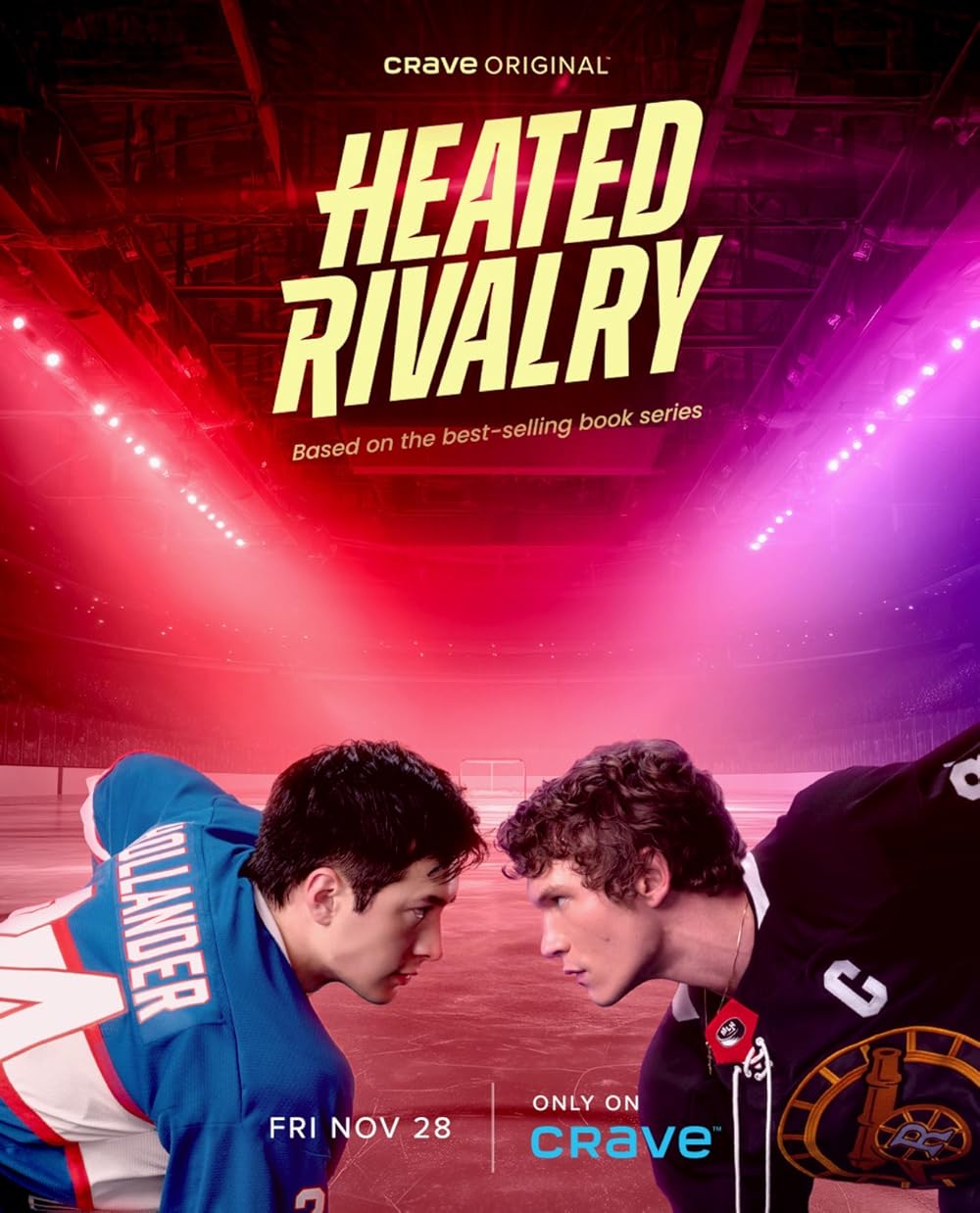
 HEATED RIVALRY
Created by Jacob Tierney
Crave / HBO Max
SINCE LATE LAST YEAR, social media have been abuzz about the Canadian TV series Heated Rivalry, a titillating tale of forbidden love between two professional hockey stars. In the show, Russian rebel Ilya Rozanov and Canadian choirboy Shane Hollander begin casually hooking up as teens shortly before their rookie season, then realize gradually, over a period of years, that they have genuine feelings for each other. Their many fans and the sports media see the pair as enemies, little suspecting that after facing off on the ice they bury their faces in each other’s laps.
The series depicts two young men who are conventionally attractive beyond all reason having deeply idealized and surprisingly explicit sex in the gentle amber lighting of impossibly well-appointed penthouse apartments and luxury hotel suites. It’s based on a romance novel by Rachel Reid (the pen name of Rachelle Goguen, who’s married to a man and has two children) that contains some insight into human nature but whose prose evinces no aspirations beyond pedestrian, literal-minded descriptions; it was basically a script already. The novel describes scenarios that most readers could never imagine experiencing but captures some of the illicit excitement that those who came of age when same-sex encounters were necessarily clandestine will recall—and perhaps remain nostalgic about. Any experience is more exciting when the outside culture proscribes it.

Despite the graphic gay content, many fans of the series are straight women who seemingly enjoy these encounters between muscular youths in much the same way that straight men have long appreciated “lesbian” scenes that cater to the male gaze. Feminist writer Jessica Valenti has suggested that the sex in Heated Rivalry appeals to straight women because so few onscreen heterosexual encounters depict two equals. “When it comes to sex in pop culture that is targeted towards us, there is always a massive power imbalance,” Valenti said on social media. “I think part of the reason this show is doing well is because it’s appealing to watch sex between equal partners.”
The show depicts a woman’s romance-novel fantasy of what being a gay man might be like. Tops with rippling muscles lift their bottoms effortlessly and carry them to bed, where they are vigorously buggered with little mention of lube, sphincter-loosening, or any of the untelegenic elements of anal sex. In this world, lust is a powerful, inescapable drive that’s indistinguishable from true love at first sight; love is always mutual and never unrequited; and the only real problem the characters have is society’s pressure to be straight. Nonetheless, this is one of the rare cases in which the adaptation is better than the book, avoiding many of its excesses.
That said, much of the show is taken nearly word for word from the novel—even the staging of the sex scenes—but other elements are heightened or improved by nuanced staging and performances. The series is thoughtfully written and directed by Jacob Tierney, a gay man best known for his work as a writer and actor on the very unsexy Canadian show Letterkenny. Heated Rivalry gives viewers a lot of steamy sex up front but then tightens the spigot as the series moves on. In the later episodes, there’s increasing focus on the characters’ emotions, as feelings come to the fore and both men admit there’s more going on between them than sex.
Lead actors Hudson Williams (Shane) and Connor Storrie (Ilya) are as deeply committed to their roles as they apparently are to squats and crunches, and they have an interpersonal ease and chemistry that feel genuine. Williams is persuasive as Shane, a charming goody-two-shoes who would naturally be drawn to—and submissive for—Storrie’s dangerously appealing and naturally dominant Ilya, and Storrie captures both his character’s swagger and the vulnerability he’s trying so hard to hide. As their situationship evolves into a romance, Williams and Storrie produce the facial micro-expressions and physical tics that reveal the longing and jealousy they’ve almost given up masking.
Heated Rivalry makes modest reference to real-world issues such as the oppression of LGBT people in Russia, but the world depicted here has low gravity and less gravitas. There are some minor racial head-scratchers, including the show’s depiction of Shane’s Japanese-Canadian mother, who barely figures in the novel, as a stereotypical tiger mom. That aside, the show is generally enjoyable, and it will surely be an activating experience for many adolescents, in part because it views Shane and Ilya in the dreamy, airbrushed way that women were once depicted in Playboy magazine. This isn’t the world most of us live in, but for many it’s a welcome break from tales of LGBT oppression and personal tragedy, a nice place to spend a few hours. And there will be more hours to come, as Canadian TV network Crave has given the series a greenlight for Season 2.
Jeremy C. Fox is the managing editor of The G&LR.