

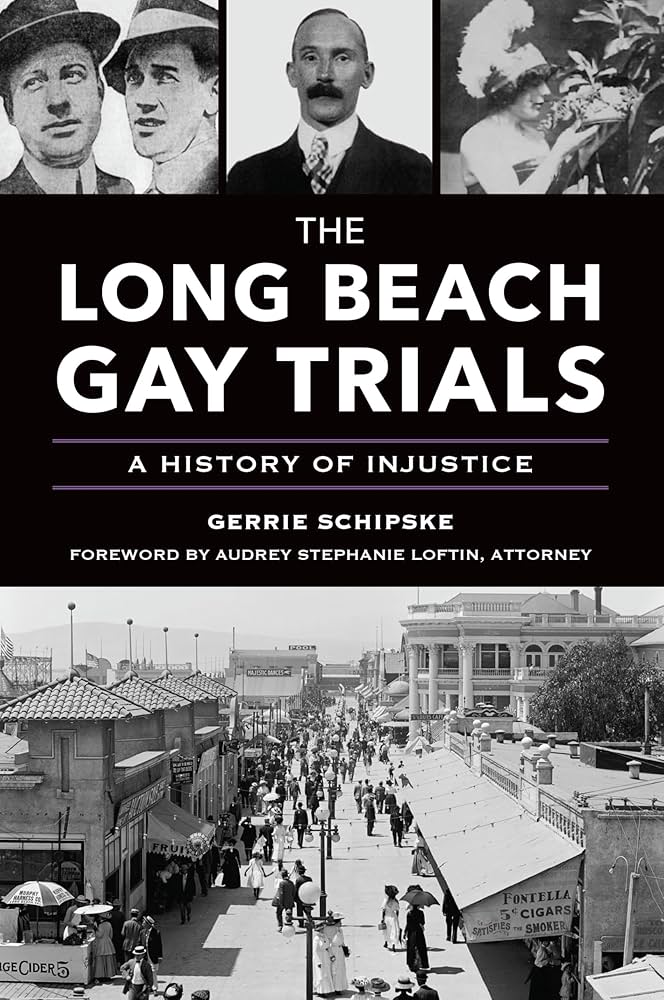
 THE LONG BEACH GAY TRIALS
A History of Injustice
by Gerrie Schipske
The History Press. 192 pages, $24.99
A LITTLE MORE THAN 100 years ago, the City of Long Beach, California, began targeting and entrapping prominent gay men. Originally, the police extorted fines of $500 (approximately $16,000 in today’s dollars) and gave the victims the impression that prompt payment would result in no further action. The fines were used to finance the sting operation. Unfortunately, The Los Angeles Times published the names of all arrested, with devastating results for the victims, one of whom died by suicide. How did this happen?
It was in 1914 that a new mayor took control of Long Beach, fired the police chief, raided the treasury, and began arresting and fining “fruiters,” or gay men, caught engaging in oral sex in a newly constructed “comfort station,” or public restroom. Two decoys enticed targets entering the restroom and “left their mark” on their prey’s private parts for identification (with a laundry pencil, one hopes, and not their teeth). One of these decoys, who had a “woman’s face,” moved into a rental cottage behind a prominent victim’s home and initiated an early morning seduction to entrap him.
In The Long Beach Gay Trials, author Gerrie Schipske presents a narrative peppered with newspaper clippings, court records, archival material, and photographs. The reader discovers the story as it unfolds in these historical documents, much as the author did. Schipske is a Long Beach native, a lawyer, politician, nurse practitioner, and the author of one novel, The Case of the Missing Librarian, and seven other books of Long Beach history, including LGBTQ+ Long Beach. The events she details are also the basis for a play by Tom Jacobson, The Twentieth-Century Way, named for the colloquial term for oral sex between two men that was used by a local reporter.
The story of John Lamb, a local pharmacist, banker, churchman, and bachelor who lived with his sister, provides the book’s narrative thread. Lamb was arrested after he offered himself to a police decoy through a glory hole in a toilet partition in the comfort station. When Lamb went around the partition “to give better access” to the decoy, he was arrested. He tried to escape but was captured. Lamb immediately paid a $500 fine, hoping the incident would not be publicized. However, on November 14, 1914, The Los Angeles Times published all the names of those arrested. On the same day, Lamb ended his life by drinking potassium cyanide. He was found at Point Fermin with a copy of the Times article and a postcard addressed to his sister that declared his innocence and appointed his friend and probable lover, Louis Hazelwood Smith, to handle his estate.
Schipske’s meticulous research and documentation provide an excellent model for other writers and researchers seeking to capture moments in LGBT history. Her book unites elements in the history of Long Beach in the early 1900s: its local government, police, and courts; the power of the press for both good and ill; and the long, slow process of change. Included are details of popular female impersonators’ performances contemporaneously advertised in local newspapers. At the time it was illegal to wear clothing of the opposite sex on the theory that such “disguises” would disrupt the ability of the police to identify criminals. However, drag shows didn’t prove to concern the public or the police as much as “fruiters” invading the “comfort station.”
Long Beach continued to entrap and arrest men in public restrooms until 2016, when former Los Angeles Superior Court Judge Halim Dhanidina granted victim Rory Moroney’s motion to dismiss charges. The judge ruled that “by utilizing undercover officer decoys in a pre-planned, lewd conduct sting operation designed to ensnare men who engage in homosexual sex without any relationship to complaints … [Long Beach] demonstrated its intent to discriminate against the defendant and other members of this group.” The judge concluded that “the defendant would not have been prosecuted except for this invidious discrimination.” This decision finally brought an end to the practice of entrapping gay men in Long Beach.
_________________________________________________________________
Larry Reynolds is a retired federal attorney.



