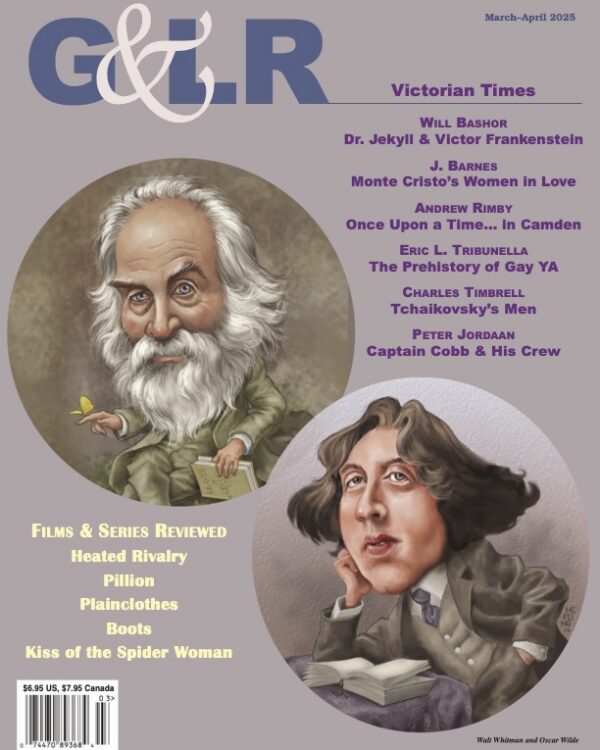

NOTWITHSTANDING this issue’s theme, the cover features Charles Hefling’s gentle caricature of writer Edmund White, who passed away in June and is remembered here by three friends.
It could be said that “forgotten histories” are the stock-in-trade of this magazine: the discovery of people or places whose history has been neglected or actively suppressed. Many of these articles take this excavation a step further, bringing out activities that were deliberately hidden or disguised: underground worlds that didn’t leave a record by design, or episodes whose participants actively covered their tracks. The cases are presented in roughly chronological order.
The earliest comes from our resident sleuth, William Benemann, who reports on a curious phenomenon of mid-19th-century America: a growing sales force of men who worked the counters in the new department stores and were often available for a variety of services, including sexual ones. After a promising start, their obvious queerness brought the “counter jumpers” into ill repute by the time of the Civil War.
Speaking of which, an article by Andrew Holleran takes us to the Civil War era and a discourse on the homoerotic character of public posters and private photos and letters, especially in the South. Here the issue is that much of this is operating at the level of subtext or innuendo; but the author of Confederate Sympathies offers many intriguing facts to make his case.
Moving to early 20th-century America, Harlan Greene writes of an improbable love affair between two young men who would both go on to become prominent writers and educators. George Sylvester Viereck was a widely published poet and journalist who was later convicted of being a Nazi provocateur, while Ludwig Lewisohn was a popular novelist and possibly the most famous Zionist of his generation.
Edna St. Vincent Millay is the subject of an Art Memo by Denise Noe, who brings out a side of the poet that the anthologies tend to ignore. Many of her poems express a fascination with women and even a sexual attraction to their beauty, while her private life reveals an exuberant history of relations with both men and women.
Staying in this time frame but moving to France, Vernon Rosario explores an underground culture that long predates the arrival of a lesbian movement as such. New sexual identities for women emerged after World War I, but the subculture they formed, however rich and durable, kept a mostly low profile.
Back in the U.S., an incident in 1953 gets Denny Nivens’ vote as the first LGBT riot in history. It happened at a northern California “school” for girls too young for adult incarceration at a time when just being homosexual could land you in prison or an asylum. Los Guilucos was a little of both, and its lesbian inmates played a key role in the fracas.