
AT SIX O’CLOCK on the evening of Thursday, March 19th, 1953, 79 inmates entered the main dining hall at Los Guilucos School for Girls, a state correctional institution seven miles east of Santa Rosa in the tranquil Sonoma Valley. Los Guilucos was considered the gem of the California Youth Authority (CYA). The school housed 159 girls between ages eleven and seventeen from all over the state, each assigned private living quarters with pastel-colored walls, bed, dresser, radio, and floral-patterned drapes. There were no barred windows and no locks on the dormitory room doors. It was intended to be homey.
Fifteen minutes into the dinner hour, a fourteen-year-old girl stood up from her seat at one of the long tables and began swinging her arms at the girl opposite her, who rose and did the same. In a few seconds many more were on their feet, screaming and overturning tables. The four adults in the room quickly lost control. Girls used chairs to break windows, and about fifteen climbed out onto the school grounds. Several were cut by broken glass. Once outside, they used rocks and sticks to smash the windows of the administration building and dormitories.
Only one male attendant was on the property. School officials summoned assistance from the sheriff’s office in Santa Rosa and the Sonoma State Home, an institution for people with developmental disabilities. Eventually the calls for help would bring eight sheriff’s deputies, two security officers from the State Home, two California Highway Patrol officers, several off-duty school supervisors and security officers, and a flock of reporters from local and Bay Area newspapers.
When reinforcements arrived, they found sixty girls wandering the 315-acre grounds, many of them crying, cursing, or calling for their mothers. About forty were engaged in vandalism. Some had broken into the staff’s vending machine and stolen money and sodas, then pitched the empties at officers. A thrown bottle struck a lieutenant from the State Home’s security force on the nose, while another narrowly missed a reporter. There was no perimeter fence, so the guards formed a cordon around the grounds. By half past seven, most of the violence had been contained, but flare-ups continued until ten o’clock.
Twenty girls had fled in a break for freedom. Fourteen were quickly rounded up and locked in the Observation and Treatment ward—“O & T”—of the school hospital, which had become a makeshift maximum-security wing, but other girls smashed the supposedly shatterproof windows from the outside. The girls inside broke toilets off fittings and used them to bash through the remaining windows, and they were free.
Several eluded capture by hiding in bushes near the grounds. At half past nine, ten girls were found in the town of Kenwood, three-and-a-half miles away—they’d broken into a store and were taken back into custody, drunk and reeking of beer. Three more were picked up an hour later on the highway outside Santa Rosa. One turned up the next night at her foster parents’ home in San Francisco, sixty miles south. Girls who hadn’t taken part in the riot were sent to their dormitories. Those who’d missed dinner were given sandwiches, soft drinks, and candy. The more violent were corralled in the O & T ward, in a section where the windows were still intact. The school physician administered injections of a sedative but quickly ran out and called Sonoma County Hospital for a supply of Nembutal.

“Police handcuff rioting girl at Los Guilucos Friday Night.”
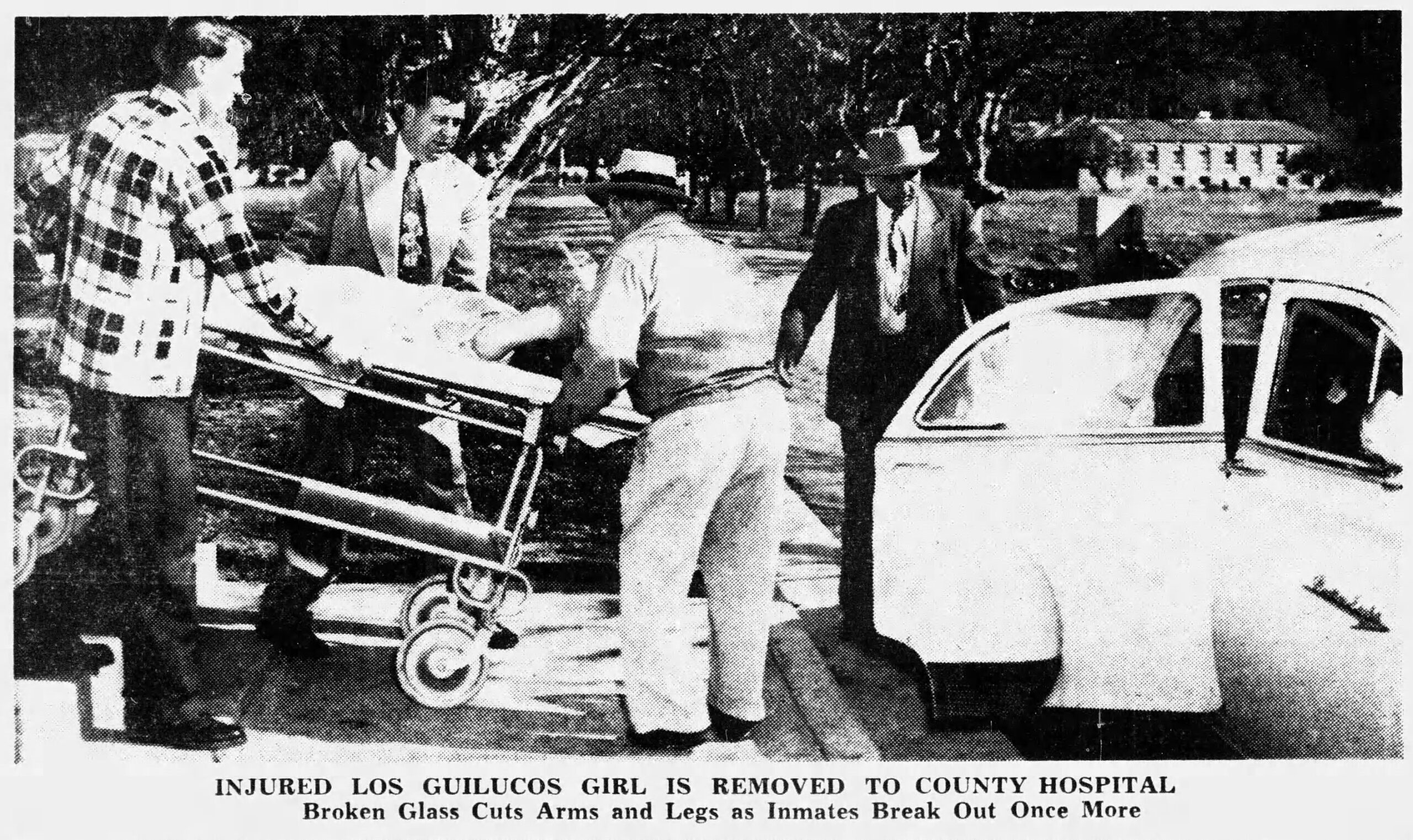
Thirty girls had been injured, four badly enough to be sent to the county hospital. A sixteen-year-old was hurt seriously, with severe cuts from broken glass on her eye, arm, and leg, and was in a state of shock caused by blood loss. Doctors stabilized her and reported her condition as “good” but warned she might lose sight in the injured eye. Damage to the school, mostly in the form of some 400 broken windows, was estimated at $5,000 to $6,000. Hardest hit were the buildings constructed in the previous year. In addition, furniture was smashed, dinner plates broken, bed linens torn. Nothing like this had happened in the nine years since the institution had opened. Reporters overheard school officials say the riot was caused by “a homosexuality problem.”
The Los Guilucos incident came amid a national wave of prison riots. Twenty-five major inmate uprisings had taken place in the previous year at institutions across the nation. After a massive disturbance involving more than 2,000 men incarcerated at the Southern Michigan Prison, Warden Julian Frisbie told the press that homosexuality was responsible for 98 percent of disciplinary problems. Similar blame had been lain on homosexuals in earlier riots at the New Mexico State Penitentiary in 1950 and at South Carolina’s Boykin State Prison in 1947. Violence often flared when someone or something came between established partners. Los Guilucos was no different.
Hours before the mayhem there, two girls had been transferred to the Napa State Hospital, a psychiatric institution intended for adults. They’d been sent to Los Guilucos with thirteen others over the previous few weeks from detention homes in L.A. School officials blamed them for several recent problems, including a rise in lesbian activity. The girls were sent to Napa for treatment as sexual deviants. The transfers not only tore apart the partnerships formed at Los Guilucos but disrupted the social structure and made other lesbian girls fearful they might be sent away next. “You wanna know how it started?” a girl had asked a reporter for Santa Rosa’s Press Democrat, well into the riot Thursday night. “It was over two girls we liked a lot. They told ’em they were crazy and they wasn’t. And today they sent ’em to Napa. That’s what started it.”
§
Heman Stark, a director of the CYA, arrived at Los Guilucos around 10:30 Thursday night with two of his chief executives, driving 85 miles from Sacramento. The next morning, school officials met to discuss their response. Stark planned to “break the back of this thing” by cracking down on the riot’s alleged ringleaders. Thirty girls from O & T were brought into the superintendent’s office individually and quickly removed in handcuffs, screaming insults and profanity.
Wreckage from the revolt was visible everywhere. Broken glass and chipped tile littered the concrete walkway outside the administration building. Chunks of mud were tracked through the lobby. Trash cans were filled with debris. In the dormitories, beds piled high with rumpled sheets lined the halls. Blood was spattered on floor tiles, window frames, the walls of the O & T ward. “I’ve worked in three different insane asylums in this state,” a cook told a reporter, “and I never saw anything as bad as this.”
Soon violence erupted again. Rumors had been flying through the school since daybreak: It was feared that rioters would be sent to Napa State Hospital or denied parole. The atmosphere was said to be one of hysteria and “seething unrest.” Around mid-morning, a girl confined to an isolation room kicked through a metal ventilator to free herself, then helped another do the same. Police quickly subdued them. A third girl, age fifteen, climbed through a window and made a break across the schoolyard. She was halted by a sheriff’s deputy, who fired a shot over her head, handcuffed her, and dragged her back inside.
Security officers began clearing girls out of the more raucous dorms and herding them to an outdoor compound, warning that tear gas would be deployed if they didn’t quiet down. A record player was set up to calm them—in a canny move, the music played was bebop and jazz, rather than the soothing sounds typically used in adult prisons. Meanwhile, the CYA plotted its next move. By noon, four more girls had been transferred to Napa and four had been sent to Mendocino State Hospital, another adult psychiatric institution that was Northern California’s primary dumping ground for homosexuals and other “psychopaths.”
Early in the afternoon, fifteen girls escaped O & T by wrapping sweaters around their hands and smashing through the remaining windows. They armed themselves with shards of broken glass, and as police and security officers scrambled to contain them, five girls passed stolen kitchen knives through the windows to those still inside. Again the school called Santa Rosa police to add to the more than twenty sheriff’s deputies, highway patrolmen, and special officers already on scene.
California Governor Earl Warren authorized use of the National Guard. Twenty-five men from the Santa Rosa battalion were put on standby. The unit’s commander drove to the school but concluded the situation didn’t require military action. The police barrier enclosing the grounds was kept in place through the night, which passed quietly, although many girls were still armed with knives and broken glass. Stark said the school was a potential powder keg, but the weekend passed in relative peace.
Medical and psychiatric advisors met with administrators Sunday morning to develop a plan for weeding out troublemakers before they were admitted to the school. The group discussed security improvements, particularly with regard to shatterproof windows. It also settled the fates of nine girls temporarily housed in the Sonoma County Juvenile Detention Home. Three would be returned to Los Guilucos. Four would be sent to the Ventura School for Girls, a facility for slightly older offenders that had better security. The final two had already been transferred to Napa.
§
Mental hospitals were big business in 1953. More than half of U.S. hospital beds were occupied by mental patients: Home care and outpatient services were not the norm. Before the advent of psychotropic drugs, it was felt that many patients couldn’t be managed without constant supervision. It was estimated that one in twenty Americans would spend time in an institution.
The California State Hospital system alone housed 40,000 people across its nine facilities. Half were hospitalized longer than eight years. The vast majority were committed by court order, through petitions filed by family or friends, or after a criminal case prompted an examination. Transfers from correctional institutions required no judicial review. The conceit among psychiatrists and psychologists was that every mental disorder could be corrected by the proper combination of psychotherapy, sedatives, neurological treatments, and surgery, and that every personality trait they deemed undesirable was a mental disorder.
Electroconvulsive therapy (ECT) was considered something of a cure-all in the 1950s. To this day, there is no theoretical explanation for why inducing a grand mal seizure should relieve a mental disorder: ECT is essentially the medical equivalent of banging on a television set to improve the picture. In the postwar era, it was administered with no anesthetic at a much higher voltage than is used today, and as a continuous wave rather than a brief pulse. The moment between the application of current and the onset of unconsciousness was described as giving the sensation that the brain was exploding, a feeling so terrible that threats of further treatments were enough to keep unruly hospital patients in line. Aftereffects included confusion that persisted for days and memory loss that could be permanent. The shocks were applied two or three times a week until the symptoms of the disorder disappeared. For homosexuals, the symptoms never went away.
The last resort for those who hadn’t responded to other therapies was lobotomy. California subscribed to the transorbital or “icepick” method, in which a long steel spike was inserted through the eye socket to sever the connection between thalamus and frontal lobes in a ten-minute operation. Post-surgery, patients would be tranquil, smiling, and vacant. Memory, intelligence, capacity for higher thinking, and control of bodily functions were often severely diminished. Success was measured by the lack of behavioral problems. Preserving the patient’s intellect and individuality was not a consideration.
Twenty-nine icepick lobotomies were performed at Mendocino State Hospital in 1953 and early ’54. The number was small compared to the patient population, but it was undoubtedly a significant concern for a group of juvenile delinquents with a recent history of violent behavior and a diagnosed mental disorder that couldn’t be “corrected” by other means. The juvenile court judge heading a committee to investigate Los Guilucos claimed rioters hadn’t understood that the girls who were transferred to Napa and Mendocino were merely being sent to places where they’d receive more appropriate care. In truth, the girls of Los Guilucos had good reason to be angry and afraid.
At half past eight on Monday morning, rioting flared up again. Forty or fifty girls bolted from their morning exercises and ran to the school hospital to free the eleven still held in O & T. Once more they began smashing windows, many of them replaced only the day before. Sheriff’s deputies chased the girls into a nearby dormitory, where they screamed profanities from doorways and windows. The building was surrounded and the girls penned in for an hour while school officials worked on procuring a court order to send the so-called ringleaders to jail.
As deputies began separating the more violent girls from the rest, all hell broke loose. The girls used chairs to bash windows and hurled shards of broken glass at the officers, tore steel slats from beds and used them to shatter more windows, smash the furniture, and gouge the walls. One girl was badly cut on the leg trying to climb through a broken window. An officer was knocked flat by a solid punch to the face. Four girls escaped the police cordon and fled the grounds. They were picked up more than an hour later, two miles away.
School officials called out for help and six Santa Rosa officers were dispatched. A security force of more than thirty herded the girls into the dormitory’s basement, and the riot was shut down. Thirteen were immediately led away in handcuffs. Sixteen more were brought out shortly afterward. Eventually 41 were separated from the general population for removal—apparently there were quite a few “ringleaders.” For an hour they were shuttled in police cruisers, eight carloads in all, from the school to the Sonoma County Jail, where they were held in two large tanks cleared especially for them.
At one o’clock that afternoon, CYA and school officials held a board of review at the jail to determine the fates of those held there. It was decided that ten would be sent to Napa and seven to Mendocino. The rest would be scattered to detention homes across the state. Of the 159 girls who’d populated the school on Thursday evening, only 91 would remain. Sixty-eight were sent elsewhere, including all fifteen who’d been brought from Los Angeles since January and were blamed for the rise in homosexuality and other troubles. At the school, all was calm. Los Guilucos officials and the remaining girls proclaimed the violence was over, but there was another headline to come.
§
Frank Herbert was a reporter for Santa Rosa’s Press Democrat who’d been immersed in the story from the start: He’d arrived at the school Thursday evening, less than an hour after the first riot had begun. Herbert had been allowed to observe the review board’s interviews with some of the girls. From those sessions, along with private discussions with the school psychologist, a dorm supervisor, a part-time school chaplain, an inmate’s mother, and a few girls he’d interviewed during the riots, he pieced together an elaborate social structure at the school, centering on lesbian relationships and embodying its own unique ethos, language, and rites of passage. His story hit the front page on Wednesday afternoon.
The two girls transferred to Napa on Thursday were “daddies,” the heads of surrogate family units the girls had established. They bragged about being lesbians and vowed they’d never have a man. Beneath them was a family tree of “sons,” “daughters,” “brothers,” “sisters,” and “in-laws,” based on mutual pairings and sexual roles. Submissive, typically younger girls were known as “chicks,” while their dominant, usually older counterparts were “gals” or “votts”—a word possibly derived from the Mexican slang term vato, equivalent to the modern American dude. One fifteen-year-old described a variety of sexual acts to Herbert in explicit detail, illustrating some with hand gestures before adding with a smile: “I guess quite a few of the girls did it. I wouldn’t know.”
The girls reveled in discussing their sexual activities openly, under the noses of the supervisors, using their secret code. They were especially proud of a complex system they’d constructed for performing wedding ceremonies to formalize partnerships. In the swimming pool, a girl chosen to officiate would be designated the “caller.” She’d yell out a prearranged set of commands to the rest—the bride was an “orange,” the groom a “diver,” the bridesmaids “swimmers”—with certain letters of each word spelling out: “I now pronounce you man and wife.” When she finished, peers would dunk the happy couple to complete the ceremony. Similar rituals were established for holding weddings at choir practice or in line at the dining hall.
Some girls claimed they were bullied into participating in lesbian activities, threatened with beatings if they didn’t comply. Others swore nothing sexual ever took place outside a marriage, and girls who didn’t want to participate could pair up in pretended relationships to be left alone. The two “daddies,” far from leading a reign of terror, were described by nearly everyone as popular girls.
Such a highly developed subculture couldn’t have been established within a few weeks. Those who claimed lesbian activity had begun with the arrival of the Los Angeles transfers had likely been telling school officials what they wanted to hear. One girl told Herbert more than twenty marriages had taken place in the pool since the prior summer. The facility had been closed for the season since fall, well before the transfers arrived.
Soon after Herbert’s story appeared, the official denials began. Sheriff’s deputies tried to blame the riots on racial tension: The two girls whose transfer to Napa had touched off the violence were Black. A school chaplain who’d been present each day of the rioting quickly refuted that claim, saying he’d never seen any group of children or adults in which race was less of an issue. Reporters had noted from the start that color lines seemed nonexistent among rioters and non-rioters alike.
The CYA’s Herman Stark claimed that homosexuality was no more prevalent at Los Guilucos than at any other institution, and at least a hundred of the girls had not been involved. But his numbers seemed to imply the school had been more than one-third lesbian, a figure that would sound shockingly high to most outside observers. School Superintendent Julia Combs lent credence to Herbert’s story by announcing: “We’re going to cut out this ‘chick’ business.” Nonetheless, the CYA’s official position was that the riot’s cause was unknown. “After all,” said Chief Psychologist Burton Castner, “we’re dealing with disturbed, adolescent children, and it is not unusual that they should get out of hand occasionally.”
The agency’s final report, released nearly six months after the riots, ignored the causes and focused instead on the inadequate security measures that allowed them to happen. Combs resigned from her position eight weeks after the riots, allegedly of her own free will and for unrelated reasons. She said she was unable to perform her job due to “conditions” existing at the school, without elaborating.
§
Coming six years before the Cooper Do-Nuts riot in L.A. and thirteen before Compton’s Cafeteria in San Francisco, the violence at Los Guilucos was the largest and most publicized LGBT uprising in the U.S. until Stonewall in 1969. While it’s likely that neither school officials nor the rioters fully understood what was at stake, the girls were fighting for a human right more basic than any denied by police in a coffee shop, restaurant, or bar. They rioted for the simple right to exist, just as they were, without psychiatric or surgical intervention. They lashed out against the idea that lesbians were mentally ill. As an inmate was heard shouting at the school physician on the first night: “You said [those girls]were crazy? Well, you’re crazy!”
Their cause failed to gain traction in the gay community for several reasons. Los Guilucos was in an isolated area, away from major cities. News of the riots had spread far and wide, but the only detailed coverage was in the Santa Rosa paper, serving a town of 20,000. The rest of the nation heard a sanitized version. An article in the October issue of Collier’s all but denied a lesbian presence at the school: The “chick business,” with its complex social structure and rituals, was dismissed as innocent playacting. Ignoring what the girls had told reporters, the author blamed the riots on inadequate recreational facilities and poorly trained staff, making no mention of a triggering event.
Locked away in juvenile institutions, the girls had no public voice. The era’s fledgling gay rights organizations shied away from any association with criminals. Fighting for the rights of lesbian delinquents was not their métier. But the most insurmountable barrier was that, among the mainstream population then, it was taken as fact that homosexuals were mentally unfit and in need of psychiatric treatment.
In early June, Herbert was summoned to a hearing with a special committee of the State Board of Corrections. The panel voiced disapproval for his plainspoken reporting, then asked his opinion on the cause of the riots. His explanation was probably the most reasonable and nonjudgmental assessment possible at the time. He said the girls of Los Guilucos needed, more than anything else, a sense of family, something that many had lacked even in their homes. The school failed to provide one, so the girls formed their own. And when the family units they’d created were split apart, the girls rebelled.
Denny Nivens is an independent researcher based in Hermosa Beach, CA, with a special interest in LGBT history of the early Cold War.