
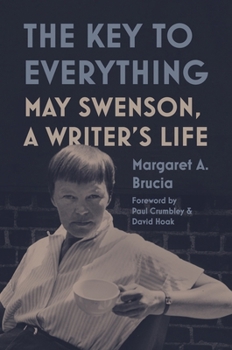
 THE KEY TO EVERYTHING
May Swenson, A Writer’s Life
by Margaret A. Brucia
Princeton University Press
288 pages, $29.95
IN THE FALL OF 1970, fresh out of college, I was teaching at a private girls’ school in Kansas City. The headmistress required the seniors to attend a poetry reading given by May Swenson. Although I’d majored in English, I had never heard of Swenson, then 57 years old with five books of poetry to her credit.
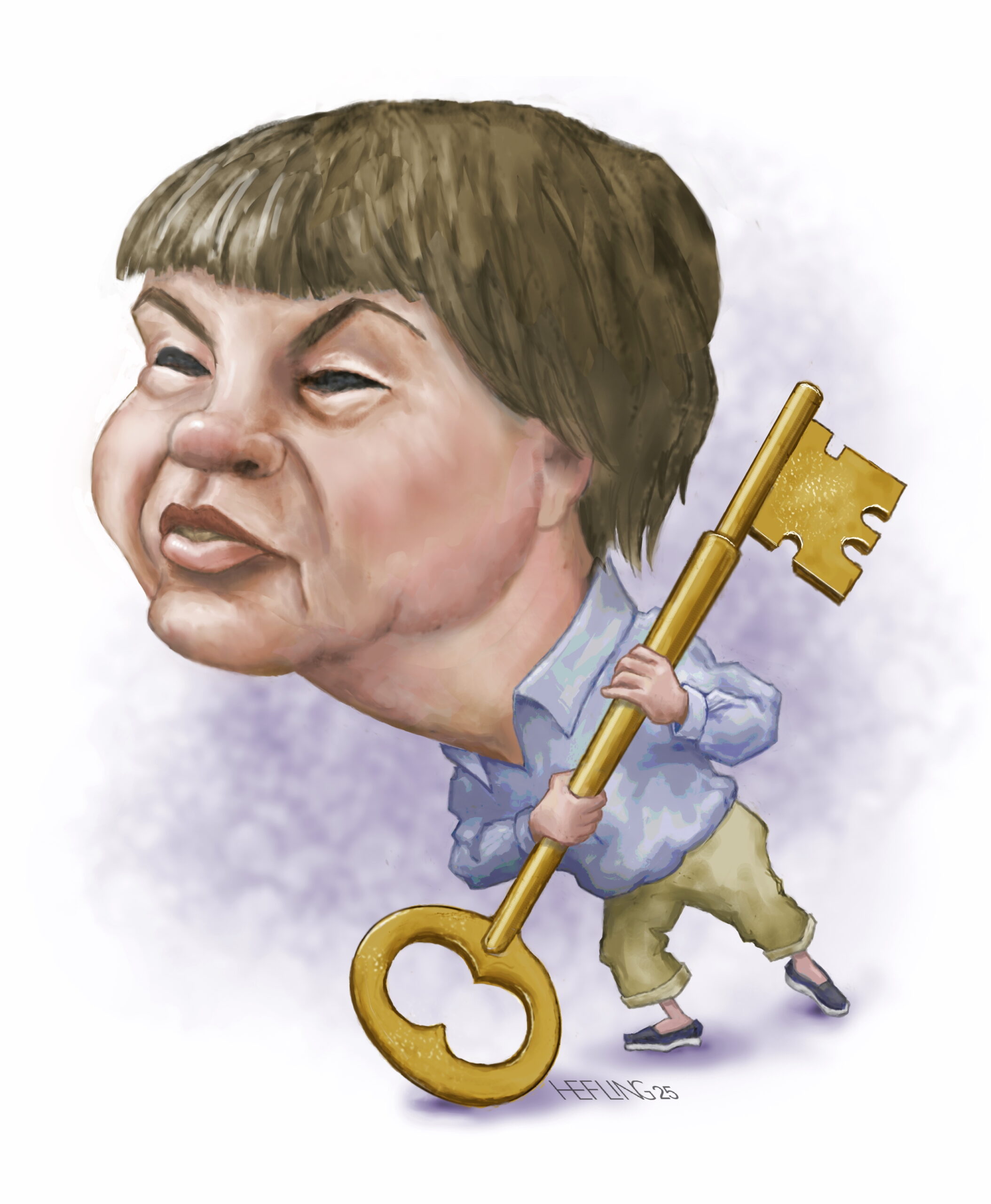
Swenson, “a little walnut of a person,” according to one of her friends, was at the top of her game that night. I remember being delighted by the wit and humor in the poems she read, their coy wisdom and crisp imagery. What I most remember, though, was Swenson’s haircut, close-cropped and boyish. In New England, where I hailed from, her look wouldn’t have attracted my attention. But in Kansas City, where women and girls groomed themselves for maximum “feminine” appeal, Swenson was an outlier. My God, I thought. She’s a lesbian!
Swenson’s lesbianism is at the heart of Margaret A. Brucia’s new biography, The Key to Everything: May Swenson, A Writer’s Life. Making use of the poet’s extensive diaries, correspondence, autobiographical pieces, and interviews, Brucia has written what is, according to Paul Crumbley and David Hoak, two Swenson scholars who contributed a foreword to the book, “the most intimate study of the poet’s life to date.”
Publicly Swenson was guarded about her sexuality. Growing up in “a bubble of Mormonism,” she was expected to live a pure, righteous, and heterosexually married life. Nevertheless, by her teenage years, she felt a “devastating passion” for other women. While studying at Utah State Agricultural College, she drifted away from the church, started smoking, used profanity, and quietly embraced her lesbian identity. Soon after she graduated, the restless would-be poet found herself yearning for “glory, every kind,” as she wrote in her diary. New York, the city of Thomas Wolfe and Walt Whitman, was “ferociously awaiting” her.
In 1936 Swenson moved there, rented a typewriter, and got to work. By her own admission, she “came at poetry backwards,” never having studied prosody or “acquired a background in what had already been done by others.” The lack of a firm poetic grounding did not deter her. Nor did her workaday life, which floundered in a series of menial dead-end jobs. Swenson plunged into New York’s literary and social life, hanging out in Greenwich Village and reading lesbian fiction. She was looking to connect with artists and writers. Instead, in 1937, she met Arnold Kates, an advertising executive. She shared some of her poems with him and was delighted to see that “he knows and feels what I feel.” Kates became a major presence in Swenson’s life, accompanying her on “raucous evenings spent studio hopping and drinking with young artists.” Brucia says that Swenson loved Arnold and enjoyed him sexually, but the conventional life he offered could never satisfy her. “In relationships with women, May saw no threat to her ability to grow, flourish, and remain her own person.”
By 1938, Swenson had landed a gig as a fieldworker with the Federal Writers’ Project, conducting interviews with immigrants and native-born Americans. One of those interviews was with Anca Vrbovska, a Czech Jew, ardent Communist, and poet with whom she soon began an affair. “And now again,” Swenson recorded in her diary, “the thing electric and dreadful and unwillingly desired—but desired. I have never really loved any man.” By December she and Anca were living together.
Although she was now in a satisfying lesbian relationship, Swenson continued to hide the gender of her inamorata in her love poems. When the affair ended in 1948, she wrote an autobiographical work—Brucia calls it “her heady novelette”—in which she explored “the whirlpool of [her]innermost thoughts.” She was also exploring her “look.” “The problem of Fem or Butch,” she wrote, “wanting to be both at once—excruciating conflict.”
 In 1949, Swenson met Pearl Schwartz, who would become her committed partner for the next seventeen years. Things were looking up in her literary life as well. She published her first poem in a national literary magazine, the Saturday Review of Literature. Although her literary mentor, the writer and literary critic Alfred Kreymborg, told her that her work showed “a streak of genius,” she had yet to achieve her goal of supporting herself as a poet. Kreymborg paved the way for Swenson to win a residency at the prestigious Yaddo writers’ colony in Saratoga Springs, New York. There she met poet Elizabeth Bishop and began a friendship that endured for thirty years.
Swenson’s first book of poems, Another Animal, came out in 1954, when she was 41, and was later named one of twelve finalists for the National Book Award. She didn’t receive the award, but other successes followed, including a travel grant from the Rockefeller Foundation, fellowships at the Bread Loaf Writers’ Conference and the Guggenheim Foundation, and publication in The New Yorker. “Life shines in the heaving straining muscular waves of the never-subsiding sea,” she confided to her diary. Now in the literary whirlwind, Swenson met other poets and writers of distinction, including John Ciardi, James Broughton, Lawrence Ferlinghetti, Josephine Miles, Edward Field, Richard Wright, and James Baldwin, whose gay novel Giovanni’s Room she deemed “an embarrassingly bad book,” though she admired how he had “disclosed himself in it.”
During the academic year 1966-’67, she was writer-in-residence at Purdue University, a position that provided not only something new to spark her creativity but also needed distance from Pearl as their relationship was breaking down. Life in Indiana was “Squaresville.” Gossip was the sport there, she said, “second only to football.” But it was also at Purdue that she met Rozanne (“Zan”) Knudson, who would become her final partner and ultimately her literary executor. At the end of the academic year, she and Zan moved to Sea Cliff, a village on the north shore of Long Island, which became Swenson’s final home.
For the next several years, Swenson’s life consisted of giving readings, teaching, judging contests, writing poems, and, writes Brucia, “trying to navigate life with boundlessly energetic Zan.” In 1970, she was invited to read at the Library of Congress and was inducted into the National Institute of Arts and Letters. “Why am I there?” she wrote in her diary. “If distinction comes, can extinction be far behind?”
Brucia devotes only a handful of pages to the final fifteen years of Swenson’s life. During those years, there were both literary triumphs, including a MacArthur Foundation fellowship, and personal losses such as the death of her beloved friend and correspondent, Elizabeth Bishop, and her own struggles with deteriorating health and old age. “Her life is one of the most astonishing and inspiring stories in American letters,” write Crumbley and Hoak. Brucia’s biography does a creditable job of supporting this claim. Strong on Swenson’s relationships, skimpy on a discussion of the actual work, The Key to Everything is a fine introduction to this poet who, as Brucia puts it, “never hesitated to prod any aspect of life.”
Philip Gambone recently published his seventh book, Zigzag (Rattling Good Yarns Press), a collection of short stories about older gay men.