FOR MILLENNIA sapphic women have been marginalized in both life and fiction. Historians are quick to dismiss potential lesbian love among figures from the past, and in most novels prior to the last few decades, queer-coded women inevitably set aside their sapphism by the end or suffered gruesome fates. None of the lesbian relationships in John Cleland’s Fanny Hill (1749) are seriously developed, and despite the heroine’s sapphic dalliances, she ultimately marries a man. In the eponymous 1872 novella, lesbian vampire Carmilla has a stake driven through her heart. In Sylvia Plath’s 1963 novel The Bell Jar, the protagonist’s sapphic friend kills herself in a mental institution.
Yet in 1846, Alexander Dumas published a book that not only depicted lesbians in a positive light but gave them a happy ending and an escape from society. The Count of Monte Cristo is loaded with text and subtext about a relationship between Louise d’Armilly and Eugénie Danglars. Their romance dovetails with queer themes explored in Dumas’ other works as well as with the gay underworld that existed in France at the time. By synthesizing information from both sources, the reader can see that a loving relationship exists between the two women, providing them with a fulfilling narrative sorely lacking in many more recent works, let alone novels of the 19th century.
§
Dumas’ magnum opus deals with an ordinary French sailor’s fall from grace, his rise to power as the count, and his vengeance on the men who took everything from him. Along the way, he deals with an amusing cast of characters, ranging from soldiers of fortune to police officers to a telegraph operator. He also destroys several corporations and families, including the Danglars family, a wealthy clan in Paris consisting of the corrupt banker Baron Danglars, his cheating wife, and their daughter Eugénie. Before she even appears on the page, Eugénie’s nonconformity is evident in the words of the daughter of another enemy of the count, Valentine de Villefort: “[Eugénie] told me that she loved no one … that she disliked the idea of being married; that she would infinitely prefer leading an independent and unfettered life; and that she almost wished her father might lose his fortune, that she might become an artist, like her friend, Mademoiselle Louise d’Armilly.”
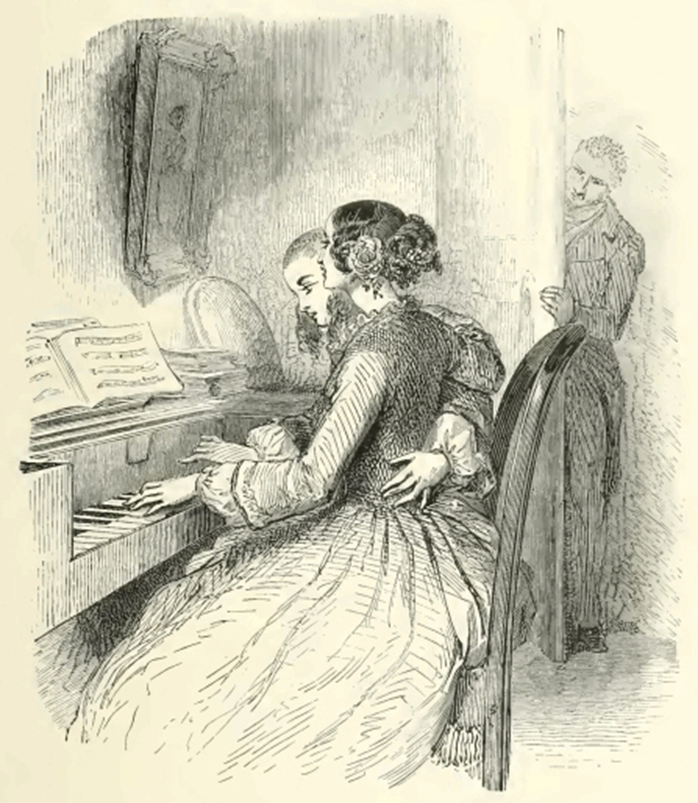
Louise d’Armilly is Eugénie’s piano teacher. The two women have little impact on the plot for most of the novel, even as the count schemes to disgrace Baron Danglars by tricking him into engaging Eugénie to the criminal Andrea Cavalcanti, then having Cavalcanti arrested at their engagement party in front of the cream of Paris society. While the count puts his plans in motion, Eugénie is content lurking off the page with Louise. The two often spend time together in her bedroom after dinner, where Louise plays the piano to put Eugénie to sleep.
The two women are obviously in love. Our early introduction to them is loaded with queer subtext:
[Eugénie and Louise] were seen seated on the same chair, at the piano, accompanying themselves, each with one hand, a fancy to which they had accustomed themselves, and performed admirably. … [Louise] was somewhat beautiful, and exquisitely formed—a little fairy-like figure, with large curls falling on her neck, which was rather too long, as Perugino sometimes makes his Virgins, and her eyes dull from fatigue. She was said to have a weak chest, and like Antonia in the Cremona Violin, she would die one day while singing.
Despite Eugénie’s engagement to Albert de Morcerf, she evidently cares not a fig for him and primarily keeps company exclusively with Louise, not even seeing other women.
Due to social mores, however, Louise and Eugénie cannot be friends publicly, as the narrator says: “[Eugénie], though perfectly willing to allow Mademoiselle Louise d’Armilly … to practice with her through the day, took especial care not to be seen in her company. Still, though not actually received at the Hôtel Danglars in the light of an acknowledged friend, Louise was treated with far more kindness and consideration than is usually bestowed on a governess.” Again, there is a theme of a forbidden friendship. Louise is a performer, a profession seen as undesirable, sinful, and not an acceptable line of work for a banker’s daughter. Thus the prohibition is twofold: one because of the nature of their relationship as two women, the other because of their unequal station in society.
There are allusions to Louise’s sway over Eugénie: “Now, Madame Danglars feared Eugénie’s sagacity and the influence of Mademoiselle d’Armilly; she had frequently observed the contemptuous expression with which her daughter looked upon Debray [her mother’s lover].” Although Madame Danglars is thinking about Louise’s potential to lure Eugénie away from the world of banking, the implication could just as easily be that Louise may be exposing Eugénie to non-heterosexual mores. Indeed, Louise’s association with the performing arts is another mark of her gayness, as queer people have long been overrepresented in such creative pursuits.
At last, the count’s scheming comes to a head. Eugénie’s father cancels her engagement to Morcerf and instead betroths her to Cavalcanti, whom the count has arranged to have arrested during their engagement party. The resulting scandal empties the Danglars household and leaves the family’s attention everywhere except on Eugénie and Louise. Eugénie, seeing the golden opportunity, proposes an escape from France. Louise suggests prudence. In response, Eugénie proclaims: “Hold your tongue! The men are all infamous, and I am happy to be able now to do more than detest them—I despise them.” Her words connect with themes of frustration with men by sapphic women, who see them as invasive and unwelcome in places like the marital bed. Louise reveals her traveling documents have been provided by the count, indicating that they are for a man. The passport reads: “M. Léon d’Armilly, twenty years of age; profession, artist; hair black, eyes black; travelling with his sister.” With this falsified form in hand, the two quickly pack their assets and bags.
Eugénie has always felt trapped in her society and had a disdain of men who wish to marry or bed her. Although she is civil to the count, she detests the notion of being shackled to a man’s whims and desires, a sentiment common among women throughout history, but especially queer women. Eugénie adds to this her disillusionment with her father’s affairs as a banker: “Oh, I am done with considering! I am tired of hearing only of market reports, of the end of the month, of the rise and fall of Spanish funds, of Haitian bonds. Instead of that, Louise—do you understand?—air, liberty, melody of birds, plains of Lombardy, Venetian canals, Roman palaces, the Bay of Naples.” Bolstered by this, the two continue packing.
The reader learns that Eugénie has previously dressed as a man: “From the same drawer [Eugénie] took a man’s complete costume, from the boots to the coat, and a provision of linen, where there was nothing superfluous, but every requisite. Then, with a promptitude which indicated that this was not the first time she had amused herself by adopting the garb of the opposite sex, Eugénie drew on the boots and pantaloons, tied her cravat, buttoned her waistcoat up to the throat, and put on a coat which admirably fitted her beautiful figure.” The result is quite fabulous, as Louise confirms: “Oh, that is very good—indeed, it is very good! … but that beautiful black hair, those magnificent braids, which made all the ladies sigh with envy, will they go under a man’s hat like the one I see down there?” To Louise’s dismay, Eugénie shears her hair.
Eugénie feels empowered as she does this: “And am I not a hundred times better thus? … and do you not think me handsomer so?” A dramatic haircut is common in coming-of-age stories, but especially in sapphic media, in which many women and girls feel a powerful sense of liberation at styling their hair the way they want it. Eugénie’s preference for short hair and masculine dress also could be seen as casting her in the role of a “butch” lesbian, while Louise’s femininity, fondness for music, and more frivolous nature suggest that she’s more of a “femme.” The gay themes continue from there: “‘Oh, you are beautiful—always beautiful!’ cried Louise. ‘Now, where are you going?’” Eugénie asks: “What are you looking at?” Louise responds: “I am looking at you; indeed you are adorable like that! One would say you were carrying me off.”
Inexplicably, the two return one more time in the novel after taking flight, giving them a sendoff together with some subtle pro-lesbian lecturing from Dumas. As in many 19th-century novels, the same few-dozen characters constantly meet each other, no matter how far apart they are or how bizarre the circumstances. When Eugénie’s former fiancé Cavalcanti escapes prison and tries hiding in a hotel, he literally falls into the room where she and Louise are sharing a bed. While Cavalcanti tries to persuade the two to hide him, he underestimates their disdain. “The two ladies, pressing closely to one another, and drawing the bedclothes tightly around them, remained silent to this supplicating voice, repugnance and fear taking possession of their minds.” Though Eugénie relents and offers him a chance to escape, it’s too late, and he’s recaptured by the gendarmes. Louise tells him to get lost, while Eugénie tells him to kill himself.
Cavalcanti quickly regains control, however, and exposes the two to the gendarmes: “Have you any message for your father, Mademoiselle Danglars, for in all probability I shall return to Paris? Oh, oh! … you need not be ashamed, even though you did post after me. Was I not nearly your husband?” News quickly gets out to the other hotel patrons, “leaving the two girls a prey to their own feelings of shame, and to the comments of the crowd.” They leave the hotel dressed as women, and although “the gate of the hotel had been closed to screen them from sight,” as they step into their coach, they are “forced, when the door was open, to pass through a throng of curious glances and whispering voices.” Eugénie shuts her eyes but cannot close her ears, and she realizes the crowd is mocking and sneering at her.
“‘Oh, why is not the world a wilderness?’ she exclaimed, throwing herself into the arms of Mademoiselle d’Armilly, her eyes sparkling with the same kind of rage which made Nero wish that the Roman world had but one neck, that he might sever it at a single blow. The next day they stopped at the Hôtel de Flandre, at Brussels. The same evening Andrea was incarcerated in the Conciergerie.” Thus do the two women exit the story. Unlike nearly everyone else in the narrative, who is dead, disgraced, or bound for Africa by the end, Eugénie and Louise get a happier ending even than the count.
§
Forbidden love is a recurring theme in Dumas’ works. The Three Musketeers and its sequels delve into it a great deal. Themes of gay love also appear: La Dame de Monsoreau is rife with them. Protagonist Count de Bussy and side character François duc d’Anjou are implied to be in a relationship, as are King Henri III and the court jester, Chicot. Sodomy had been decriminalized in France in 1791 but remained stigmatized at the time, and accusations of queerness were used to smear political opponents. It remained persecuted through laws against “indecency” and “corruption,” although its enforcement varied by time and place.
Depictions of queerness were not uncommon in French media of the era; Honoré de Balzac, a contemporary of Dumas, wrote numerous such works. His novella Sarrasine chronicles the relationship between two men, while his novel Séraphîta details a love triangle including an androgynous person, a man, and a woman. The Girl with the Golden Eyes is about a similar love triangle among a man, the woman he’s in love with, and her lover, who is the man’s half-sister. Another contemporary, Théophile Gautier, wrote Mademoiselle de Maupin, a novel that revolves around a polyamorous genderfluid person.
This freedom regarding gender and sexuality was often available only to people of the middle and upper classes. People of the lower classes were policed more heavily, as in 1843, when Parisian prostitutes were banned from rooming together lest they have sexual relations. Committed same-sex relationships did exist, however, among the classes in which they were permitted. Writers Joseph Fiévée (1767–1839) and Théodore Leclercq (1777–1851) lived together for decades and were buried in the same tomb. Dumas himself freely indulged his libido but is not known to have had any gay relationships. Nevertheless, his presence in French high society meant that he would have had freer access to people whose sexuality was an open secret and therefore familiar with their social norms and mores.
Dumas made the lesbian themes in The Count of Monte Cristo obvious enough that they were evident to Victorian censors. The original 1846 English translation redacted most of Eugénie’s sapphic tendencies, such as sharing a bed with Louise. The book also invokes antiquity, in particular Classical Greece, a place and time famous in the Victorian era for its tolerance of homosexuality. Louise compares Eugénie to Hippolyta, saying: “You are a perfect Amazon, Eugénie!” Eugénie compares herself to Hercules and his mistress: “‘Ah, you do well to ask,’ said Eugénie, laughing; ‘I forgot that I was Hercules, and you only the pale Omphale!’”
Despite the extensive evidence, only a smattering of blog posts and Goodreads threads have tried to analyze the gay themes of The Count of Monte Cristo in depth. Most academic analyses of the work focus on the nature of revenge and the development of the historical novel, not on the interpersonal relationships portrayed or the sexuality of its characters. Perhaps as a new generation, one of the most queer-identified in history, discovers the work, its gayness can be better appreciated.
J. Barnes, a freelance writer currently working for The Indypendent, lives in New York City.