

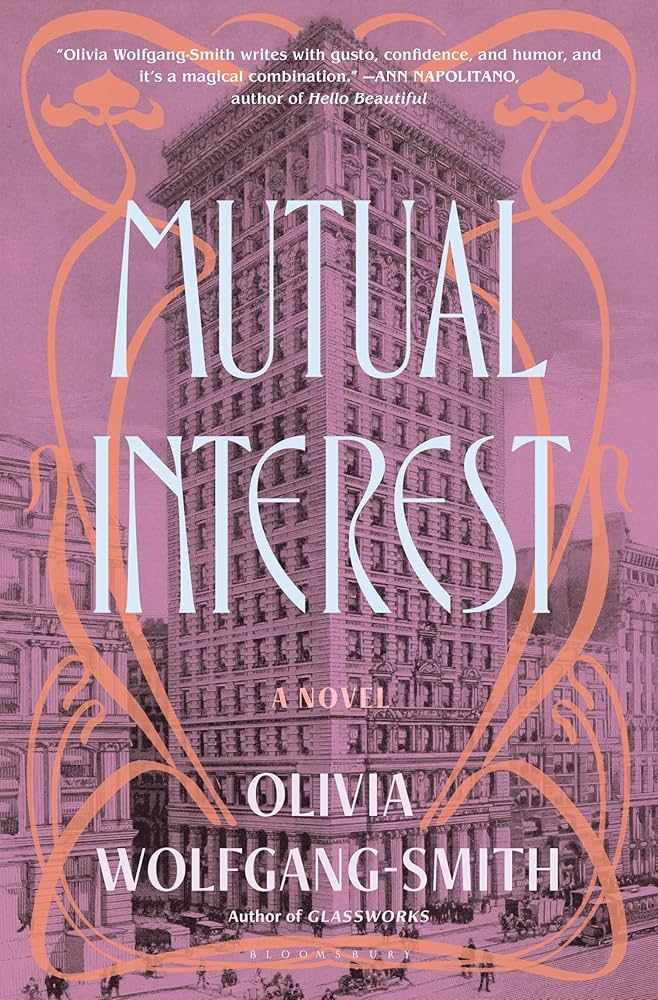
 MUTUAL INTEREST: A Novel
by Olivia Wolfgang-Smith
Bloomsbury Publishing
336 pages, $28.99
THE WHIMSICAL PRELUDE of Olivia Wolfgang-Smith’s engaging novel Mutual Interest introduces readers to the historical sweep of the fictional action to come. Citing an actual event, the eruption of Mount Tambora in the Dutch East Indies, as the cause of the “Year Without a Summer” in 1816, Wolfgang-Smith’s narrator directs us to the literary device of pins on a historical and geographical map. The narrator explains: “The Year Without a Summer is neither the beginning nor the end of this story, but time and cause unravel in all directions, and we find a hollow, simplifying comfort in Capital Letters. The Dutch East Indies. The Hundred Days.” The narrator ends the Prelude with the invention of the bicycle in 1817, an event that provides the flimsiest of connections to a scene in the first chapter.
The first part of the narrative illustrates the ambiance of Gilded Age New York to persuasive effect. Historical notes involving such particulars as the construction and development of the New York subway system reflect the considerable research the author has undertaken. Clothing of the era is worn, social conventions are upheld, and the novels of Edith Wharton are suggested. A short Interlude links the two parts of the novel, bridging a ten-year time gap, which the narrator records with much wry commentary. Taking a retrospective stance, this speaker describes the setting of 1915, a period of early labor unions and suffrage agitation, as follows: “Still, one day, those who take comfort in Capital Letters will call this the Progressive Era. Hurry: we have turned the page and missed a decade’s worth of Progress.”
The second part of Mutual Interest introduces Vivian, Oscar, and Squire’s personal care company, Clancey & Schmidt, as a prosperous fixture of the business world. Vivian and Oscar have married for convenience, Oscar and Squire have become lovers, and Vivian has mostly given up her short trysts with young members of the Tiffany Club, based on a real group of single young women who cut and placed Tiffany gems for a living.
Sarah, one lover of interest during this period, who flips pancakes in the window of a restaurant for work, affords Wolfgang-Smith the chance to reveal Vivian’s character as a self-made woman who barely notices the rising labor movement and openly disdains the increasingly visible suffrage effort. Of this crusade, the narrator explains: “This madness for the vote struck Vivian as one more whining demand for things to be too easy, like the Sapphic teahouses and the abandonment of corsets—a bizarre need to ape men in all their clumsy, wasteful, unobservant ease.” Vivian is clearly the central character, with her story beginning and ending the novel, though Oscar and Squire occupy key roles in the structure and action,
Part Two introduces several new subplots and secondary characters. Among them are Squire’s widowed mother Mrs. Clancey, the firm’s business manager Elias Knox, and Rebecca Van Beek, a painter and widow who ultimately marries Elias. Electra Blake Stevens, Vivian’s early lover from Part One, also emerges to temporary prominence. These colorful presences, with their own dramas and concerns, generally provide humorous additions to the story and, in Electra’s case, deepen the plot considerably.
Several key scenes are presented hilariously. One involves the unlikely business alliance between Oscar and Squire, forged when they are secretly pushed by Vivian into a walrus tank at the New York Aquarium. During an awkward gathering in Squire’s apartment immediately after this episode, Wolfgang-Smith describes the aftermath of a disagreement about the fragrance of a bouquet in the room as follows: “And then, the inevitable orchestration: all three noses pressed to the blooms.” In a similar vein, the narrator observes of the ordering ritual at an exclusive French restaurant Squire and Oscar frequent: “Squire had a ridiculous bit of eyebrow choreography that accompanied this particular order, each time.” These droll depictions hint that in the end the comedic perspective of the narrator prevails, propelling the story forward at a fast pace and in delightful directions.
While Wolfgang-Smith touches upon serious themes, and the novel’s conclusion is both resolved and open-ended, suggesting thematic and generic complexity, direct addresses to the reader and countless asides deepen insights and inject disarming commentary about the characters’ motivations and the sometimes serendipitous outcomes that ensue. Mutual Interest is a novel of manners at its finest, an ideal antidote to our difficult times.
Anne Charles lives in Montpelier, VT. With her partner and a friend, she co-hosts the cable-access show All Things LGBTQ.



