

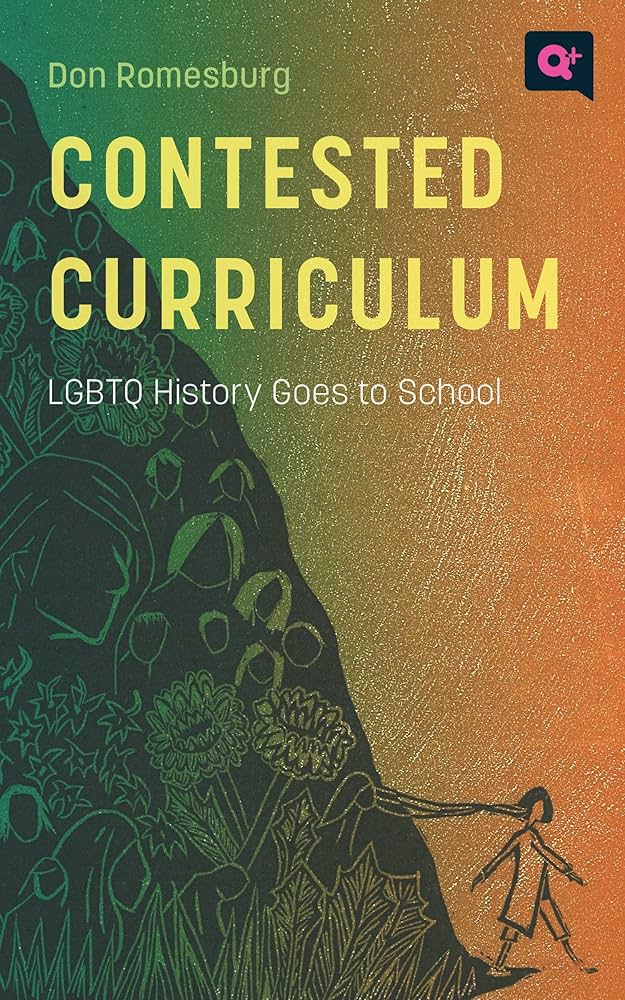
 CONTESTED CURRICULUM
LGBTQ History Goes to School
by Don Romesburg
Rutgers University Press
284 pages, $28.95
WE ARE LIVING through a time when LGBT books are being banned from many public libraries. “Don’t Say Gay” laws preventing LGBT topics from being taught in schools have passed in several states. The Trump administration’s assault on diversity, equity, and inclusion policies is threatening the existence of queer-related resources in many institutions, schools, and colleges. Yet as awful as these developments are, it is helpful to remember that the present reaction is occurring in response to substantial gains made by LGBT communities over the last generation. These gains, including in schools, came through much hard work and struggle in the face of resistance. Author Don Romesburg’s Contested Curriculum: LGBTQ History Goes to School traces the fight to have LGBT materials taught in history and social science classes across several decades. Romesburg was a major actor in this effort in California, where significant inclusion first occurred. He brings both the interpretive insight of a historian and the passion of an activist into his account.
Romesburg begins by recounting what his first chapter describes as a prehistory. In the 1970s and early ’80s, there was almost no literature available on LGBT history for inclusion in school curricula. The first LGBT teachers were coming out, and they sometimes found themselves having to challenge their firing in court. By the late 1980s, a bottom-up effort by students and teachers to form gay-straight alliance groups in schools and build a safe-schools movement was taking form. But regarding class content, at best these decades saw what Romesburg describes as “modest, sporadic, and generally short-lived curriculum interventions.” In the 1990s, there was an expanding scholarly literature of LGBT history. The founding of glstn (the Gay-Lesbian-Straight Teachers Network, later changed to glsen) created a national structure for school-related organizing. Glstn worked with Rodney Wilson, a Missouri schoolteacher who promoted what he called “Gay History Month,” to make this a national effort in 1994. But curriculum inclusion remained a dream. Mainstream movement organizations avoided the issue because they considered it too controversial. In a front-page story about safe school organizing in Massachusetts, a 1993 Boston Herald headline captured how marginal and unpopular curriculum inclusion was: “There’ll Be No Gay School Lessons,” it declared. The tone was celebratory. As the book’s timeline moves into the 21st century, Romesburg focuses on California. Sheila Kuehl, an out lesbian state legislator, had been trying since the 1990s to mandate curriculum reform and inclusion through legislation. In 2006, when both houses of the state legislature passed such a bill, Republican Governor Arnold Schwarzenegger vetoed it. After Jerry Brown’s election as governor in 2010, a renewed effort finally succeeded, and in July 2011 the Fair, Accurate, Inclusive, and Respectful Education Act—known as the FAIR Act—became law. It was the first such mandate in the U.S. Passage of the FAIR Act was cause for celebration, but as Romesburg demonstrates in compelling detail, it was far from the end of the story. Activists had to work for several more years to make implementation possible. As California state education officials began reviewing the pre-existing framework for history and social science curriculum content, a statewide coalition of LGBT activists came together. It first had to fight to defeat right-wing Christian efforts to have the FAIR Act repealed. But then, with the help of professional historians and other educators, it also had to create resources to aid individual educators across the state. It pushed publishers to revise textbooks to include significant LGBT historical figures and events. Perhaps most significantly, it had to keep pressuring California’s Board of Education to make inclusion a reality. As Romesburg reveals, “in the end, we were successful.” In 2016, five years after passage of the FAIR Act, California’s new History-Social Science Framework had LGBT content for inclusion in elementary, middle, and high school classes, from the second to the twelfth grade. And, as he turns his attention away from California to the national picture, Romesburg takes pride in the “incredible strides” made since 2011. Trade publishers are now producing textbooks that have a significant amount of LGBT material in them. And while conservative states are passing “Don’t Say Gay” laws, seven others—Colorado, Connecticut, Illinois, Nevada, New Jersey, Oregon, and Washington—have approved inclusion. Apart from the overall arc of the history that Romesburg laid out, what most touched me about his narrative were the instances of courageous and innovative action by individual teachers. Even without mandates, many teachers have taken it upon themselves to add queer stories into their teaching of U.S. history. This is no small achievement, since even college-level history courses are often lacking this content. If college students who are aiming to be teachers are not learning this history in their undergraduate years, it will make the work of inclusion harder to implement. But, as Romesburg demonstrates, activist educators are making resources available. Projects like History Unerased offer tremendous online resources available to teachers everywhere. In this period of escalating attacks on the LGBT community, Romesburg’s account of the dedicated, determined work of activist educators over more than a generation provides some much-needed hope and inspiration. It can also serve as a resource for future progress. John D’Emilio’s books include Memories of a Gay Catholic Boyhood: Coming of Age in the Sixties and Lost Prophet: The Life and Times of Bayard Rustin.