

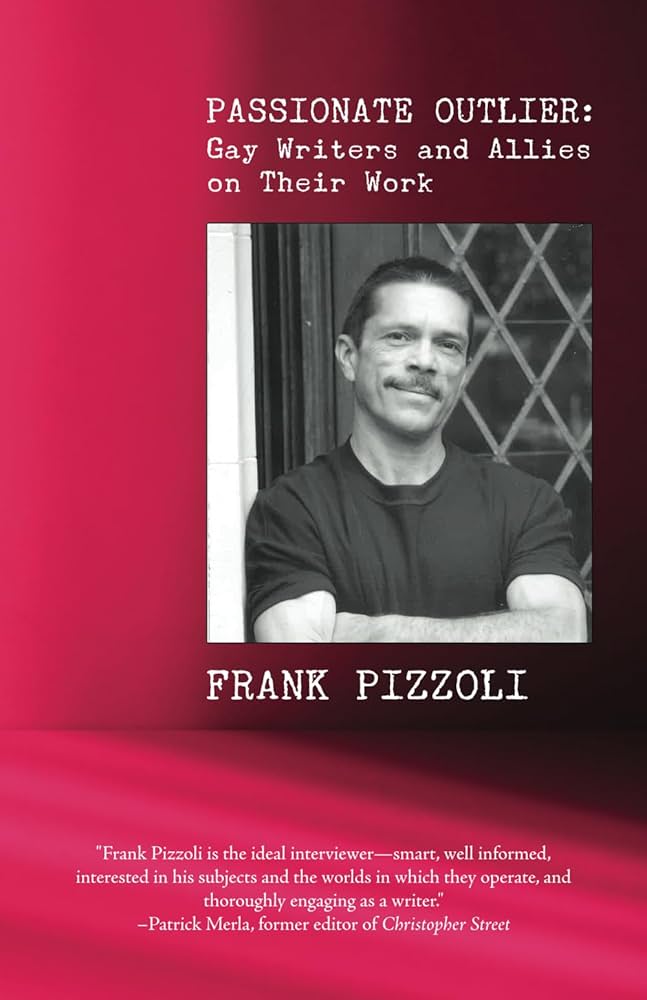
 PASSIONATE OUTLIER
Gay Writers and Allies on Their Work
by Frank Pizzoli
Rebel Satori Press
246 pages, $18.95
BETWEEN 2007 AND 2019, Frank Pizzoli conducted interviews with a dozen LGBT writers of the past half-century, among them Edmund White, Christopher Bram, Andrew Holleran, Felice Picano, Martin Duberman, John Rechy, and Anne-christine d’Adesky. Brought together in Passionate Outlier: Gay Writers and Allies on Their Work, they provide intelligent, sometimes surprising insights into their own and other writers’ works and relationships.
As an interviewer, Pizzoli has certainly paid his dues. “I have spent my professional life in journalism and human services,” he says, referencing decades of interviewing people and writing for Pennsylvania’s The Central Voice, an award-winning bimonthly LGBT newspaper that he founded in 2001; The Village Voice; POZ; and other magazines. He also spent many years interviewing clients and others as part of his work in HIV organizations. Of the interviews collected here, Pizzoli says: “I wanted to ask the writers who interpreted my generation’s experience through their work what they thought about, well, everything—their own and others’ work as well as their reflections on past and current events.”
To find out what happened for these writers, Pizzoli turns first to the late Edmund White, the éminence grise of contemporary queer literature, who died in June. There are two solo interviews with White, who muses that before 1969, the general population regarded homosexuality as a crime, a sin, or a mental illness. That, he says, explains why “there really aren’t that many books [pre-1969] that show homosexuality in a positive light. City of Night, no. Jean Genet, no. … [Y]ou have to wait until you get to [Christopher] Isherwood in A Single Man before a reader can find a picture of a [gay]guy who is just a guy.” Unlike other writers interviewed here, White rejects the notion of a “gay sensibility”: “I don’t think there is a gay sensibility any more than there is a single Black or Jewish sensibility.”
Along with Christopher Cox, Robert Ferro, Michael Grumley, Andrew Holleran, George Whitmore, and Felice Picano, White was part of the storied Violet Quill, a group that met only briefly around 1980 but, according to Pizzoli, “set into motion a literary movement.” In 2013, Pizzoli sat with White, Picano, and Holleran—at the time, the three remaining members, the others having succumbed to AIDS—for a freewheeling discussion of their early work, Queer Theory, Susan Sontag, diversity, Grindr, and AIDS. While Holleran expresses the view that the Violet Quill “is a turkey that has been eaten, deboned, and already used for soup,” this discussion is one of the delights of this collection. Of the Violet Quill, White says: “We were enabled by the invention of new gay publications such as Christopher Street and about 70 new gay bookstores across the country. … We were suddenly writing fiction that addressed the gay reader, not the straight one.”
There is a conversation recorded two years later with only Picano, who died in March, discussing everything from his “impeccable” memory, which he attributes to “a physiological fault in the brain that inhibits forgetting” to his friendship with Vito Russo, author of The Celluloid Closet, to his critique of the early Gay Liberation movement as “a 98% white, male, college-educated, middle-class movement.” Along the way, he reflects on the first wave of the AIDS pandemic: “a period of fourteen years. I’d buried a partner and, as many of us did, asked, ‘Who’s next?’ and moved through life caring for and burying friends until there was no one left.”
Two of the writers interviewed issue a call for compiling a true, warts-and-all history of the gay community. Sean Strub—the founder of POZ magazine and the Sero Project, author of Body Counts: A Memoir of Politics, Sex, AIDS, and Survival, mayor of Milford, PA, from 2016 to ’24—argues for coming to terms with the mistruths, half-truths, and wishful thinking: “In the earlier years of the epidemic, many of us were not entirely honest with ourselves let alone the public about the degree to which the sexual behaviors of many gay men, myself included, facilitated the spread of disease.” He also says that we in the community were often deceived. “Many of us bought into the hype of AZT as a miracle drug … only later to learn how many of us were harmed by AZT monotherapy.” He is skeptical of the “we were all heroes” and “we changed the world” tropes in discussing the pandemic: “That’s just too rah-rah and simplistic; we deserve a more nuanced understanding of those times and how it affected us.”
Also interviewed is LGBT historian Martin Duberman, a professor emeritus at the CUNY Graduate Center. He has written a celebrated biography of actor-singer-activist Paul Robeson and a joint biography of singer-activist Michael Callen and poet-activist Essex Hemphill (Hold Tight Gently), as well as his groundbreaking Stonewall (1993). Ever the radical thinker, Duberman laments that the LGBT movement has devolved from its early radicalism toward assimilationism, going along to get along: “The Human Rights Campaign manages to get comfortably affluent gay people accepted, but that’s not going to help those who are economically marginalized.” But greater assimilation into heteronormative social structures may be inevitable: “Maybe groups like the Gay & Lesbian Task Force and the Human Rights Campaign are all that one can hope for in a country as basically conservative as ours.” He does, however, seem optimistic about contemporary young people who reject old-hat labels and ways of living.
There are many not-to-be-missed gems among Pizzoli’s interviews: Jay Parini discussing the genesis of his authorized biography of Gore Vidal; Michael Carroll, husband to Edmund White, talking about his two collections of short stories; Salman Rushdie contemplating gender identity and the state of LGBT people in majority-Muslim countries.
The one I enjoyed most was the interview with John Rechy, perhaps because City of Night is the first gay book I ever read, and I’ve never forgotten it. In this interview, Rechy’s reputed super-sized ego is on display, but he seems to have grown a sense of humor about his multifaceted life and career. And he remains rock certain of his opinions. Although a couple of the other authors included in this collection balked at the notion of a “gay sensibility,” Rechy responded forcefully: “Of course there’s a gay sensibility … we are shaped by exile, born into the ‘heterosexual camp’ with all that implies. Very early, we deal with ‘camouflage’ in various ways, and that shapes a unique ‘sensibility.’ I uphold our differences and resent them being ‘erased.’” And although he still disdains the word “gay” and Pride parades, he did relent and marry his partner after many years together.
Passionate Outlier is one of those rare books that is both great fun to read and historically significant. It will be an invaluable resource for anyone researching the LGBT authors who gave birth to and nurtured queer literature in the 20th century.
Hank Trout has served as editor at a number of publications, most recently as senior editor for A&U: America’s AIDS Magazine.