


In the decades leading up to the 1969 Stonewall uprising, police raids on queer establishments were commonplace. And while homophobia has existed in various cultures throughout recorded history, McCarthyism brought on an increase in the mistreatment of the U.S. queer community. The anti-Communist Red Scare also invigorated a moral panic about LGBT people now known as the Lavender Scare. Deemed “misfits,” “undesirables,” “morally bankrupt,” “sexual perverts,” and considered security risks susceptible to blackmail by foreign agents, homosexuals were barred from holding federal positions by Eisenhower’s Executive Order 10450. This led to a massive homophobic oppression of LGBT people nationwide, including the firings of more than 5,000 federal workers, and forced millions of government employees to sign oaths of moral purity.
Although peoples’ lives were put in jeopardy by being outed, it didn’t stop some from risking their safety, reputation, and careers to find ways to connect. In 1950s New York City, a curious cluster of bars and nightclubs with bird-related names emerged as covert places for the LGBT community to gather. Located within a short walking distance of each other near Third Avenue in the East Fifties, the four venues—the Swan, the Blue Parrot, the Golden Pheasant (The Faison d’Or), and the Yellow Cockatoo—became known as the Bird Circuit.
A pattern of bird-inspired bar names can be found in cities across the world, and while no formal conspiracy is confirmed and not all queer bars use bird names, this avian trend was too prominent to ignore. In Los Angeles there were venues like Flamingos, The Red Raven, and a local version of the Blue Parrot. San Francisco had the White Swallow, double entendre intended, along with its motto “an intimate place to drink.” The rise of The Eagle bars in the 1970s became synonymous with gay leather subculture. At their height, more than fifty independently operated Eagle venues existed worldwide, all originating from The Eagle Open Kitchen, a longshoreman’s tavern in operation from 1931 to 1970 in New York City. The recurring motif suggests a subtle code with cultural resonance, one that offered a clever form of camouflage, signaling freedom and the possible thrill of “finding one’s flock.” With their vibrant plumage, complex songs, and dynamic movement, birds provided poetic metaphors for queer lives lived at the margins and ready to take flight.
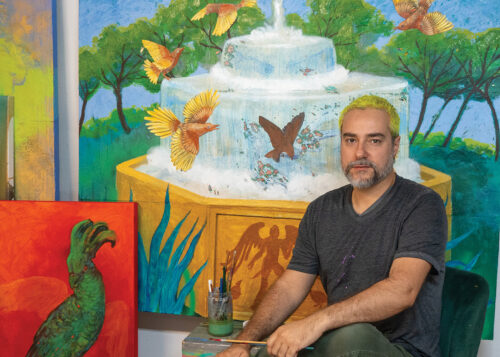
This unique coded history forms the symbolic point of departure for artist Vojislav Radovanović’s recent art exhibition Bird Circuit, which was on view during Pride month from May 30 to June 28, 2025, at the Ronald H. Silverman Fine Arts Gallery at Cal State L.A. Drawing from personal experience, historical concepts, and spiritual iconography, Radovanović situates his subjects within the lineage of LGBT subculture, layering his work with mystery, quiet subversion, and kaleidoscopic exuberance. Birds assume multiple roles as guides, guardians, messengers, and shape-shifting embodiments of queer life in Radovanović’s paintings, sculptures, installations, and multichannel video work.
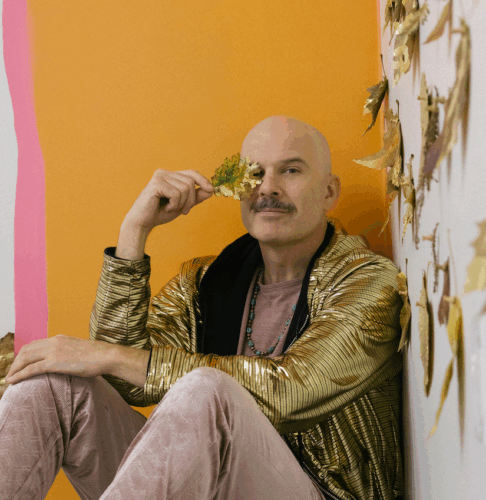
Radovanović, born in the former Yugoslavia, now Serbia, became fascinated by the more openly expressed queer culture and art community of Los Angeles upon his arrival in 2017. It was while collaborating on a 2021 film project, The Stuart Timmons City of West Hollywood LGBTQ History Tour, that Radovanović first encountered the concept of the historical Bird Circuit, which was mentioned in the script by Timmons, the late historian and author of The Trouble with Harry Hay, co-author of Gay L.A. As Radovanović’s life partner, artistic collaborator, and curator of the exhibition, I’ve witnessed firsthand how this body of work developed out of painful personal and cultural histories into a transformative meditation on queer resistance, survival, and joy.
Birds have long appeared in Radovanović’s work as metaphors for freedom, migration and hidden knowledge. His 2021 solo exhibition for the Diana Berger Gallery at Mt. San Antonio College, Ornithomancy, examined human attempts to interpret nature, specifically through the ancient practice of reading bird behavior as omens. For Bird Circuit, he blended personal memory, folkloric symbolism, and queer aesthetics into multilayered compositions that are both jubilant and subversive. Coded messages are expressed covertly with a furtive glance, a coy tilt of the head, a subtle hand gesture, to reveal hidden meaning beneath their playful visuals and dazzling colors. Like the secretive signals that have long defined queer communication, Radovanović’s work invites viewers into multifaceted narratives, open to interpretation and rich with allusion.
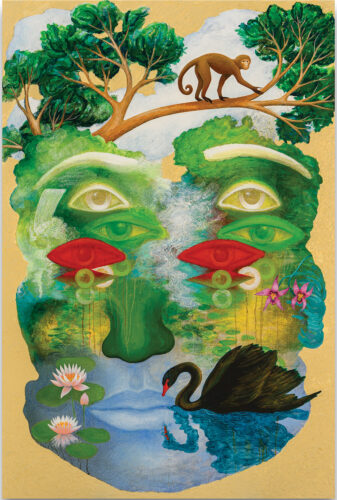
In Waiting for the Kiss, a large human face is shaped from a lush lake setting. A black swan glides upon the water with its beak just beginning to touch the outer edge of humanoid lips, with a hallucinatory burst of fourteen different eyes, both human and bird, erupting above the image, reinforcing the exhibition’s metaphorical connection between species. The painting was reflected in a mirrored lake installed on the gallery floor, which featured a sculpture of two swans that looked as if they’d just swum out of a Monet lily pond. Hanging on either side were two large-scale paintings, Sun Valley and In the Moonlight, each featuring a massive bird depicted in the foreground using inverse perspective, while two small couples were present in the landscape backgrounds depicted in blissful romantic scenes.
Affection and flirtation permeated the exhibition as transformative acts born out of pain. In works like Ultraviolet and The Little Love Affair, Radovanović placed pairs of birds coyly checking each other out while perched in the branches of wildly stylized trees. Anthropomorphic birds, masks, and eyes, human or otherwise, recurred as a visual motif throughout the exhibition, reinforcing the themes of desire and surveillance, being seen and hiding. Boundaries were blurred between predator, prey, and protector, between observation, voyeurism, and objectification. This concept is particularly prevalent in works like Glancing Cruising Staring I, II, III and The Magician, which allude to the homosexual gaze and the importance of eye signals and covert messages in queer culture and communication: The eyes can express volumes when words dare not be spoken.
The exploration of these themes feels especially urgent today, as LGBT communities continue to face attempts to oppress, marginalize, and erase queer culture. The coded expressions and resilient spirit that once defined spaces like the historic Bird Circuit offer an opportunity for introspection and reflection on contemporary issues like drag bans, transphobic legislation, and the repeal of diversity, equity, and inclusion initiatives. Radovanović’s artwork is a reminder of the ongoing need for queer sanctuary, whether physical or symbolic, and the role that art plays in spotlighting, expressing, and celebrating those spaces. Bird Circuit is ultimately a declaration that queer culture persists, resists, and refuses to be silenced. Love wins.
During turbulent times, profound meaning can be found in a tremulous song, a rich brushstroke, a flirtatious glance. Colorful birds, long used as metaphors for freedom and beauty, still have so much more to say. Long may they sing.




Discussion1 Comment
The queer bird history you opened your review of Vojislav’s avian exhibition totally bewitched me. The paintings are wonderfully iridescent renderings of the artist’s mythopoetic oeuvre. I loved them and I want one for my queer living room, if I can afford it. – Phil Tarley