
 When We All Get to Heaven
Eureka Street Productions
Created by Lynne Gerber, Siri Colom, and Ariana Nedelman
“If you were wandering around the Castro, San Francisco’s gay neighborhood, on a Sunday evening in the ’80s or the ’90s you might have come across a pink and purple church squeezed between two houses. Not where you’d expect a hopping church scene, but the Metropolitan Community Church was different.”
“What a bright, shiny, unapologetically gay place to be.”
“We were really trying to address what does Christianity look like if your starting point is sexuality is good.”
“You’d also notice a lot of men in the Castro, sick with AIDS.”
“We were going to memorial services it seemed like every other week.”
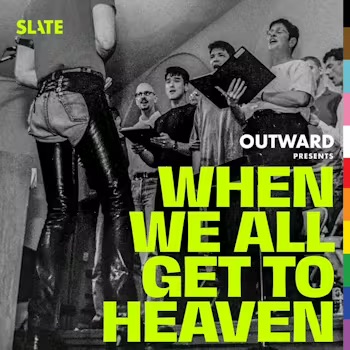
This short excerpt describes the newly released ten-episode podcast When We All Get to Heaven, which shares the story of the Metropolitan Community Church (MCC) of San Francisco, one of the country’s first gay-positive churches, and how it faced the personal, social, and political trials of the AIDS epidemic, including the deaths of hundreds of its members. The series, available through Slate’s LGBT initiative “Outward,” was produced and co-created by Eureka Street Productions, a collective of Lynne Gerber, Siri Colom, and Ariana Nedelman.
Gerber, the host of the podcast, is an independent scholar who writes about religious responses to HIV/AIDS in 1980s and ’90s San Francisco. A self-identified “Jewish girl from Long Island,” she’s held research and teaching positions at Harvard Divinity School and the University of California at Berkeley.
The beautifully written, edited, and produced series is both entertaining and educational as it immerses the listener in its dynamic world. And, as fascinating as it is, its backstory is equally compelling.
Gerber explains: “In 1987 a guy named Keith Wismer was a regular at MCC. He worked in audio and wanted to help folks who were sick and missing out on the spiritual center of the week. If you missed an event, you couldn’t watch it on the internet five minutes later. Cassette recordings would help people stay part of things. People who were too sick to come to church could get news from the announcements, sing along with the hymns, learn a little something from the sermons. They could stay part of the church’s community.”
She continues: “Almost 25 years later a guy named Steve Ferrario, another longtime MCC congregant, asked me if I knew about all these tapes he had found. I’m a scholar of American religion and a longtime friend of the church. And I had recently gotten interested in their history. Now I’m not Christian, and I’m not a lesbian, and I told MCC that when I first started hanging out there. And they told me, you know, we have this saying: ‘If you’re here, you’re queer.’
“So there I was in the church office when Steve told me he had picked all these tapes out of a trash pile and stored them under the floor of the sound room. … He showed me a collection of 1,200 cassettes, recordings of two services every Sunday for most of the years between 1987 and 2003. I knew what those years were about in San Francisco, and that these tapes had to be a remarkable record of a terrible time. But I didn’t know specifics.
“Then I started listening. And my imagination was utterly taken by the stories these tapes were telling. Stories of people, of relationships, of crises, of fear and fury and faith. I didn’t know people laughed that much in church. I didn’t know all the different ways they channeled their grief. I didn’t know any of the songs! The combination of utter queerness and utter Christian-ness messed with my head. I listened and I listened. And I’ve been listening ever since.”
Gerber is a gracious guide as she expertly and seemingly effortlessly escorts listeners back in time via sound effects, music, contemporary interviews and excerpts from the tapes, providing just enough context to make meaning while allowing listeners their own audio experience. Her erudition and enthusiasm is infectious. After recounting the history of the founding of MCC in Los Angeles by the Rev. Troy Perry, the series explores how lesbians encountered the church, as MCCSF became known as “a church with AIDS,” and how the religious establishment—even in San Francisco—believed a gay church was an oxymoron.
Among the voices, the most prominent is that of the Rev. Jim Mitulski, who preached there throughout the period, collaborating with his then-partner, music director Bob Crocker. The well-chosen musical excerpts from hymns, popular songs, and showtunes suffuse the production. Others join the chorus: Coni Staff, who describes her initial encounter with a “sea of men,” is accompanied by the voices of women including Kitt Cherry and Audrey Lockwood, Lynn Jordan, and the Rev. Penny Nixon. One episode is devoted to a single sermon, just as the congregation heard it in 1991, the Sunday after basketball legend Magic Johnson announced his HIV status. As the episodes unfold, the experience becomes deeper, richer, more poignant.
Allow me—as an areligious gay man who eschews podcasts—to emphasize the power and importance of this production. The milieu of homophobia, anti-gay violence, and a juicy scandal, in addition to descriptions of the disease, can be challenging to absorb. But spontaneous laughter permeates this emotionally impactful time capsule, evoking the visceral feeling of uplift, of survival, of joy, of community, of empowerment, of the sacredness of one small church seemingly adrift in a dark sea of fear, dealing with the epidemic’s devastation.
Jim Van Buskirk was the program manager of the James C. Hormel LGBTQIA Center at the San Francisco Public Library (1992-2007).