
 Heated Rivalry
Crave (Available in the U.S. on HBO Max)
Created by Jacob Tierney
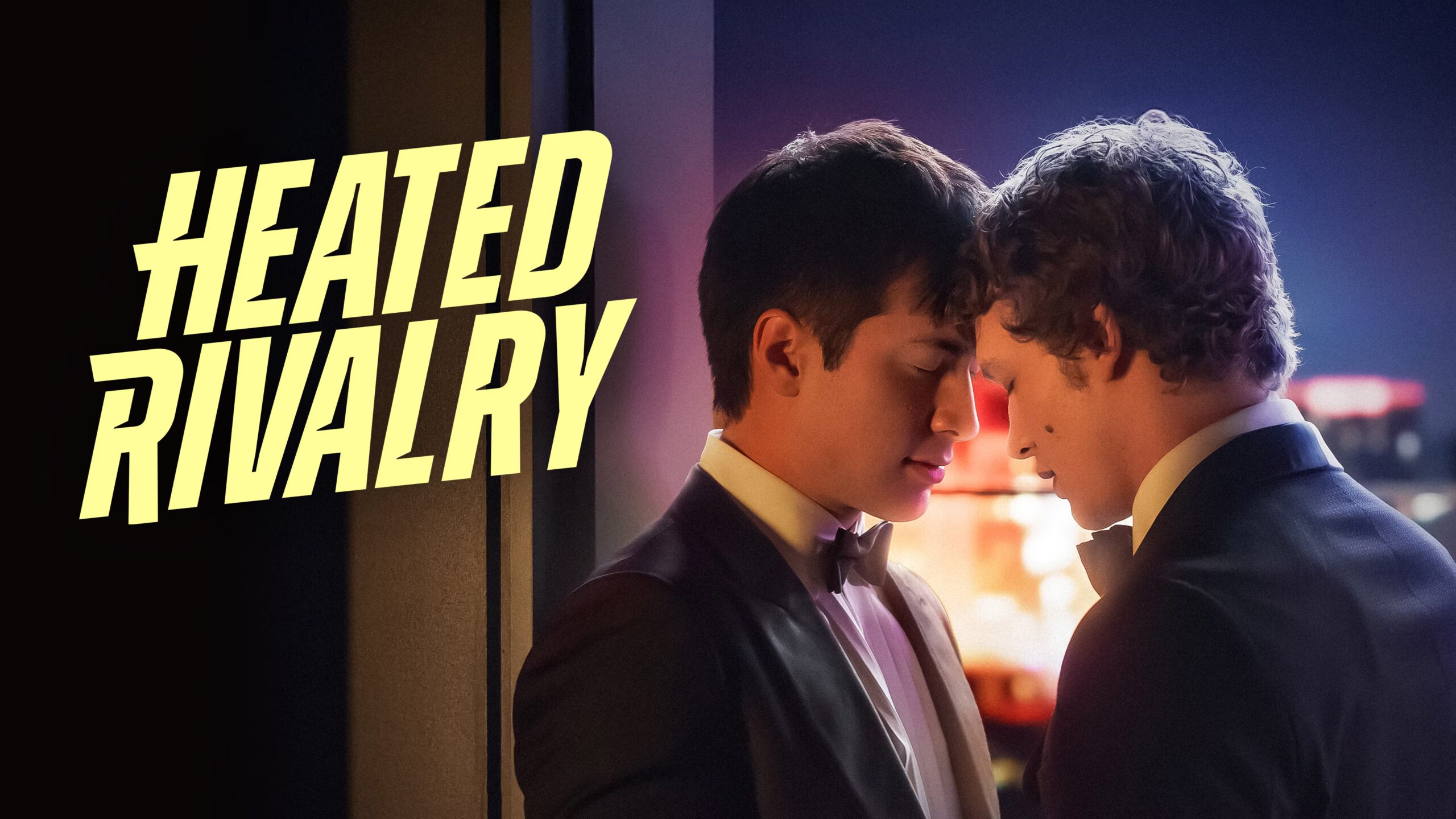
Lately the girls ’n’ gays on social media have been feverish with excitement for the Canadian TV show Heated Rivalry, a titillating tale of forbidden love between two professional hockey stars. In the show, Russian rebel Ilya Rozanov and Canadian choirboy Shane Hollander begin casually hooking up as teens shortly before their rookie season, then realize gradually over a period of years that they have genuine feelings for each other. Fans and the sports media see the pair as enemies, little suspecting that after facing off on the ice they bury their faces in each other’s laps.
The show depicts men who are conventionally attractive beyond all reason having deeply idealized and surprisingly explicit sex in the gentle amber lighting of impossibly well-appointed penthouse apartments and luxury hotel suites. Despite the disparate setting, there’s some shared DNA with Brokeback Mountain in the seeming impossibility of their romance and their denial of their feelings, and coincidence or not, it’s notable that Ilya is a fair-haired Heath Ledger-type while Shane’s appearance and behavior might summon memories of Jake Gyllenhaal. Or for women who grew up with the Twilight novels and movies, perhaps the more apt dichotomy is Edward and Jacob.
It’s noteworthy that many of the fans of the series are straight women who seemingly enjoy these graphic homosexual encounters between muscular youths in much the same way that straight men have long appreciated “lesbian” scenes between women who cater to the male gaze. Feminist writer Jessica Valenti has suggested that the sex in Heated Rivalry appeals to straight women because so few onscreen heterosexual encounters depict two equals. “When it comes to sex in pop culture that is targeted towards us, there is always a massive power imbalance,” Valenti said in a video posted on Instagram. “I think part of the reason this show is doing well is because it’s appealing to watch sex between equal partners.” Perhaps this popularity portends more shows and movies about LGBT people that will have crossover appeal to straight audiences, but let’s not get our hopes up.
Heated Rivalry is based on a romance novel by Rachel Reid (the pen name of Rachelle Goguen, who’s married to a man and has two children) that contains some insight into human nature but whose prose evinces no aspirations beyond pedestrian, literal-minded descriptions. The series emerges from fiction that was nearly a script already, and many scenes are reproduced with the fidelity of a true believer. The novel describes scenarios that most readers could never imagine experiencing but does, however, capture some of the illicit excitement that many who came of age when same-sex encounters were necessarily clandestine will recall—and perhaps remain nostalgic about. Any experience is more exciting when the outside culture proscribes it.
The show depicts a woman’s romance-novel fantasy of what being a gay man might be like. Tops with rippling muscles lift their bottoms effortlessly and carry them to bed, where they vigorously bugger them with little mention of lube, sphincter-loosening, or any of the untelegenic outcomes of anal sex. Lust is a powerful, inescapable drive that is indistinguishable from true love at first sight, it’s always mutual and never unrequited, and the only real problem these characters have is society’s pressure to be straight. Nonetheless, this is one of the rare cases in which the TV version is better than the book.
It helps that the series is thoughtfully adapted and directed by Jacob Tierney, best known for his work as a writer and actor on the very unsexy Canadian show Letterkenny, and that lead actors Hudson Williams (as Shane) and Connor Storrie (as Ilya) are as deeply committed to their roles as they apparently are to squats and crunches. Much of the show is taken nearly word for word from the novel, but other elements are heightened or improved upon by more nuanced staging and performances. Williams is persuasive as Shane, a charming goody-two-shoes who would naturally be drawn to—and submissive for—Storrie’s dangerously appealing and naturally dominant Ilya, and Storrie captures both his character’s swagger and the vulnerability he’s trying so hard to hide. The third episode focuses on another couple, Scott and Kip, who present a variant idea of gay romance, one built on deep mutual respect despite disparate socioeconomic situations.
Heated Rivalry makes modest references to real-world issues such as the oppression of LGBT people in Russia, but the world depicted here has low gravity and less gravitas. There are some minor racial head-scratchers, including the show’s depiction of Shane’s Japanese Canadian mother, who barely figures in the novel, as a stereotypical tiger mom, and the random skin-lightening of a bartender who flirts with Shane and is described in the novel as a dark-complexioned Haitian. That aside, the show is generally easy to like and mostly harmless, and it will surely be an activating experience for many adolescents—if gays were ever actually looking to recruit, this would be an effective tool. That is in part because it views Shane and Ilya in the dreamy, airbrushed, softly lit way that women were once depicted in Playboy magazine.
By the end of the third episode I found myself switching streaming services to rewatch the dreary-but-honest 2016 movie Other People for a true-to-life queer experience. Directed and written by Chris Kelly, the first openly gay head writer for Saturday Night Live, Other People includes at its midpoint a scene of awkward, unfulfilling sex with an ex that turns into a moving moment of empathy and deep understanding, which is established through specific individual quirks and bears no similarity to the fantasy version of romance.
“Let people enjoy things!” someone seems to be screaming outside my window, and I do want people to enjoy Heated Rivalry. I enjoyed most of what I’ve seen so far (four of six episodes have been released as of this writing). I want there to be room for Heated Rivalry and for Other People, and for Luca Guadagnino’s Queer and Andrew Haigh’s All of Us Strangers and Sally Wainwright’s Gentleman Jack, which HBO cancelled far too soon. I want to see all the queer stories being told. And if the sweet, sexy fantasy of Heated Rivalry feels a little too good to be true after a while, I want audiences to know that there are more tart stories out there waiting.

Jeremy C. Fox is the managing editor of The G&LR.