
“Like so many aspects of Western culture, our understandings and views of love have been influenced by contributions from Greek thought. The Greek vocabulary for ‘love’ includes the nouns ‘storge,’ ‘epithymia,’ ‘philia,’ ‘eros,’ and ‘agape,’ and their respective verb forms. On occasion some of these words for love are interchangeable but they are not strong synonyms. As we shall see, the history of the language of love is intimately related to the history of ideas.” — Carter Lindberg, Love: A Brief History Through Western Christianity
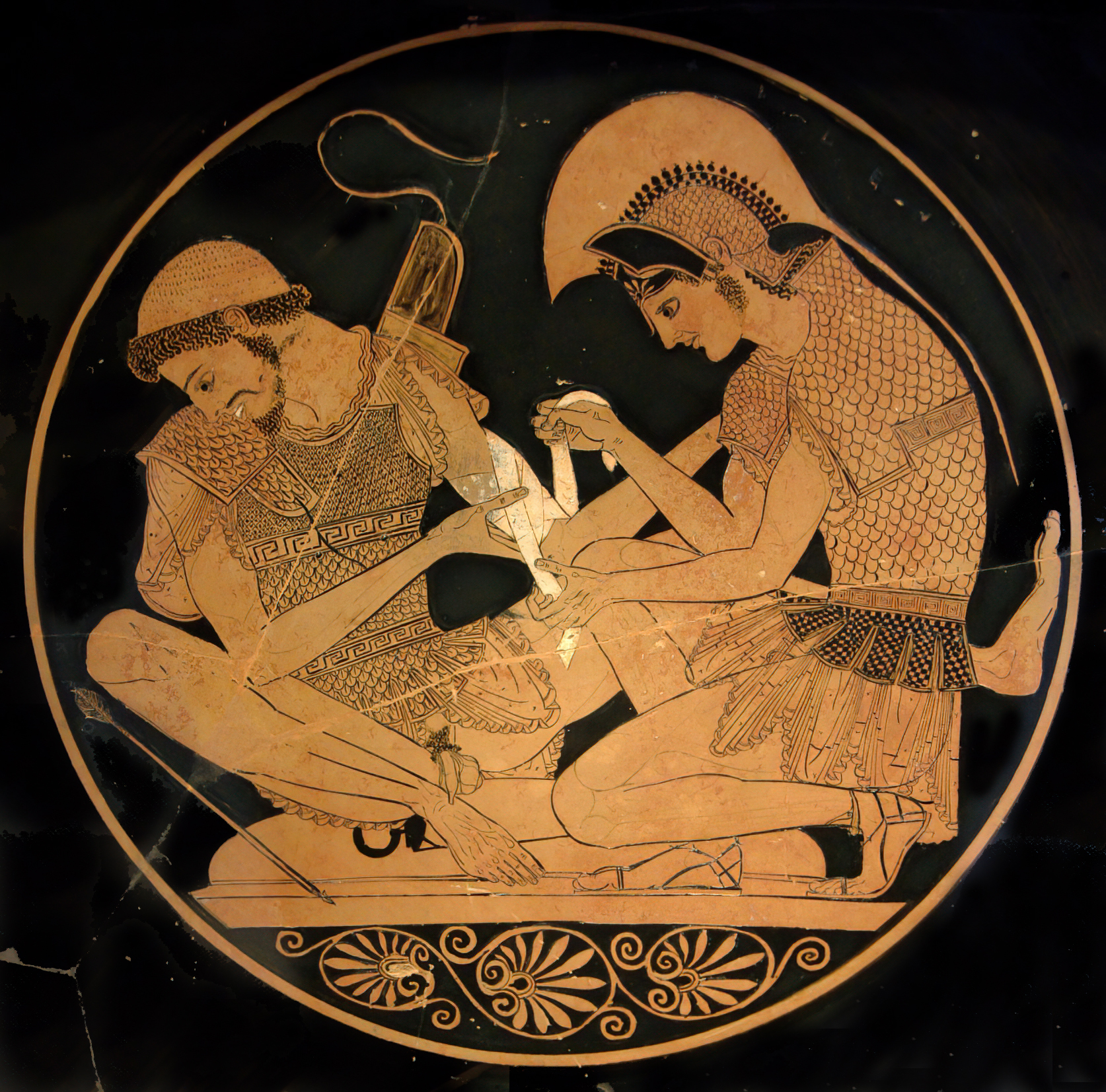
The Iliad is perhaps the most influential piece of non-religious literature in the Western canon. Almost 3,000 years after its first performances, it continues to shape how we understand heroism, individuality, violence, and even what it means to be human. And yet, despite centuries of readings, it still poses questions. One of the most enduring concerns the relationship between Achilles and Patroklos. Were they friends, lovers, comrades, or something beyond any modern category? The question of Classical queerness has not faded; if anything, it has intensified, fueled by popular works such as Mary Renault’s The Persian Boy, Madeline Miller’s The Song of Achilles, and Jan Morris’s historical writing. Their intimacy has become a flashpoint for wider debates about queerness in the Classical world.
When Achilles learns of Patroklos’ death, his grief is overwhelming: “My dear comrade’s dead,/ Patroklos, the man I loved beyond all other comrades,/ loved as my own life—I’ve lost him. Hector’s killed him,/ stripped the gigantic armor off his back, a marvel to behold,/ my burnished gear.” These words have long invited interpretation. But before we call Achilles and Patroklos “gay lovers,” we must examine both the Greek language of love and the dangers of retroactively imposing modern categories.
Ancient Greek included a spectrum of words for love: eros for passionate desire, philia for affection and loyalty, storgē for familial love, and later agapē for unconditional devotion. In Homer, however, the vocabulary around Achilles and Patroklos is strikingly limited. Achilles repeatedly calls Patroklos philtatos (most beloved), while Homer also uses hetairos (companion). These words emphasize closeness, loyalty, and affection, but not explicitly erotic desire. Unlike later texts, the Iliad never deploys eros to describe their bond.
This absence has fueled debate. Classical authors, themselves living centuries after Homer, filled the gap differently: Aeschylus, in his now-fragmentary tragedy Myrmidons (ca. 450 BCE), implied a sexual bond, while Plato’s Symposium (ca. 380 BCE) cast Achilles and Patroklos as exemplars of noble same-sex love. In other words, the meaning of their relationship was already contested in antiquity.
Comparisons can be made with other ancient epics. Gilgamesh’s grief for Enkidu in Mesopotamian literature echoes Achilles’ mourning, with similar ambiguities: Is this brotherhood, or something more? These parallels suggest that epic poetry often left intimate male bonds undefined, resisting the modern urge to categorize.
This raises the key question: Does it even make sense to call Achilles “gay?” If by “gay” we mean a fixed sexual identity, the answer is no. Identity categories like homosexual and heterosexual are modern constructions, shaped by 19th- and 20th-century medical, legal, and political discourse. Achilles and Patroklos lived in a conceptual universe that thought about desire, gender, and love differently.
Queerness, broadly understood, means resisting or destabilizing normative boundaries of gender and sexuality. By that measure, the ancient world was rich in queer possibilities, though not in ways that map neatly onto today. Examples abound: Alexander the Great’s deep bonds with Hephaistion and his alleged eunuch lover Bagoas; the homoerotic poetry of Sappho; the Sacred Band of Thebes, an elite fighting unit of paired male lovers. Greek pederasty institutionalized same-sex desire within a pedagogical framework, structuring relationships between older and younger men around roles of activity and passivity. For the Greeks, what mattered was not a person’s gender so much as their role in the act.
This “top/bottom” system resists our modern identity politics. Achilles, as a dominant warrior, would never have been slotted into the category of “homosexual” as we use it. Likewise, myths like Tiresias’ gender transformation illustrate an imaginative fluidity about sex and identity that seems queerer than any single category. The Greeks cared deeply about power, honor, and status, but not about enforcing a binary “straight” or “gay” identity.
Thus to call Achilles “queer” is more accurate than calling him “gay.” His bond with Patroklos unsettles categories, blurring lines between love, loyalty, family, and eroticism. If the Greeks lived with such fluidity, why do we return so obsessively to the question of Achilles’ sexuality? Part of the answer lies in how later cultures have used antiquity as a mirror.
From Oscar Wilde’s invocation of “Greek love” in his defense at his trial, to Walt Whitman’s homoerotic poetics, to Virginia Woolf’s explorations of gender fluidity, classical texts have been reinterpreted to legitimize queer identities. In the 20th and 21st centuries, novelists such as Renault and Miller brought the story of Achilles and Patroklos into popular fiction, often framing their love in explicitly modern romantic terms. For many queer readers, these reimaginings offer representation and continuity, a lineage of desire stretching back to antiquity.
But back-projection carries risks. Declaring Achilles and Patroklos “gay lovers” erases the nuances of Greek sexual frameworks. It flattens Homer’s layered vocabulary into the binaries of modern identity politics. Worse, it imposes Judeo-Christian moral categories on a pre-Christian world that operated by very different logics. By rewriting antiquity in our own terms, we risk misunderstanding both the past and ourselves.
The relationship between Achilles and Patroklos resists simple definition. In Homer’s text, it is framed through words of affection (philos) and companionship (hetairos), not through eros. Later writers, ancient and modern, reimagined that intimacy as sexual, romantic, or symbolic, depending on their own cultural needs.
Perhaps this is precisely why the story endures. Achilles and Patroklos embody queerness not as an identity but as a refusal to fit categories. They remind us that love, grief, and desire are historically shaped yet perpetually open to reinterpretation. To ask if Achilles was “gay” is to miss the point. Better to see in him a mirror for our own uncertainties about love, masculinity, and the boundaries of the human.

Asa Williams is a writer and researcher whose work explores the intersections of literature, music, and counterculture. Having studied Classics at Durham University (Van Mildert College), he is currently completing a doctorate at the University of East Anglia. His thesis, Rock ’n’ Roll Rimbaud, examines the influence of Arthur Rimbaud on 20th-century American music, from the Beat poets to punk. He also runs the music-poetry project The Leadfoots (@the_leadfoots on Instagram).