Upstairs Inferno
Directed by Robert Camina
Camina Entertainment
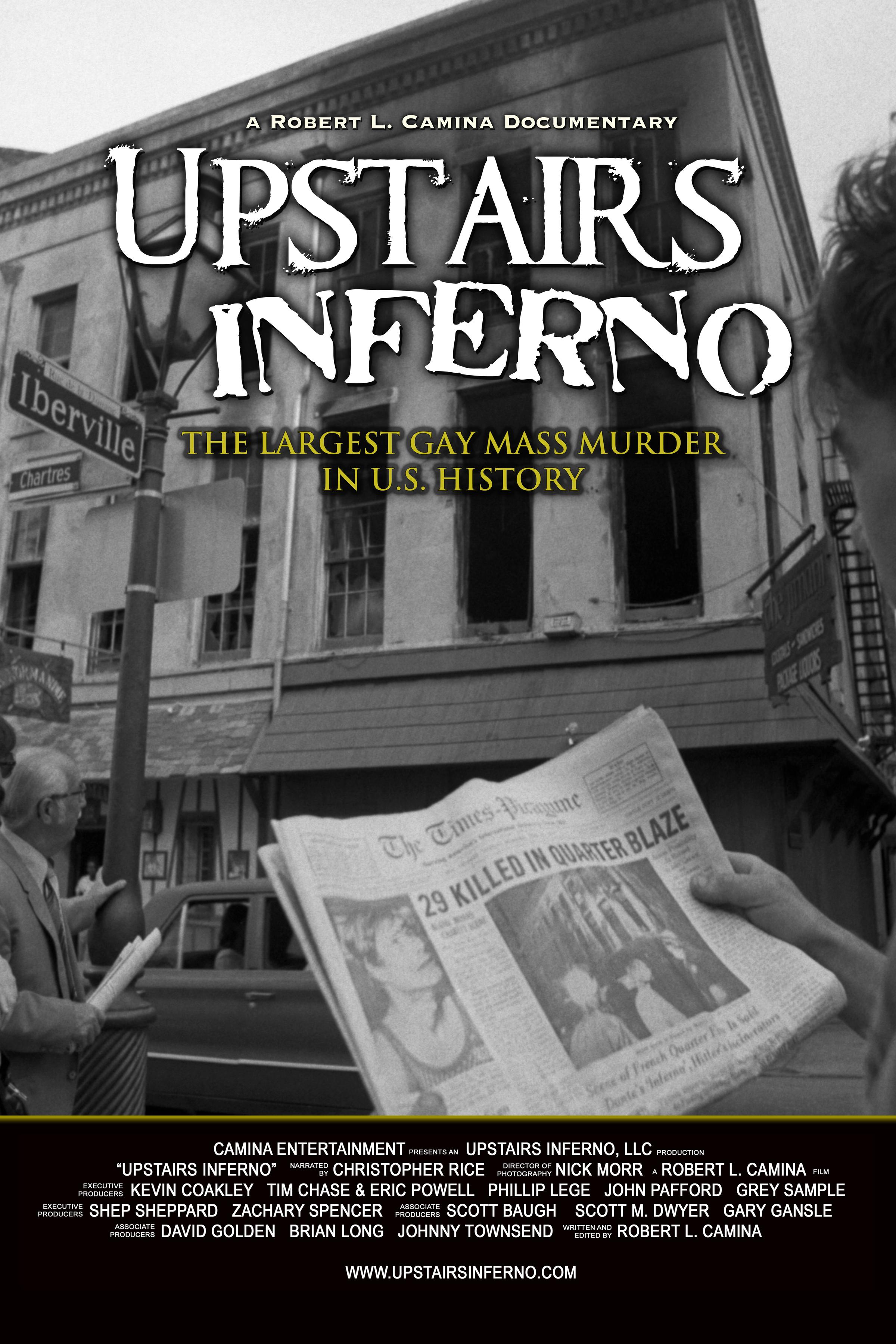
THE DEADLIEST CRIME against GLBT people in U.S. history occurred on June 24, 1973, at a gay bar in New Orleans. On that night, an arsonist set fire to the bar and consequently killed 32 people. Now if you’ve never heard of the Up Stairs Lounge arson, you’re not alone. Until a few years ago very few people, including in New Orleans, had heard of the tragedy.

On that fateful evening, an unruly hustler, Rodger Dale Nunez, was physically thrown out of the bar for badgering a regular customer, Mike Scarborough. The latter was in the bathroom when Nunez, who was in the next stall, started harassing him through the glory hole. Scarborough complained to the bartender. As he was being escorted out the bar, Nunez threatened to “burn you all out.” About thirty minutes later, a fire broke out in the stairwell. As the fire spread, panic ensued. Bartender Buddy Rasmussen led about twenty people through a poorly marked rear fire exit. Many dashed for the windows, but they had burglar bars. A few were thin enough to squeeze through, but the others were doomed. Firefighters were met by a grisly, horrific scene. The lifeless body of Bill Larson, pastor of the newly formed local Metropolitan Community Church, was wedged in a window, his face and right arm protruding stiffly over the street. Several bodies were huddled in a corner, burned and fused to each other. Many of the dead were burned beyond recognition and were ultimately identified through the dental records of local dentist Perry Waters, who also perished in the fire. Nunez, who admitted starting the fire but was never arrested, committed suicide the following year. Initial media reports and the police response were less than sympathetic. Some family members of the deceased refused to claim the ashes of their relatives. Radio commentators joked that the remains should be buried in fruit jars. On the issue of identifying the victims, Major Henry Morris, a detective with the New Orleans Police Department, said: “We don’t even know these papers belonged to the people we found them on. Some thieves hung out there, and you know this was a queer bar.” While the media reaction was cruel and the police were nonchalant, the religious establishment was downright hateful. Church after church refused the use of their facilities for a memorial service. Father Bill Richardson (a closeted gay man) of St. George’s Episcopal Church, however, believed the dead should have a service and graciously allowed the use of St. George’s sanctuary for a prayer service, which was attended by roughly eighty people. He was subsequently chastised by his bishop and received no small amount of hate mail. Days later, a Unitarian Church also held a small memorial service. A larger service was held on July 1st at St. Mark’s United Methodist Church with Rev. Troy Perry officiating. The arson attracted gay activists from all over the country to New Orleans. Troy Perry and others criticized the gay community of New Orleans for its apathetic attitude toward the gay liberation movement that was burgeoning in other U.S. cities. Local bar owners concerned about how all the attention might affect their bottom line responded by calling Perry and the other activists “carpetbaggers” and “outside agitators.” Until recently, the tragedy had gone largely ignored in national GLBT historical narratives. The first researcher to show any significant interest in the fire was Johnny Townsend, who began compiling information on the victims and writing the story of the arson in 1989. The manuscript he completed in 1990 would not be published until 2011, as Let the Faggots Burn. James Sears briefly discusses the fire in his landmark book Rebels, Rubyfruit, and Rhinestones (2001). In 2013, on the fortieth anniversary of the fire, filmmaker Royd Anderson released a short documentary called The UpStairs Lounge Fire. A short article appeared in The Advocate, and a longer piece ran in Time magazine titled “The Upstairs Lounge Fire: The Little Known Story of the Largest Killing of Gays in US History.” A book called The Up Stairs Lounge Arson: Thirty-Two Deaths in a New Orleans Gay Bar, June 24, 1973, by Clayton Delery-Edwards, was published in 2014. Now a new documentary by filmmaker Robert Camina titled Upstairs Inferno is out and making the rounds on the film festival circuit. Its world premiere in New Orleans sold out quickly, as did a second screening. The premiere was something of a historical event in itself, as it was attended by three survivors of the fire and several family members of the victims. Observed Camina: “Never again will you have so many survivors and key players of one of the biggest events in U.S. LGBT history in the same room. It’s not hard to see the significance of that.” A major misconception that Upstairs Inferno debunks is that the arson was a hate crime. Nunez was no religious zealot acting on behalf of God when he set fire to the building. Rather, he was a deeply troubled young man who was angry about being ejected from the bar. The film’s portrayal of Nunez is to some extent sympathetic. In his interview for the film, Delery-Edwards theorizes that Nunez, having come to New Orleans from a small town, was deeply closeted and just beginning to find acceptance in the gay bar scene in the French Quarter. Also in the film, the Reverends Troy Perry and Paul Breton talk about the importance of forgiveness when discussing Nunez. Others who were interviewed speculate that Nunez had no intention of killing anyone but wanted only to scare the people who had shunned him. Upstairs Inferno is an important film because it sheds light on a largely neglected watershed moment in our history. Camina superbly illustrates how the reaction of the New Orleans gay community (which was essentially to retreat deeper into the closet) complicates the narrative about the trajectory of the gay liberation movement after Stonewall. One might speculate that event would have been a more prominent cause célèbre in the gay community had it been a hate crime. But the lack of interest could also stem from an anti-Southern bias among historians. Perhaps the film’s focus on the GLBT community in New Orleans will suggest another perspective from which historians might want to examine this horrific event. Frank Perez is the co-author of In Exile: The History and Lore Surrounding New Orleans Gay Culture and Its Oldest Gay Bar.