
A bimonthly magazine of
history, culture and politics.

Dandy Situations
Padlock IconThis is a premium subscriber article. If you are already a premium subscriber and are not seeing all of the article, please login. If you are not a premium subscriber, please subscribe for access to all of our content.

0
Published in: January-February 2006 issue.
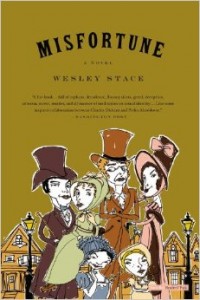
 

MisfortuneMisfortune: A Novel
by Wesley Stace
Little Brown and Company. 529 pages, $23.95


WITH HIS DEBUT NOVEL, Wesley Stace (known to music lovers as John Wesley Harding) creates a world of repressed sexuality, confused identity, and deception lurking behind every corner. With the plot twists of a George Elliot yarn and the dark Gothicism of Wilkie Collins, Misfortune breaks away from the insipid, predictable type of novel that one may have come to expect of recently published fare. Its style is unconventional, and it raises a host of serious issues in the guise of fiction, notably those surrounding the fluidity and boundaries of gender and sexual identity. If Judith Butler were to write a novel, this would be it.


Set somewhere in the midst of Victorian England, the novel begins with a boy being told to carry out an unusual errand: he is instructed to bring a package into the woods to “get rid of it.” The package is later found by Lord Geoffrey Loveall, a carefree Victorian dandy. Living in a time period shortly before the invention of the word “homosexual,” Lord Geoffrey appears to be the quintessential gay man. He also happens to be obsessed with “resurrecting” his sister Dolores, who died tragically at the age of five. Lord Geoffrey is the heir apparent to the Loveall family fortune. This places a weighty burden on his shoulders, one that he’s not readily able to fulfill. He must find a suitable bride, marry her, and produce heirs for the family estate. And Lady Loveall, his chronically ill mother, will not allow her son to forget his responsibilities for a moment. She’s forever prodding him to marry, and seems to sense that there might be a special reason for his reluctance.

Geoffrey’s conflicts are miraculously resolved for him during a carriage ride into the woods. He comes upon the package discarded by the young boy and discovers, to his delight, that it contains a baby. He immediately believes that Fate has given him this child to replace Dolores, whom he lost so long ago. He plans to take the baby home and raise her as his daughter, naming the child Rose. Just when he couldn’t be happier at his good fortune, he discovers that the child is, in fact, a boy. Undaunted by this discovery, however, Lord Geoffrey decides to raise the baby as the daughter he wants. From there, the narrative traces the intricate plots that Geoffrey is forced to weave in his efforts to protect this façade. A female librarian comes to the estate, hoping to catalogue the many volumes of books held in the library. Geoffrey cares only for the baby, the librarian only for the books; from this, a marriage is born. The marriage is entirely without sex; its entire purpose is to legitimize Rose, making her the next heiress to the estate. The new Lady Loveall goes into hiding along with Rose for just long enough to have given birth to the baby.

Rose is raised in isolation from the rest of the world. She doesn’t attend school and has only a few select friends. As she becomes aware of her body, she naturally assumes that all girls have the same feelings as she. Her adoptive parents have taken the precaution of instructing her never to undress in front of others. An air of illusion comes to permeate the Loveall household and those who occupy it. When Rose develops a strong sexual attraction to Sarah, one of her friends, interesting questions arise about the sexuality of the two individuals. If Sarah is attracted to a person who she thinks is a girl, does that make her a lesbian? If Rose thinks she’s a girl, even if she’s not one from an anatomical standpoint, what does that make her? Eve Sedgwick and Judith Butler have argued that sex and gender are separate issues (sex being anatomical, gender being socially constructed). Which, then, the novel seems to ask, is paramount when it comes to defining one’s sexual orientation?

This is a novel that delves into issues of gender fluidity and sexuality that will undoubtedly resonate more strongly for GLBT people than for heterosexual readers. Some critics have compared the book to Virginia Woolf’s Orlando, whose main character undergoes more than one change of gender, and whose author may well have been a lesbian who was forced by social convention to marry a man. Stace has captured a vivid Victorian style and feel, and his characters fairly leap off the page in a narrative that’s both thought-provoking and thoroughly entertaining.
_____________________________________________________

Michael DiSchiavi is a writer living in Brooklyn, NY.

Share

Read More from Michael DiSchiavi