

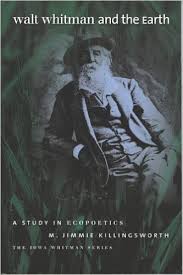
 Walt Whitman and the Earth
by M. Jimmie Killingsworth
University of Iowa Press. 225 pages, $39.95
THIS BOOK had to happen at some point. Someone had to embrace Whitman as an environmentalist, and thus we have Killingsworth’s Walt Whitman and the Earth, demonstrating yet again that Whitman is larger than himself, extending beyond 19th-century America to embrace the ages. Over the past half-century, gay rights enthusiasts have worked aggressively to assimilate the good gray poet, who became the good “gay” poet on the basis of some striking lines scattered throughout his work and one large deliciously homoerotic segment: the “Calamus” poems. No need to waste one’s breath explaining to them that Whitman’s “Children of Adam” is as heteroerotic as “Calamus” is homo-: they’re convinced that Whitman spent his waking hours prowling the streets of Washington and Camden in search of day laborers for a roll in the hay. They endorse the romantic side of his liaison with Peter Doyle but dismiss as a smokescreen his own assertion that he fathered children.
Now Whitman is re-imagined as a conservationist. Killings-worth finds Whitman’s ecological consciousness on display in poems like “This Compost,” a piece of “ecopoetics” that places humankind in its proper position in the natural order. Killingsworth attempts here to blend his analysis with his 1991 work, Whitman’s Poetry of the Body, in which he argued that Whitman became increasingly homophobic as he aged, as revealed by his edits of successive editions of Leaves of Grass. Linked to his growing closetedness was a weakening of Whitman’s commitment to ecopoetics over time. Whitman’s word of choice for his own sexual anxiety was “perturbation,” a term he used for discomfort with any feeling he deemed inappropriate. Although Killingsworth is not breaking new ground here—sixty years ago Gay Wilson Allen noted this use of “perturbation” for sexual unease—he is the first critic to link Whitman’s alienation of himself from his sexual feelings and his ecological sensibilities. Such a link seems natural enough, since Whitman attributed a sexual energy to the natural order all along, as, for example, in the following passage, an apostrophe to the sun: “As for thy throes, thy perturbation, sudden breaks and shafts of flame gigantic,/ I understand them, I know those flames, those perturbations well.” And yet, these sentiments are not as exuberant as they are accusatory. As the years passed, Whitman’s youthful optimism darkened and his homoerotic sentiments were reworked to express feelings of democratic comradeship. With careful analysis of the poems, Killingsworth shows how Whitman consciously went about editing the homoeroticism out of many poems. Still, Whitman never completely eliminated the homoeroticism from his works. The 1860 edition was the first to print the “Calamus” poems celebrating same-sex love (poems Whitman considered calling “Flames of Evil”), but Killingsworth argues that the very act of separating these poems from his celebration of heterosexual love in “The Children of Adam” poems shows that by 1860 he no longer believed in a unified concept of love. “Division” came to be the hallmark by which Whitman could separate “adhesiveness,” his word for same-sex love, from “amativeness,” his word for male-female love. The former became a dangerous dalliance that Whitman grew to fear, while the latter became the standard of rectitude with which he aligned himself. We have several seminal writers to thank—Robert K. Martin (The Homosexual Tradition in American Poetry), Michael Moon (Disseminating Whitman), and Charley Shively (Calamus Lovers)—for teaching us to appreciate Whitman as a brave pioneer in gay literature. But Killingsworth makes a convincing case that it is only the early Whitman who can properly be viewed in this way. George Klawitter teaches literature at St. Edward’s University, Austin.
_____________________________________________________



