
FROM ABOUT 1935 until his death in 1989, the Greek artist Yannis Tsarouchis painted and openly exhibited more studies of men in uniform and more male nudes than any artist outside what might now be called the world of erotica. He was a rough contemporary of two great artists of the male figure, Paul Cadmus, who didn’t paint genitals, and Tom of Finland, who painted little else. Tsarouchis’s unapologetic manner in presenting these nudes long predated that of David Hockney, who would come to admire him. In Greece Tsarouchis’s name is a household word, but outside his country he and his work have been little known except in some European art circles and certain gay ones. Also little known is that a large body of his work is accessible in one of the most charming ways for art to be displayed—in the artist’s former home, now a museum.
That body of work is of Greek subjects. Country village men wear their one good city suit awkwardly. Young men sit bored in tavernas, while others dance. Soldiers and sailors sit uncomfortably in their required uniforms as if they long to get rid of them—and do, lounging barefoot on flowered 19th-century couches, lying nude on the brass beds of cheap hotels. While these bodies seem earthy and are even made available to us as viewers, other male figures are more ethereal, a perfect desired form made light with the addition of the traditional—if improbable—wings of an Eros.
Tsarouchis used techniques from artists of the Greek tradition for his first audience, his countrymen, to remind them that the glory of Greek art had not faded. It did not end when Rome conquered Greece. It could be meaningfully extended by them and for them. He preserved ordinary Greek faces, as those of gods and statesmen and saints had been preserved for centuries. He also reminded Greeks that the subject matter of much of that art was the representation of males, often nude males. For another audience, the gay tradition that for most of Western history has looked toward Greece for both inspiration and validation, the art of Tsarouchis portrays the ordinary objects of desire between men as did his predecessor artists and the Classical and Hellenistic poets collected in The Greek Anthology of 1916.These desirable young men are given the prominence of those found in statuary depicting athletic heroes, on Attic drinking cups depicting lovers, and on the walls depicting gods painted by Greeks in Pompeii and Herculaneum.

In 1940, when painting a large nude with a dark background, Tsarouchis reached an impasse. The results disgusted him. He was using techniques from the 19th-century Academy. His diary recorded stopping work on that painting. He then copied a Hellenistic mosaic known as the Piraeus Medusa. He pinned this copy next to his model and saw that they resembled each other. A secret of Hellenistic painting emerged: colors must be rendered exactly. He determined what it was that must distinguish his art and modern Greek art from what held sway for centuries. Tsarouchis rejected the tonalities of Renaissance chiaroscuro, the subtle shading of darks into still darker backgrounds. Greek painting with its bright, true colors—cold ones receding and warm ones coming forward—became his standard. With this approach to the modern through completely Greek sources, he revolutionized Greek painting. His influence on Greek thought—still felt today—had begun.
The Nude with Oleanders and Bandaged Hand (1941) was one result of this æsthetic awakening. The almost life-sized young man stands with one foot forward like a still kouros of the Archaic period. The stark, unmixed white that highlights contours of the young man’s body suggests a strong reflection of the vivid Greek light, a technique common to Byzantine painting. The flowers on a table near him could as well be funereal as decorative. Their pink is reflected in the tones of the youth’s body. The blossoms and the vulnerable expression of the nude youth are reminders of mortality. The life mask of this portrait threatens to become a death mask. The young man with his soulful gaze could be from any Greek era, or be the flesh-and-blood modern Greek that he is. In 1940, he’s the political subject of a dictator in a country in economic depression, living in a world on the brink of war in a land that’s about to be invaded by two powers. It is a portrait of a kouros become palikari—a hero of Greece’s war of independence from the Turks in the 1820’s, used ever since to denote a handsome young hero.
From that time Tsarouchis forged a modern realist style by studying art of the Greek tradition, for technique and the ability to express the essential spirit of Greece. He found in the strong colors of the encaustic funeral portraits of the Greeks in the Fayum, in Egypt, the means to depict persons of strong thoughts, imbued with a sense of time and mortality. Works with this influence are close to memorials or epitaphs, as were so many works of The Greek Anthology. He stressed the accomplishments and uses of the large body of Byzantine art that were different from most art in the West. He saw that the Renaissance arts and others of the West had interpreted and even distorted Greek sources for their own purposes.
He invented a watercolor style derived from Attic vase painting showing figures rendered in outline with washes of color. Works in this style could represent a world less tied to a social reality. He used the graffiti of the vase painters to indicate that his male figures represented an Eros of love between males, scenes of nude young men and the god Eros with his laurel wreath flying above them as if inciting this love and giving it his blessing.
Tsarouchis represented Eros as a Greek male of the working classes or the armed services. The young men are lost between their family and the military, lost between the country or the islands and the city. They are between economies, as they were between wars in his earlier work. They are “between east and west,” as Tsarouchis saw it, between Greece and its eastern diaspora with its capital at Constantinople and the more familiar, western locale at Athens. They gathered in working class rebetika tavernas, rejected by the bourgeoisie. They are young men, but at a crossroads to maturity. They have been or will be called upon to be legitimate heroes. Their features are bold and masculine, yet they often express a sense of deep thought. Their gaze from the canvas is often forlorn.
They are sexually in-between, as well. Most will marry and father children, but for now they are dressed up with nowhere to go. They are bored in the military and sit waiting in cafés. For homosexuals at this time these men were prize tricks, willing prey for an assertive queen on the prowl. The men portrayed would not mind finding an attractive young man and, with him, would be willing to play certain defined roles in a homosexual encounter. The Alexandrian Greek poet C. P. Cavafy wrote in In an Old Book, a poem written in 1922, that the protagonist finds a painting guessed to be about a hundred years old, a portrait of a young male titled “The Appearance of Eros.” Tsarouchis’s art gives not just one such Eros but an instance of Eros time and time again in his portrayals of young modern Greeks.
Sailor with Pink Background (1955) is wearing the dark uniform worn in winter. He sits pensively, his arms leaning on a café table unique to Greece. His hands show that the fingernail of each little finger has been allowed to grow long, an affectation of the working classes and the military. An odd rupture in the wall behind him, stucco or plaster that’s worn off to reveal the laths beneath, is a visual complement of the sailor’s own thoughts, revealed as he looks directly out at the viewer. The intensity of his reverie is portrayed through his gaze like that of a Fayum portrait or a figure in a Byzantine icon. His expression could be one of contemplation or nostalgia—memories of an island home, its Orthodox religious ceremonies, and the family he left behind for this compulsory stint in the service. His thoughts may go forward or backward, to an image of his young body as fierce fighter or as strong lover. He may have just danced the introspective solo zeibekiko. He may rise to dance, or he may leave to go to a cheap hotel in the neighborhood.
Like Cavafy in his memory poems of cafés and rooms where lovers met, Tsarouchis assembled specific objects that give a solid background to his nudes: tables, sofas, vases. Again and again Tsarouchis used specific objects to unite influences of centuries of Greek history, from plaster copies of Attic sculpture to furniture derived from Greek styles. There is a tufted and flowered sofa; there are red blankets with the Greek key motif woven in black; there’s a gilt mirror. In one work a male stands nude with his back to the viewer, a Narcissus who stares into the mirror placed on a chair in front of him in order to see—and to reveal to the viewer—his genitals.
The objects themselves resided with Tsarouchis in various locations in Athens. They were with him in a studio near Syntagma Square, near the Greek Parliament with the tomb of the unknown soldier guarded by evzones, elite soldiers dressed in the 18th-century style of the palikaria, who wore the fustanella (short skirt), tights, and shoes with pom-poms. He later had a small apartment in the fashionable Kolonaki area. To be photographed by Slim Aarons for Holiday in 1961, Tsarouchis arranged a dozen of his works on the long terrace, including one painting of a life-sized sailor in uniform on an easel. He himself reclined on the brass bed with one arm resting on a plaster head copied from Praxiteles. Brushes and clutter abound, as well as a sketched cutout face.
Tsarouchis then began to build a house in the Greek neoclassical style for himself and for his legacy at the outskirts of Athens in Maroussi. In the 1960’s it was an elegant suburb, on grounds higher than the city and away from its congestion but convenient to its intellectual life by train or car. It was a place of aging villas and spacious gardens for the simple bouquets of roses and other flowers he painted and often added in his nude studies—particularly the lilac, which blossoms at Easter, the most important Greek Orthodox holiday.
IN MARCH 1966 I had just turned 21 and was a student in Greece. I had read what little I could find published about him in English. After visiting a show of his in Athens, I was introduced to him, and we became friends. I often made my way to his home, which was alos his studio. He was then 55 and slim. His head was bald on top but his hair was thick around the sides. His appearance was like that of a monk, an ascetic. He normally dressed with no pretense, but he had at least one flattering Pierre Cardin suit that he wore for openings and other special occasions.
His studio home was public, like so much of the Greek life that his art depicted. With assistants already at work, friends and models would stop by, crowding the space even more. There was always food. He quipped, “To be an artist, you must first learn to cook.” There was music. Sounds from a cheap phonograph interrupted work and signaled a break for the painter. He danced the elaborate zeibekiko. He forewarned, “You must be here seven years to learn this dance.” I don’t know why he chose the number seven, but I never did master its tricky rhythm, which he caught in life-sized canvases as soldiers or sailors in uniform danced this dance of ethnic and personal freedom.
Conversation with guests was attempted in Greek, French, and English. Nureyev might be expected to drop by if he were in Greece for a performance at the Athens Festival. Cartier-Bresson might stop in to talk about the use of color in photography. Someone from the theater might need a costume or set design consultation, work that Tsarouchis used to supplement his income. A portly Greek in middle age was often there, one Colonel Velloudios. One might well ask, colonel of what? He was best known for being a guide for homosexual men in search of strapping—and willing—sailors and soldiers, particularly evzones. The latter posed for tourists by day, but after hours they might pose for quite different photographs. Those snapped by the raffish old colonel were eventually published.
Tsarouchis kept an album of photographs of his models for reference. There were nude sailors dancing the zeibekiko. The dancer grabs his genitals in this dance, so this ritual, which derives from ancient Greece, is both sacred and profane. As I once gawked my way through the images of tempting Greeks in the album, he said, “You have found the reason that I paint.”
One of these models might stop by the studio, dressed in the current Italian gigolo style. Those times that I moved about Greece, I saw double: my sight and what Tsarouchis had made of it. I would look into the model’s features and imagine him as would the artist Tsarouchis. As a sailor in the cap now atop the plaster copy of a portrait head by Praxiteles. Concentrating on his dark hair, dark eyes, and straight dark brows, the bow of his full lips, the line of Tsarouchis’s other styles is abstracted and understood, quick brush strokes often used to make cutouts, even. I would certainly imagine the young hunk naked—with wings. Theognis, a poet of the 6th century BCE, wrote in his poem “The Beloved”: “For ever have I given wings to raise thee.” Tsarouchis added wings to indicate the figure itself is an instance or appearance of Eros, a beloved.
In one photo enlarged from the album, this model sits nude except for black socks of the kind a sailor might wear. His solid legs spread and his position on the bed raises the large balls and thick cock and its encircling foreskin. He absent-mindedly toys with a long fingernail. A late painting uses this profane figure and floats it to hover like a religious image inscribed in a cloud, unattainable between the sea and the sky. Below is a melancholy breakwater rendered in a few bold strokes of the brush. The figure is a beloved, an Eros given the bold orange and black wings of a butterfly. He is not engaged in deep thought in the way that Tsarouchis usually portrays his subjects but is instead caught in a preoccupied moment, as this self-absorbed young man looks down at his hands. Tsarouchis titled this work The Spirit of Boredom over Piraeus, referring to the port of Athens, a place of sailors, a place of arrivals and departures, as well as a place of assignations. The young man may be waiting for such an encounter, or more likely is experiencing the feeling after sex, that lassitude or petit mort.
The artist might sit with his glasses perched on his nose, bent with busy brush in hand over a quick watercolor of a bouquet just picked, done as payment to his doctor or as a birthday gift to a friend. There were Greek café tables holding brushes and paints, the brass bed frame leaning against the wall, a plaster and gilt mirror reflecting it all—each waiting to be assembled yet again for one of his paintings. Now only the work remains. These and the spirit behind them can be encountered now in the museum.
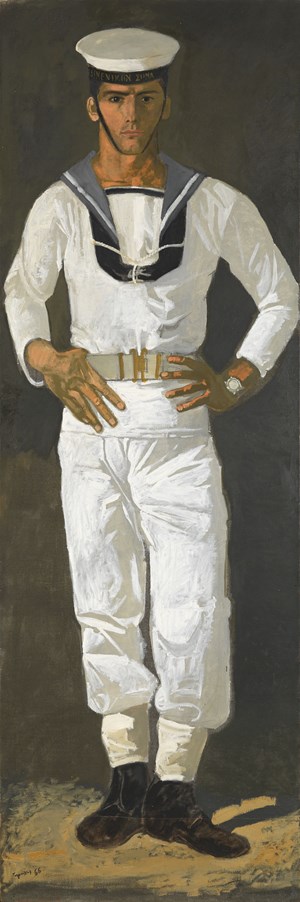
The Sailor in the Sun (1966; lost and repainted 1968–1970) is in the summer white uniform. He stands alone, life-size, ready to emerge from a dark background of earth tones, as if from the darkness of Plato’s cave or one of the caves of Byzantine icons. The brush strokes of the sailor’s uniform could be Hellenistic, even Byzantine, in their technique and purpose, assuming the effect of the robes of saints. Tsarouchis’s clothed figures often appear more naked than his unclothed ones, as the white uniform clings to the sailor to reveal his slim body and large cock. The sailor’s face is strong like all of Tsarouchis’s faces. The gaze is also naked and inspires contemplation, if not actual worship. “I am always so religious,” he said to me. “I could not live without religion, any more than live without the lilac.”
The work of Tsarouchis gives individual faces to the collective Greek myth and restores individual bodies to the timeless space of an Attic statue, a Fayum portrait, an icon sitting in dim candlelight in an island peasant chapel. One function of icons is that, with meditation, the image can lead the viewer to a spiritual world beyond the mere object. The images of Tsarouchis are icons, the faces of Greece, and they lead finally to the deep spirit of Greece and its long history of Eros and love that Tsarouchis embodied and depicted so well.
Dan Luckenbill, who works at the UCLA Library, is a writer and archivist based in Los Angeles.