

A bimonthly magazine of
history, culture and politics.

A Passage to England
Padlock IconThis is a premium subscriber article. If you are already a premium subscriber and are not seeing all of the article, please login. If you are not a premium subscriber, please subscribe for access to all of our content.

0
Published in: May-June 2007 issue.


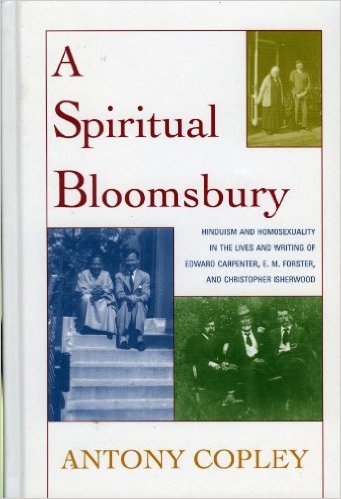
Spiritual BloomsburyA Spiritual Bloomsbury: Hinduism and Homosexuality in the Lives and Writings of Edward Carpenter, E. M. Forster and Christopher Isherwood
by Antony Copley
Lexington Books. 410 pages, $30.95


THIS BOOK is a great idea and, sadly, rather a great disappointment. The subject—broadly speaking, the relationship between the spiritual and sexual aspirations of three key gay male writers of the last century —has long warranted investigation. It is only lately, and in passing, that Forster’s engagement with Eastern society and religion has been considered in the context of his sexuality. For instance, Joe Bristow’s Effeminate England (1995) has a wonderful chapter on the subject, though Copley, despite copious research, seems not to have come across it.


A debilitating air of imprecision attends A Spiritual Bloomsbury. It’s an odd title, for starters. Only one of the three men had anything to do with the Bloomsbury circle —and he (Forster) is usually considered as distinct from it. Isherwood may have been helped early on by the Woolfs, but the material Copley discusses —his late fiction—is strikingly Californian: un-English, and far from Bloomsbury in myriad ways. Carpenter’s gay writings—panegyrics toward the English working-class male, written under the strong influence of Walt Whitman —preceded Bloomsbury, and his polemical style and solid conviction would surely have been disturbingly overt in that milieu.

Copley’s writing style is awkward, even painful. Straightforward points are needlessly complicated by “lit. theory” coinages, such as the words “problematic” and “apologetic” used as nouns. (A “problematic” is what you and I might call a problem.) Still odder is the fact that the publisher gives Copley license not only to interrupt his textual readings and biographical summaries with numerous anecdotal personal asides, but to add a ninety-page appendix, “Extracts from a Diary of the Visit to India 1999.” In it, Copley records such incidental details as: “Stuck at it at the library,” “Gandhi’s birthday,” and so on. Imagine, though, if every book likewise contained all the material an author had gathered or written down towards its realization. Surely, especially in light of that, he might agree that less can often be more.

Inevitably, given the rich source material, there’s much quoted here that is diverting. It’s shocking, sometimes uplifting, to hear how improvised past gay lives were. Carpenter fell in love with the basically heterosexual George Hukin, noting presciently that the affair was “too good almost to be true.” But when Hukin broke it off to marry Fannie, Carpenter rather archly bought them a double bed as a gift. Hukin promptly proposed a threesome —but Carpenter was not comfortable around women anywhere, and certainly not between the sheets. Though he once let slip that “I think every woman in her heart of hearts wishes to be ravaged,” he wasn’t the man to do it. George Merrill, a more substantial lover, was “compliant,” though, as an untutored boy, “quite beyond civilisation”—a compliment.

In his 1892 travel book about India, From Adam’s Peak to Elephanta (which inspired Forster), Carpenter possibly outs himself as a foot fetishist. Of the Indian variety, he writes: “it is so broad and free and full and muscular, with a good concave curve in the inner line, and the toes standing well apart from each other, so different from the ill-nourished, unsightly thing we are accustomed to. ” He had, though, no answer to the status imbalance that informed his every encounter in India, lamenting the relentless “ignominy of guides and baksheesh.” Ultimately, as Copley argues, Carpenter could only take a limited amount of Hinduist thinking, and even less made it into his writings. Whitman’s tricky amalgam of spiritual and bodily impulses simply promised more; but Carpenter also found Eastern philosophy politically lacking.

Forster went much further. Even when noting that his relationship with one boy, Masood, was doomed, he wrote in a moving letter, “You have made me half an oriental and my soul is in the east long before my body reaches it. ” In Howards End (1910), the author had seemed to back his character Margaret’s implicit injunction, “Only connect.” Forster’s narrator added that, if we could connect, “the beast and the monk [in us], robbed of the isolation that is life to either, will die. ” Virginia Woolf had felt, when Forster visited India in 1921, that he would not only connect with its spiritual resonances, but would in fact succumb to them entirely and reinvent himself: “He will become a mystic, sit by the roadside and forget Europe.”

It was not to be. Forster returned, becoming progressively more bound by Western conventions. The twin consequences of his repression were paradoxical: on one hand, there is the novel that remains his masterpiece, A Passage to India (1924); on the other, a creative block that Forster himself attributed to his homosexuality. Maurice, which he had finished in 1917, had proffered a gay Eden at its close—daring for the time; but Forster could never do more than circulate the manuscript among friends during his lifetime.

Of the three writers, only Isherwood arguably forgot the continent of Europe, as Woolf anticipated. Even then, what replaced Europe’s values was very much a partial and customized form of Vedantism, the form of Hinduism that most appealed to him. But as hard as Isherwood listened and wrote on the subject, he sustained his worldly and carnal desire and ambition until his death.

Copley could benefit from a similar single-mindedness. No sooner has he gotten Isherwood to Vedanta than he is wondering: “How did other contemporary Europeans and Americans search for a guru?” The plot is lost, here and repeatedly, as if linear argument were too obvious. Also, some odd statements are made throughout. Oscar Wilde’s trial may in some ways have been “an English equivalent to France’s Dreyfus affair,” but they will need spelling out. There are imprecise assertions: “Carpenter went to great lengths to clear the decks of his Christian background”; “India stretched Forster to his limits.” Isherwood, we are told, “probably never obtained non-duality.”

At other moments, Copley’s syntax is so bewildering as to make no sense at all: “And quite how strong an affect stuck to Isherwood’s hostile attitudes to religion from his leaving Cambridge and his arrival in America in 1939 is a matter of guess-work. ” I found this baffling too: “If Isherwood was later to show a readiness for casual sex with older men, indeed with the one-legged and the deaf and the mute, his preference was for younger men, from sixteen or seventeen to early twenties. ” Auden’s poem “September, 1939” is given as just “1939,” and “Nietzche” has clearly lost something (an “s,” to be exact).

Still, A Spiritual Bloomsbury concludes aptly; all three authors, it turns out, had only limited use for Hinduist thinking. Isherwood had begun writing against the legacy of his parents’generation in All the Conspirators, and it is easy to see how the solid Anglican values of his mother Kathleen provided him with a vital touchstone against which to react. The holistic world view espoused by Vedantism he could never fully surrender to: he’d have “lost the counter-force which gave him strength,” as Copley puts it.


Richard Canning’s anthology of new gay fiction, Between Men (Carroll & Graf), has recently been published.

Share