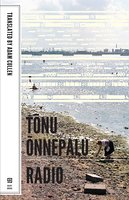

Radio
by Tõnu Õnnepalu
Translated by Adam Cullen
Dalkey Archive Press
600 pages, $17.95.
ESTONIA IS NOT a country that leaps immediately to mind in discussions of today’s literary lights, but—based on the evidence of Radio, at least—that situation may be in need of change. The novel’s author is Tõnu Õnnepalu, who is well known in Estonia and whose previous novel, Border States (written under the pseudonym Emil Tode), won the Baltic Assembly Prize for Literature. Radio was originally published in 2002 and is being reissued by the Dalkey Archive Press, which deserves a special shout-out for bringing forth a large number of similarly overlooked works over the years.

Radio is the story of a middle-aged gay filmmaker returning to his homeland after living for over a decade in Paris. The book begins with the unnamed narrator musing to himself about the differences between euros and Estonian currency, then lamenting that “Those old, large, appealing bank notes are already starting to fade from memory.” He then waxes nostalgic that they were the currency in which he earned his first real money, back in 1991, in Paris, when he first met Liz Franz, an elusive presence whose disappearance still haunts him. The search to discover what happened to her ostensibly provides the motivation for the remainder of the novel. A strangely detached, claustrophobic, and self-absorbed discussion about the differences between currencies may not seem the most auspicious way to begin a 600-page novel, and it must be said that the entry into Õnnepalu’s sizable tome is sometimes daunting. However, this small topic provides a key not only to the personality of the narrator but also to the major themes of the book. For a gay Estonian like the narrator, issues of national and personal identity are intertwined. Writes the author: “the question of origin is in no way clear to me. What is significant, what is insignificant?” After all, “the Republic of Estonia … existed in the year 1920 [and]continued to exist even during the years that it was annexed by the Soviet Union, the Third Reich, and then once again by the Soviet Union.” In other words, it is a country whose identity is fluid, even muddled, like that of the narrator. It is a country “made up of marshes” where “the river’s course must be surveyed once again and recorded on new land-survey maps” annually in order to record the erosion. Just as Estonia itself has suffered a series of identity crises as reflected in the redrawn maps, the narrator has confronted his shifting identity as an expatriate living in Paris, as an Estonian, as a gay man, and as a person. Complicating this struggle for identity—and the novel is wholly consumed by this struggle—are two facts. One is that the narrator is strangely unwilling to confront the truths about himself. Indeed, the entire discussion about currency, and the numerous and recurring discussions about Estonia’s history and identity, are actually the narrator’s way to avoid talking about himself and his history with Liz Franz: “I’m only writing about all this at such length because I somehow don’t have the courage to approach what actually interests me right now,” he writes at one point. And later: “I’m only talking about all of this in order to not talk about me meeting Liz Franz—to delay it.” Such oblique references to this mysterious person, this mythical object of the narrator’s quest, can be frustrating at times, and readers may even begin to wonder whether Liz Franz is real or merely a figment of the narrator’s imagination, perhaps even a made-up alter ego. The second complication stems from the fact that the narrator is so self-absorbed and formless—one is tempted to call him a “borderless” personality—that spending so much time with him and his endless musings can become a test of one’s patience. As the narrator himself admits at one point, “I don’t know what people are like.” And in another: “The thing is simply that I can only take an interest in another person to a very limited extent, and only inasmuch as it is actually within my own interests. I don’t know—is it that way with everyone?” It may or may not be, but at least this narrator has enough curiosity to ask the question. Without this level of self-awareness, the narrative itself, which is spent entirely in the narrator’s company, would become completely insufferable. That Radio ultimately keeps the reader engaged is a testimony to Õnnepalu’s skill as a writer and as an artist. Much of this success stems from the device of having the narrator try to find the whereabouts of Liz Franz, and to explain, finally, what this mysterious figure has meant to him. Readers may be both bemused and shocked to learn that the narrator—who, by his own acknowledgment and by all available evidence within the text, is definitely gay—has been in a relationship with Ms. Franz for over ten years. Also, that the relationship between them is—at least to a certain point—sexual. It is also surprising to learn from an apparently reliable source that Liz Franz is actually a lesbian. The author spends some time recounting Ms. Franz’ history. A popular Estonian folk singer who rose to fame in the early 1970s, she spent time in Moscow after Estonia’s annexation by the Soviet Union, and popularized certain freedom anthems, which the narrator grew up listening to and ultimately idolizing: “for me, those songs were all hymns to freedom, calls to battle. I masturbated to them sometimes.” This perfectly encapsulates the narrator’s conflicted psyche: he thrills to the songs’ call to freedom yet does nothing but masturbate to them. In essence, Radio is the story of a very lonely man who once found, in Liz Franz, someone who touched him very deeply. He is exceedingly conflicted about the nature of love. He quotes Proust’s remark that “Homosexuals’ main tragedy is namely based in the fact that they don’t actually love each other.” But the purpose of this, I think, is not to reflect any belief on the part of the author, but instead to show the narrator’s defeatism. Over the course of the novel, he falls head-over-heels in love with people unavailable to him any number of times, but in the next breath he speaks of “the spider’s web of relationships woven from those fine, gentle bonds; from those soft hugs.” One of these overriding love objects is a casual acquaintance named Asko, a straight man over whom the narrator expends a great deal of energy erecting fantasy scenarios. But then in the next breath, the narrator avoids speaking to him, and claims: “Inspecting his face, I discovered that it has pimples.” And “it was hard for me to understand what I had ever seen in him.” Only in his relationship with Liz Franz does the narrator seem ever to have broken out of this nihilistic cul de sac. She “was the first to reach out her small hand to me with such a movement … that all at once I became someone again.” Startlingly, the way she’s able to do this is to assert to him, after viewing some of his films: “I’ll tell you the kind of thing that maybe no one has ever told you: you’ve loved a lot. You probably aren’t able to appreciate it, nor should you be; but actually, that’s the most important thing.” For the narrator to have someone perceive that he’s capable of love is a revelation, a benediction, an affirmation he has been trying to make sense of for over a decade. As he puts it: I’ve never searched for anything other than that anywhere. In all the cities where I’ve gone. In all cities where I’ve dreamed of going. In all villages, which I’ve seen from the window of a bus or train, and where I’ve managed to settle down in my thoughts. In all buses, all trains; especially those which travel overnight. In all the cars that I’ve stopped; in all the airplanes on which I’ve flown; in all the ships, over the railings of which I’ve leaned, pretending to myself that I’m enjoying the view of the sea. … In all the hotels, all the empty places, all the shores, forests, highways, hills. In all the books, all the films, all the dreams. That is all I’ve searched for everywhere and all the time. The narrator writes: “No one had ever told me that I had truly loved.” However, he then continues: “What good is that loving? It is always just a mirage, it never actually leads anywhere.” As the narrator wrestles with Liz Franz’s remark, and also with his feelings for her, a very complex relationship is evoked, not only between the narrator and Liz but also between the narrator and the reader. Interestingly, in loving the narrator, Liz Franz never really appears to have asked for anything from him in return. This is the single fact that the narrator can never quite assimilate or make peace with. Radio apparently takes its title from the fact that the narrator first heard Liz Franz’s songs on the radio and was awakened to a notion of art and love that was high above anything that could be attained in real life. But it also seems to imply that, much like love, a radio requires both a sender and a receiver—Liz and the narrator, respectively. This novel is a very strange work that calls to mind Harold Bloom’s notion that the value of any work of art lies precisely in its quality of strangeness or “strength.” Õnnepalu draws the reader into a unique world that is at once demanding, rewarding, claustrophobic, frustrating, and ultimately heartbreaking.
Dale Boyer is a writer living and working in Chicago.