ON SUNDAY, MARCH 18, Panti, one of Ireland’s best-loved drag queens, took the stage at the Olympia Theatre in Dublin to offer a prayer to Dolly Parton and a welcome to the final performance of Alternative Miss Ireland or AMI, Ireland’s long-running queer beauty pageant—or what Panti likes to call Gay Christmas. After eighteen performances over 25 years, a coming of age and a “silver jubilee,” the last AMI ended on a transformative and powerful note.
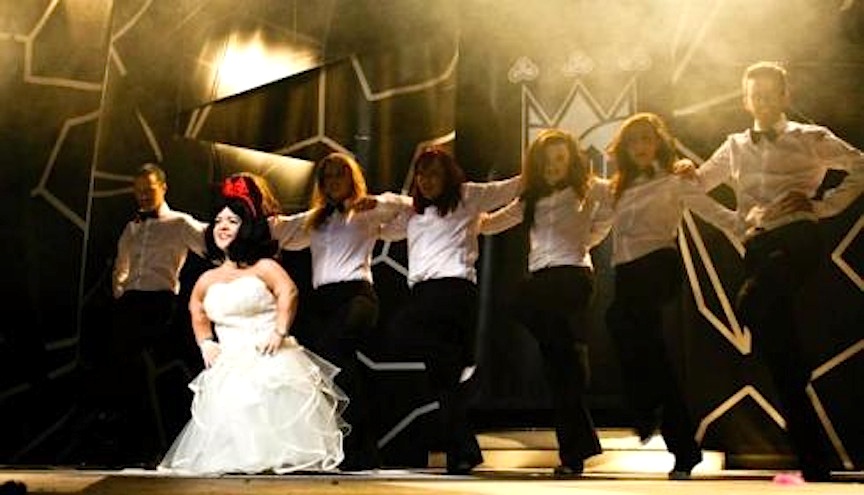
AMI has long celebrated sexual diversity, with a distinct gay sensibility and contestants of varied genders and sexualities, but the show ended this year on queerer affirmations of difference, with the crowning of Minnie Mélange, a little person who delighted the audience with her big performance, a smart subversion of the Disney fairytale of Snow White and the Seven Dwarves.
First staged on April Fool’s Day in 1987 as a fundraiser against domestic violence, Alternative Miss Ireland was revived in 1996, three years after the decriminalization of homosexuality in Ireland, as a fundraiser for AIDS charities. Since then, according to the AMI website (www.alternativemissireland.com), the event has raised over 335,000 Euros (about $433,000) for Irish HIV/AIDS organizations. This year’s closing event marked the launch of a new AIDS action website for Ireland, Get AIDS (getaids.org), intended to address the continued stigmatization and silence about HIV in Ireland.

In the years since its revival, this drag pageant has always been scheduled near St. Patrick’s Day, as if in ironic comment on the traditional (though increasingly touristy, kitschy, and commodified) versions of Irish identity on display. Indeed, although the primary appeal of the pageant seems to be the camp performances and communal celebrations of queer culture, as well as the charitable mission against HIV, an insistent subversive impulse is central to the event. Much of the mockery is aimed at traditional Irish versions of gender and sexuality, as Fintan Walsh noted in a recent issue of Irish Theatre Magazine. A lecturer in theatre at Queen Mary, University of London, Walsh writes: “Implicitly, the event mocks idealized notions of gender and sexuality which are deeply inscribed in Irish culture, particularly rigid constructions of women and morality, and iconic place-holders of virtue such as Cathleen Ní Houlihan and the Virgin Mary, not to mention commercialized competitions like the Rose of Tralee and Miss Ireland.” In addition, Walsh notes that AMI has often addressed “highly topical concerns with a frankness and immediacy” not available in mainstream cultural productions. In 2010, for example, although the winner was a more traditional drag queen, the crowd favorite was Opus Gei and the Glorious Mysteries, a wickedly smart and provocative drag act that explicitly targeted the Catholic Church for a history of institutional and sexual abuse in Ireland, which had begun to come to light in a series of devastating reports in 2009 and 2010. It implicitly targeted, as well, the media tendency to collapse homosexuality and abuse. (See my article, “The Irish Priesthood Goes Burlesque,” in the GLR’s Nov.-Dec. 2010 issue.) Befitting the end of an era, this year’s show began with a sense of nostalgia. Following a boring parade of drag queens in period costume and parasols to “Put on Your Sunday Clothes” from Hello Dolly, the show truly opened with a stunning performance by an elevated silver-clad drag queen who sang Madonna’s “Like a Virgin” in sean nós style (traditional Irish a cappella). Simultaneously hilarious and haunting, the performance captured the show’s appeals to and subversions of traditional culture, as well as the cultural nostalgia subtending this year’s event. It was a moment that drew on Poorhouse, a series of queer “trad nights” held last year in Dublin’s Pantibar—a club night that, as the Irish Times put it, “puts the gay into Gaeilgeoir” (i.e., an Irish language speaker). Originally a series of house parties hosted by Dónal Mulligan and Adam Doherty, Poorhouse migrated to the club with the tagline, “We’re gonna party like it’s 1845,” a snarky evocation of the Famine years as well as a comment on the current economic crisis. Poorhouse evenings were both nostalgic and camp, with sean nós versions of Madonna, risqué Irish language exams, and a growing crowd of young men showing up with their fiddles and pipes, ready to perform traditional music in this most untraditional of spaces, a gay bar. As Mulligan, a young lecturer in new media at Dublin City University, describes it, Poorhouse was “a fusion of a country up-bringing [with]drag and tongue-in-cheek performances” drawn from Dublin gay culture. Mulligan, also the creator of Opus Gei, was back for AMI this year with a similarly nostalgic act: Lughnasaigh (pronounced “lunacy”), a name evoking the Irish harvest festival, Lughnasa (and its titular solar deity, Lugh). He says the name was intended to suggest old Irish myth, but the act centered on the “empowering femininity” of an Irish warrior queen. “We wanted to represent the return of this ancient warrior queen model as a figure who might bring us out of the stupor and depression of imf-ecb post-bailout post-having-any-national-pride Ireland,” he explained. The act, which won first runner-up, combined Irish tri-color costuming with scantily clad boys and cheerleader lifts, and gay classic anthems with traditional Irish music. Lughnasaigh opened with a voiceover from the 1990 inaugural speech of Mary Robinson, Ireland’s first female president. (Her chant of “Come dance with me in Ireland” was a 14th-century poem adapted by W. B. Yeats). The final performance ended with the Pet Shop Boys’ version of “Go West,” suggesting a return to the traditional Irish culture associated with the west of Ireland, as the bare-chested Celtic warriors planted the Irish flag, Iwo Jima style. But the winner for the evening—both for the judges and the audience—was Minnie Mélange, the stage name for Sinéad De Burca. “Once upon a time, in a land far away, lived a little girl, who wasn’t actually gay,” said an announcer as the lights came up on an abnormally tall woman. But as the seven “dwarves” danced onstage and her skirt was tugged down to reveal 3’5” Minnie on a platform, he continued: “But why did she enter, I hear you all say. Is she alternative? Why yes—she was born this way!” And when she began to dance with her suddenly taller “dwarves” to Lady Gaga’s “Born This Way,” the crowd erupted in cheers. De Burca’s performance added a new valence to Walsh’s claim that AMI subverts idealized and normative notions of gender and sexuality. As De Burca notes on her blog, contestants in the annual Miss Ireland Pageant must fit a height requirement: “Contestants shall not be less than a minimum height of 5 ft 7 inches in stocking feet.” “In order to be deemed as a beauty,” she remarks, you have to fit the size requirement. But not at AMI. AMI promotional literature insists, “At AMI there are no boundaries of beauty, gender, creativity or even taste.” Minnie’s costume was an explicit echo of Disney’s Snow White, and following the fairy-tale script, her first act (the daywear section of the pageant) ended with a wicked queen (De Burca’s mother) handing her a poisoned apple. To the tune of Nina Simone’s “I Put a Spell on You,” she took a bite, collapsed, and her “dwarves” carried her offstage. When Minnie was asked why she entered—during the interview-swimwear portion of the pageant (in which she appeared in a Madonna-esque cone bustier)—she said that as a little girl she always wondered why Snow White had to be a tall person, and that she hoped Dublin wondered that, too. In her last act (evening wear), a little Prince Charming (De Burca’s own father) kissed the sleeping beauty, bringing her back to life for a rousing medley of One Direction’s “What Makes You Beautiful,” Rihanna’s “We Found Love,” and the Black Eyed Peas’ “I Gotta Feelin’.” It was stirring and “One of the great things about this year’s competition is that it wasn’t won by a gay man in drag,” Fintan Walsh recently said in an email, “nor did it focus on issues around Irish stereotypes, religion or necessarily a sexual morality. Minnie Mélange’s performance was about an affirmation of difference in a very queer rather than gay way, and I think that was a really interesting point for the competition to end on.” So one of Dublin’s most important gay institutions has ended on a very queer note—expanding the celebration of difference and diversity by crowning as the last high queen of Alternative Miss Ireland a little woman. Author’s Note: Thanks to Sinéad De Burca, Dónal Mulligan, Gary O’Toole, Fintan Walsh, and Tonie Walsh for their assistance. Sources for this article include: Irish Times (3/3/11); Film, Fashion & Pop Culture (4/8/12); and Irish Theatre Magazine (2/21/12). Ed Madden is an associate professor of English at the University of South Carolina and author of Prodigal: Variations
powerful. , his second collection of poetry.