

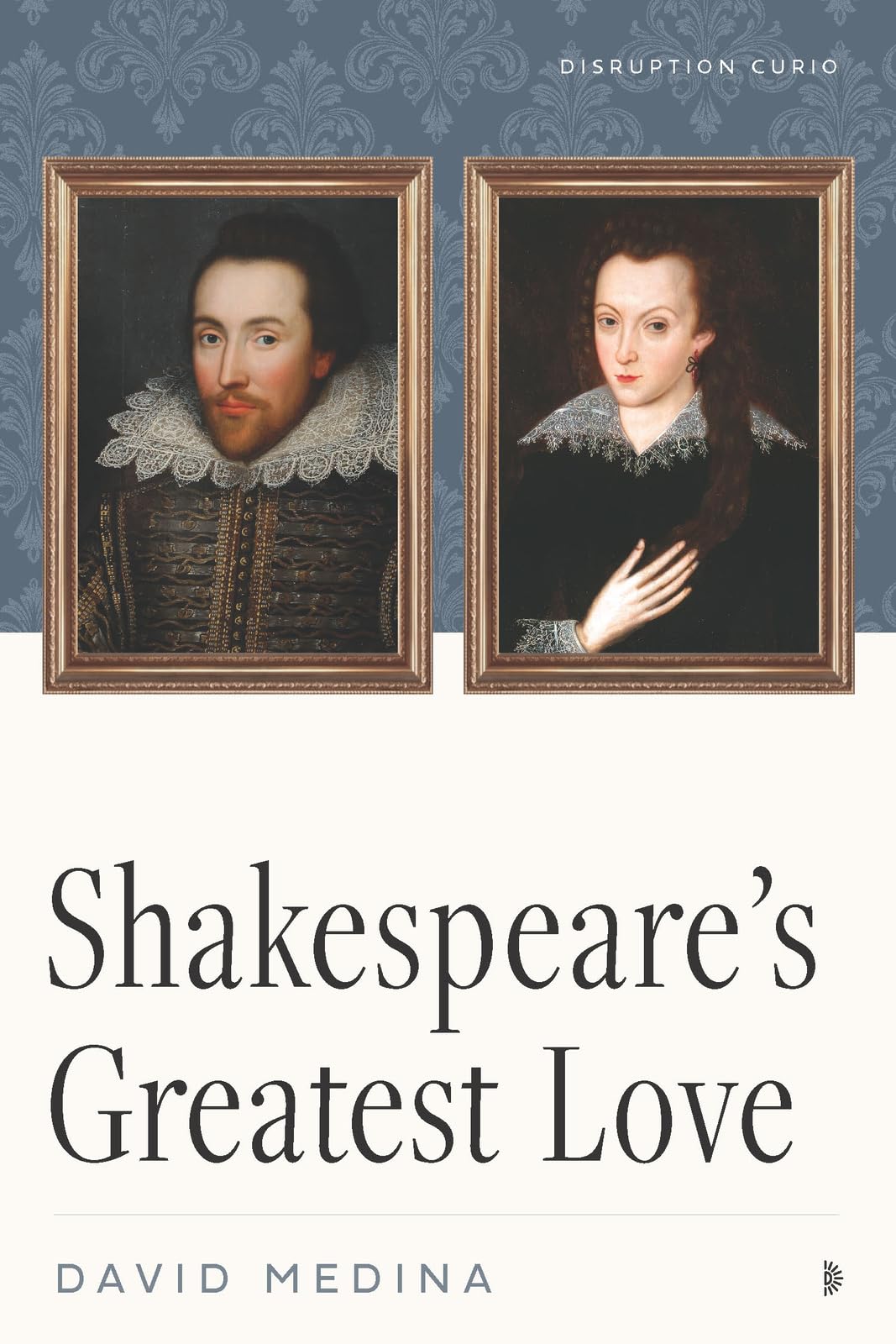
SHAKESPEARE’S GREATEST LOVE
by David Medina
Disruption Books. 128 pages, $14.99
DAVID MEDINA’S Shakespeare’s Greatest Love is a brief but forceful book arguing that William Shakespeare and Henry Wriothesley, Earl of Southampton, were lovers, and that Southampton inspired some of Shakespeare’s works. Medina, who has long worked in the Washington, D.C., political arena, wanted to explore this little-known figure after learning that Shakespeare dedicated two narrative poems to Southampton and may have written many of his sonnets about the young man. This book, his first, challenges the general view among Shakespeare experts that not enough evidence exists to authenticate Shakespeare and Southampton’s romantic relationship, as well as the persistent tradition of denying Shakespeare’s homosexual inclinations.
Southampton was a colorful character. Born to an extremely wealthy aristocratic family, after his father died the boy’s guardian became William Cecil, Queen Elizabeth’s advisor. Intelligent, well-educated, and rebellious, he consistently rejected Cecil’s attempts to marry him off to his (Cecil’s) granddaughter, even paying a large fine as punishment after he reached adulthood. He later married one of Queen Elizabeth’s maids of honor after she became pregnant, forcing the queen to imprison him for this offense. After several other setbacks, he joined a group of nobles attempting to overthrow the queen, having paid Shakespeare’s company to perform Richard II, featuring a monarch who abdicates. Southampton was imprisoned again for this portrayal and only released when James I became king.
 The book draws extensively on literary and historical analysis to make its case, suggesting that Shakespeare and Southampton met at a London theater when the earl was seventeen and the playwright 27. Because “English society … actively encouraged the development of strong bonds between boys and men,” these men of different backgrounds, ages, and classes could become intimately acquainted. In Venus and Adonis and the “Fair Youth” sonnets, Shakespeare uses phrases and images that strongly evoke Southampton, such as “brilliant eyes,” “youth,” and “rose” (the main element in the city of Southampton’s coat of arms).
The first few sonnets could have been a playfully erotic response to “Narcissus,” a poem that William Cecil sponsored to encourage Southampton to marry and have heirs. The younger man may have enjoyed Shakespeare’s homoerotic wordplay with its ostensibly similar advice. Shakespeare also commented on their relationship by putting Southampton into two plays, argues Medina. In The Merchant of Venice, Southampton is Bassanio, whose love for Antonio (Shakespeare) remains strong even though he marries Portia. All’s Well That Ends Well has Southampton as Bertram, refusing to marry Helena (Shakespeare) unless she fulfills near-impossible tasks.
Southampton handsomely rewarded Shakespeare, letting the playwright live with him when the plague closed down London theaters and gifting Shakespeare an enormous sum of money, which he used to become part owner of the Lord Chamberlain’s Men, create a family coat of arms, and buy a large home in Stratford for his family. Southampton also made Shakespeare a political appointee during James I’s entry into London and commissioned a portrait of the playwright.
The book is carefully researched, with many endnotes and some curious details. At the start of his career, Shakespeare wore lavish clothes donated by aristocrats to their favorite companies, but did so only in the theater. Medina notes that his brothers remained lifelong bachelors. Some details, like the layout of the house that Shakespeare grew up in, feel unnecessary. And despite all of the evidence presented, speculation continues, with much use of “probably,” “perhaps,” and “might have.” There is little discussion of the traditional patron-artist relationship, which might reveal a more transactional association between Shakespeare and Southampton. Still, such a bold defense of Shakespeare’s same-sex love feels exciting when so many specialists continue to reject or qualify this claim.
Charles Green is a writer based in Annapolis, Maryland.



