

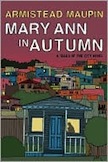
Mary Ann in Autumn: A Tales of the City Novel
by Armistead Maupin
HarperCollins. 289 pages, $25.99
THREE YEARS AGO, with his novel Michael Tolliver Lives, Armistead Maupin returned to his much-admired “Tales of the City” series after a nearly twenty-year hiatus. It was a welcome homecoming for Maupin’s many fans, who know the Tales through the original San Francisco Chronicle serials or through the books they became. (Many have also seen the “Tales”-based TV miniseries.) Told in the first person, Michael Tolliver Lives reunites readers with Tolliver, who, twenty years on, has emerged as an AIDS survivor, settled into San Francisco’s Castro neighborhood with a steady job as a landscaper, and renewed ties with former 28 Barbary Lane residents, made new friends, and found romance.

In the latest novel in the series, Mary Ann in Autumn, Maupin picks up the story of Mary Ann Singleton, whose impulsive move from Cleveland to San Francisco began the series and who is arguably its central character. He also returns to the third-person point of view, as well as to the fast-moving, quick-chapter narrative that hearkens back to the story’s serial beginnings. To those who have followed “Tales of the City” from the beginning and count themselves as contemporaries of Michael “Mouse” Tolliver and Mary Ann, there’s a poignancy to the portraits of these aging Baby Boomers. Both are now gray and have health issues, and both share a lot of dear departed friends. They also have loose ends to tie up. Mary Ann Lives opens with the title character returning to the city and to 28 Barbary Lane, her first San Francisco address. It’s a bittersweet moment. As she stands in front of those wooden steps, she reflects, “She had climbed [them]—what?—thousands of times before, and there wasn’t a hint of homecoming, nothing to take her back to where she used to be. The past doesn’t catch up with us, she thought. It escapes from us.” Mary Ann has much on her mind. She’s fleeing a failed marriage, and she has other business to handle (planned and unplanned) that reveals itself, in Maupin’s characteristically surprising plot turns, as the novel progresses. Michael and his much younger husband Ben live in the Castro, ensconced in a house on a hill, with a dog, and a spare guest-cottage that soon becomes Mary Ann’s new home. As in his earlier novels, Maupin seems to relish using his fictional San Francisco to champion those “San Francisco values” that often seem at odds with the rest of the country. In his earlier incarnation, in the 1970’s, Michael had railed against the hypocrisies of Anita Bryant’s “Save the Children” campaign. Older, settled, and married, Michael now decries Prop 8, the California law that outlawed gay marriage. As comfortably domestic as Michael and Ben appear to be, their marriage is anything but traditional. They dutifully cruise for one another, each one pointing out specimens they know the other will find attractive. Theirs is an open relationship, with Ben (more than Michael) having occasional dalliances with other men. As Mary Ann learns more about their arrangement, she’s both uncomfortable and intrigued. Michael Tolliver lives, Mary Ann Singleton lives, and so does Anna Madrigal, the beloved former landlady, and matronly guardian, of 28 Barbary Lane. Now in her eighties, Madrigal (as we first learn in Michael Tolliver Lives) has now established herself in an apartment off Duboce Park, watched over by Michael’s business partner Jake Greenleaf, an FTM trans man introduced in the previous novel. Just as Michael had to reconcile himself with Mrs. Madrigal in the last novel, so too does the prodigal Mary Ann. She burned, or at least scorched, a lot of bridges with her hasty retreat from San Francisco twenty-some years ago, so she has a lot of unfinished business to attend to. This includes her daughter Shawna, whom she adopted with her former husband and former Barbary Lane neighbor, Brian Hawkins. There’s much more to the story, of course. In this latest novel and its predecessor, Maupin has resurrected the “Tales” series lovingly and skillfully. The surviving principal players have come a long way from 28 Barbary Lane and the San Francisco of 35 years ago. They’re on Facebook. Some of them have children. And with each new chapter, they come to terms with one more ghost from the past and one more challenge of the here and now. Like Michael Tolliver Lives, Mary Ann in Autumn is intended as a stand-alone novel, and Maupin dutifully includes succinct background summaries for each old character he reintroduces. Still, it’s hard to imagine enjoying this novel as much without the experience of having traveled with these characters from the beginning. Tales of the City is our gay epic, our soap opera, and for many of the books’ devoted fans, these characters feel like old friends. Most of the surviving old names and faces are back. (Maupin even includes a reference to Gabriel Noone, his fictional alter ego from The Night Listener (2000), thus advancing the crossover he started by having Anna, DeDe Halcyon-Wilson’s daughter, appear in The Night Listener.) As in the other books in the series, Maupin weaves his menagerie of characters and multiple story lines into a novel that turns on sometimes audacious plot twists and coincidences, draws heavily on nostalgia and local color, and is thoroughly enjoyable. Jim Nawrocki is a freelance writer based in San Francisco.