
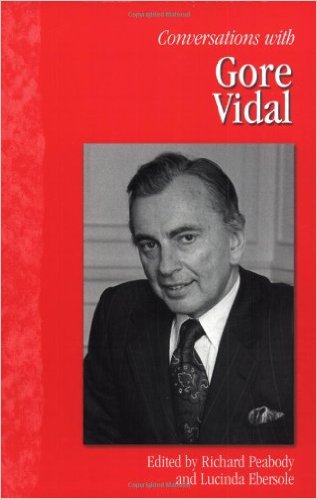
Conversations with Gore Vidal
Edited by Richard Peabody and Lucinda Ebersole
University Press of Mississippi
196 pages, $20.
LOVABLE, unlovable, wicked, vain, altruistic, egomaniacal, funny—all of these describe Vidal in the interviews he’s given over the years. The years go from 1960 to 2003, the final being Amy Goodman’s politically astute interview about post-9/11 America, originally published in Democracy Now. Most of the interviews include prologues that describe where and how Vidal was living at the time. In 1974, for instance, Gerald Clark (in The Paris Review) describes Vidal as living “in a run-down penthouse with plants that need watering.” Clark reports that at the relatively young age of fifty Vidal is already hanging it up: he writes that he’s deteriorating physically and watches that fact “with fascination.” In a 1984 interview, Charles Ruas (in Conversations with American Writers) describes Vidal as “slightly heavier than he appears in person” but goes on to praise his “straight thin nose and firm jaw line.” By 1988, all references to his physical appearance have ceased.

Along with the missing references to physical appearance, the later interviews do not recount the story of The City and the Pillar, Vidal’s upbringing in Washington, or his friendship with Anaïs Nin, facts that have been cemented so deeply into the Vidal canon that even “illiterates” can tell you a thing or two about them. The interviews in The Transatlantic Review (1960) and The Paris Review (1974) concentrate on Vidal’s first works and his treatment by The New York Times after the publication of The City and the Pillar. Twenty years after Times reviewer Orwell Prescott says he’ll never review another book by Vidal, Vidal is still talking about the incident even though the passage of time has withered his complaint to a small aside. Fans of Vidal who use the word gay as a noun rather than as an adjective may remember a famous conversation in an issue of Fag Rag in 1974. (An almost equally famous Gay Sunshine interview is strangely absent from this collection.) In the Fag Rag interview Vidal calls Truman Capote “a Republican housewife from Kansas with all the prejudices,” and describes Norman Mailer as “a VFW commander in Schenectady.” This was the era of the big literary feuds, when Vidal would declare that Dotson Rader (author of Blood Dues) “is a real cunt.” In the Fag Rag interview, Vidal also gets his history wrong when he says that André Gide “had no children.” (He had a daughter.) There’s lots of slicing and dicing the word “gay” in several early interviews: “I’ve always said that that word was just an adjective. It’s not a noun, though it’s always used as a noun.” On the other hand: “I have never allowed actively in my life the word ‘gay’ to pass my lips.” These quotes were analyzed ad nauseum back then. Ever the iconoclast, Vidal has always relished getting a rise out of people. Whether the subject is Hemingway on writing and sexual continence or the sexual attitudes of the American working class in the Bible Belt—“They’re filled with terrible passion and prejudice, but give them a sexual act to perform … and there’s nobody who’s not available”—Vidal’s picturesque sound bites could form their own Bartlett’s Familiar Quotations. Still, when Vidal tells Fag Rag that the more sexually active he is, the better he writes, some may be led to ponder the peculiarity of his long-term, chaste relationship with Howard Austen, as well as the fact that for many years, by his own admission, he had little or no sex life at all. Ironically, this voluntary “celibacy” corresponds to some of his finest work. (Could cynical old Gore really be giving tacit credence to Hemingway’s philosophy of sexual continence?) But sex and talk about sex are only a small part of these interviews. In “In America,” he tells Gerald Clark that “the race goes to the loud, the solemn, the hustler. If you think you’re a great writer, you must say that you are. Some will disagree, of course, but at least everyone will know that you are serious about your work. Speak of yourself with the slightest irony, self-deprecation, and you will be thought frivolous—perhaps even a bad person.” Many times throughout these interviews Vidal claims that the novel is dead and then goes on to blame college English courses for killing literature for the reading public. “Books are made a duty. Imagine teaching novels! Novels used to be written simply to read. It was assumed until recently that there was a direct connection between writer and reader. Now that connection is being mediated—bugged?—by English departments.” There are even more dour pronouncements, like his confession that he’s glad he won’t be around in the future writing books because “nobody will be able to read them.” About writing in general Vidal says that for him the act is kind of “an eraser.” “I know nothing about the fourth century now, but when I wrote Julian I did. A kind of mental erasure takes place. That’s why writing is also therapeutic. You can get rid of things.” In Jan Kaper’s “Dialogue on Film” interview, Vidal rips into film and stage directors. “I call the directors plagiarists because they, literally, steal the scripts,” he says. “Once the script is acquired, they bring in a second writer in order to confuse authorship, so, just to make it tidy, they say ‘Well, I guess I’ll take the credit.’” And he insists that “the director is even more useless in the theater than in movies,” only to do a U-turn and say that exceptions like Elia Kazan exist because he has the ability to “make the actor fall in love with him.” One might divide Vidal’s career into two parts, the fiction writing era and the United States of Amnesia phase, or Vidal’s plunge into everything political. Certainly his nonfiction critiques of the Bush administration and post-9/11 America constitute some of his strongest writing ever. Myra Breckenridge seems truly frivolous compared to the essays in Dreaming War or even in the massive United States, the author’s collection of essays, many of them political. Although a master of the historical novel, Vidal is best when he is not waxing imaginative but turning his radar on the business of government and social and cultural issues at large. The interview with Larry Kramer is predictably feisty, notably when Kramer takes Vidal to task for his fabled adjective-not-a-noun comment. The book’s final interview, with Amy Goodman, in which Vidal talks about his book, Perpetual War for Perpetual Peace and examines post-9/11 America, wastes no time identifying what’s at stake for all of us at this time in history. “The United States is not a normal country. We are a homeland now under military surveillance and military control,” he says. It gets worse, and scarier, from here. Thom Nickels, architecture writer for Philadelphia’s Metro newspaper, is the author of two recently published books, Out in History and Philadelphia Architecture
.