
A bimonthly magazine of
history, culture and politics.

Lillian Faderman Tells the Gay Story to Date
Padlock IconThis is a premium subscriber article. If you are already a premium subscriber and are not seeing all of the article, please login. If you are not a premium subscriber, please subscribe for access to all of our content.

0
Published in: September-October 2015 issue.


HISTORIAN Lillian Faderman is an LGBT culture hero who has won several lifetime achievement awards for her groundbreaking scholarship in LGBT history. Her most recent books are Gay L.A. (2006), co-authored with Stuart Timmons, and two memoirs, Naked in the Promised Land (2003) Fadermanand My Mother’s Wars. Two of her earlier books, Surpassing the Love of Men (1981) and Odd Girls and Twilight Lovers (1991), were named “Notable Books of the Year” by The New York Times.
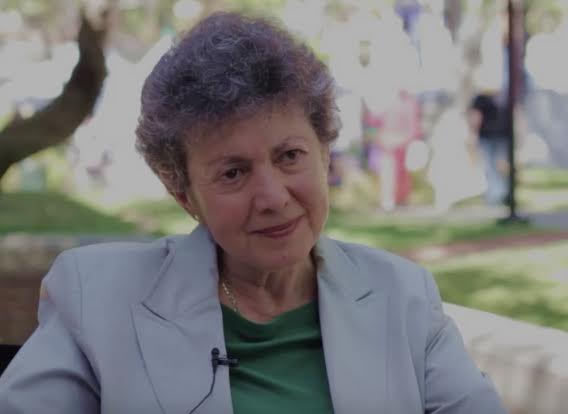
         Faderman has outdone herself in her new book of history, The Gay Revolution: The Story of the Struggle, just published by Simon & Schuster. The book tells the story of the past 65 years of our “gay revolution,” starting in the 1950s and bringing it right up to breaking news in May of this year. In addition to extensive archival research, she conducted 150 interviews to produce an 800-page book that’s undoubtedly the most complete and authoritative of its kind ever published.

         I interviewed Lillian Faderman by phone and e-mail in June.

 

Mary Meriam: How many years did it take to write The Gay Revolution and what was the biggest challenge?

Lillian Faderman: It feels like this has been my life’s work. I’ve been collecting material on our history since the 1970s, and I mined a lot of it for my other books. But for this book I wanted to present history as personal stories and group stories that would show the drama of the hard-fought battles for LGBT civil rights. So over a period of four years, I spent a lot of time in archives, finding letters and all sorts of documents that told important stories that hadn’t been told before. And I interviewed more than 150 people. Some of them had been leaders in the various movements—homophile, gay, lesbian-feminist, gay-and-lesbian, LGBT, and so on; and some had just lived through the history and had revealing and riveting personal stories to tell. So, for example, I interviewed people who in the mid-20th century had been committed to mental institutions and given shock therapy or had been hounded out of their jobs because they were homosexual. I interviewed people who helped start homophile organizations to begin to fight back against such treatment. I interviewed people who rioted or staged zaps to protest injustices to the LGBT community, and people who fought the government in the courts or got elected to public office so they could fix those injustices.

I think the biggest challenge has been to make this a book that tells the story of the whole struggle—not just as it was fought on the East and West Coasts, not just as it was fought by radicals or by mainstreamers, or by gay men or white people; but the story of how an incredibly diverse group of individuals—who often had little in common but sexual orientation or gender identity—managed to bring about the remarkable changes that transformed us from pariah status to a status that finally begins to approach first-class American citizenship.


MM: Why do you call the book the “gay” revolution?

LF: It was a challenge to settle on a historically valid adjective. I was able to trace the popular underground use of the word “gay” for a diverse community way back to the beginning of the 20th century. For example, Gertrude Stein used “gay” to describe lesbians in her 1908 story, “Miss Furr and Miss Skeene.” Up to the 1970s, when lesbian feminists reclaimed the word “lesbian,” and the 1990s, when trans people began describing themselves as “transgender” and young people began calling themselves “queer,” “gay” was the preferred underground term for all of us who were sexual or gender “outlaws.” The world outside called us “homosexual” or “invert” or “lesbian” or “queer” (all terms that were meant as insults), but “gay” was the word most of us used among ourselves. LGBT is a relatively recent term—and now it’s becoming dated in favor of lgbtq or lgbtqqiaap, or even no term at all to express sexual or gender “fluidity.”


MM: How is The Gay Revolution different from other LGBT history books, and why did you write it?

LF: I think there have been many wonderful LGBT history books, but most of them have focused on a particular period, or a particular aspect of our history, or a particular city in which that history happened. I wanted to write a sweeping history: one that began in the mid-20th century, when things were as bad as could be, and went all the way up to the present, when the president of the United States supports us publicly, and the laws that made our lives miserable are being struck down all over the country.

I wrote this book for the same reason I generally write a book: I’m interested in finding the answer to a question. In this case, it’s the question I ask at the beginning of the book. First I present the story of a much-loved professor at the University of Missouri who was brutally shamed and fired from his job in 1948 after being accused of sodomy, and then I present the story of a woman in 2012 who was promoted to brigadier general in a public ceremony in which her wife pinned the general’s star on her epaulet. The question is: how did America change from a country in which Professor E. K. Johnston was destroyed because of his sexuality to one in which General Tammy Smith’s sexuality is considered irrelevant by the Department of Defense? The story of that transformation is what the book is about.


MM: Is the “gay revolution” over?

LF: Despite all the victories we’ve had in recent years, there’s still work to be done. In the mid-1970s, Congressmembers Bella Abzug and Ed Koch tried twice to get a sweeping federal gay rights bill passed, but they couldn’t get traction. Senator Ted Kennedy tried in vain for decades to get ENDA—the Employment Non-Discrimination Act—passed, but we still don’t have a federal law. And the Right continues to invent outrageous ploys, such as the so-called “Religious Freedom Restoration Act” that would, for example, allow wedding-cake bakers or gown-makers to refuse service for a same-sex wedding if their religion frowned on such unions. Fortunately, there was such an uproar in Indiana and Arkansas last spring when their legislators passed such laws that the two states’ governors had to back down. But just as the Right will keep trying to hurt us, we’ll keep fighting them—and as polls are showing, we no longer have to fight alone. The majority of America seems to have come over to our side.


Mary Meriam’s latest book is Lady of the Moon.

Share