

A bimonthly magazine of
history, culture and politics.

Reflections on Martin Cox’ Dying Hulks
Padlock IconThis is a premium subscriber article. If you are already a premium subscriber and are not seeing all of the article, please login. If you are not a premium subscriber, please subscribe for access to all of our content.

0
Published in: May-June 2013 issue.


I’M LOOKING at 25 photographs of retired, wrecked masters of the sea, ocean liners laid up and languishing in disuse and decay. These photographs, from Stranded: The Twilight of the Ocean Liner: Photographs by Martin Cox, at the Los Angeles Maritime Museum, illustrate the reverse velocity of technology, steely in these old ships which, like us, are only as good as their last crossing. As an act of honor and salvation, from 2000 to 2005 Martin Cox traveled to various ports in the U.S., Canada, China, and the Philippines during the time when these ships from the middle of the past century were being cut adrift. They had fascinated him as a child growing up in Southampton, England. Here he gives us the titans of his youth, tethered at their final destination.

One might expect that Cox, now living with his husband in Los Angeles, would train his camera, at least occasionally, on the sailor and not the ship. But that has not been the case. Past projects focused on the slow death of the Salton Sea, the visible beauty and submerged decay of Echo Park, and the surfaces of various California lakes, as well as the lush, obscure waterways of his native England. Water, its lack or excess, is a constant.

Cox treats his mechanical, metal subjects as a portrait painter, finding details that define their character. We usually view such enormous ships in their entirety, the master-shot orientation common in tributes. Cox shoots his subjects from a variety of angles: close-ups followed by shots giving us the ocean liner as horizon, or, as in Evening at Sea/SS Independence at 12 Knots, from the point-of-view of the ship itself. Cox provides the eyes, insinuating himself into the ship’s structure.

In Stranded Liners on the Beach, Alang, India/Former Liners SS Argentina and SS Ivernia, two ships wait to be recycled into rebar. Motionless, like exhausted prisoners or immigrants waiting at a gate for a god who will take them into the depths they once skimmed. Would this be so poignant if we hadn’t read the title? The exhibition has established the context of our looking; as grand as these old things may appear, this is the end.

In View From A Dead Ship II/Alang India, we look through the window of the former SS Ivernia at the SS Argentina lurking nearby. Seen through a dirty window, framed in black like a letterboxed movie, is the hazy ghost of the other ship. Were these two old dames docked to keep each other company, or as rivals to engage in mocking banter, aiding in their own destruction? These photographs recognize the drama of looking at a once-grand subject, its veneer of respectability now under water. We look at these photos as if in a morgue.

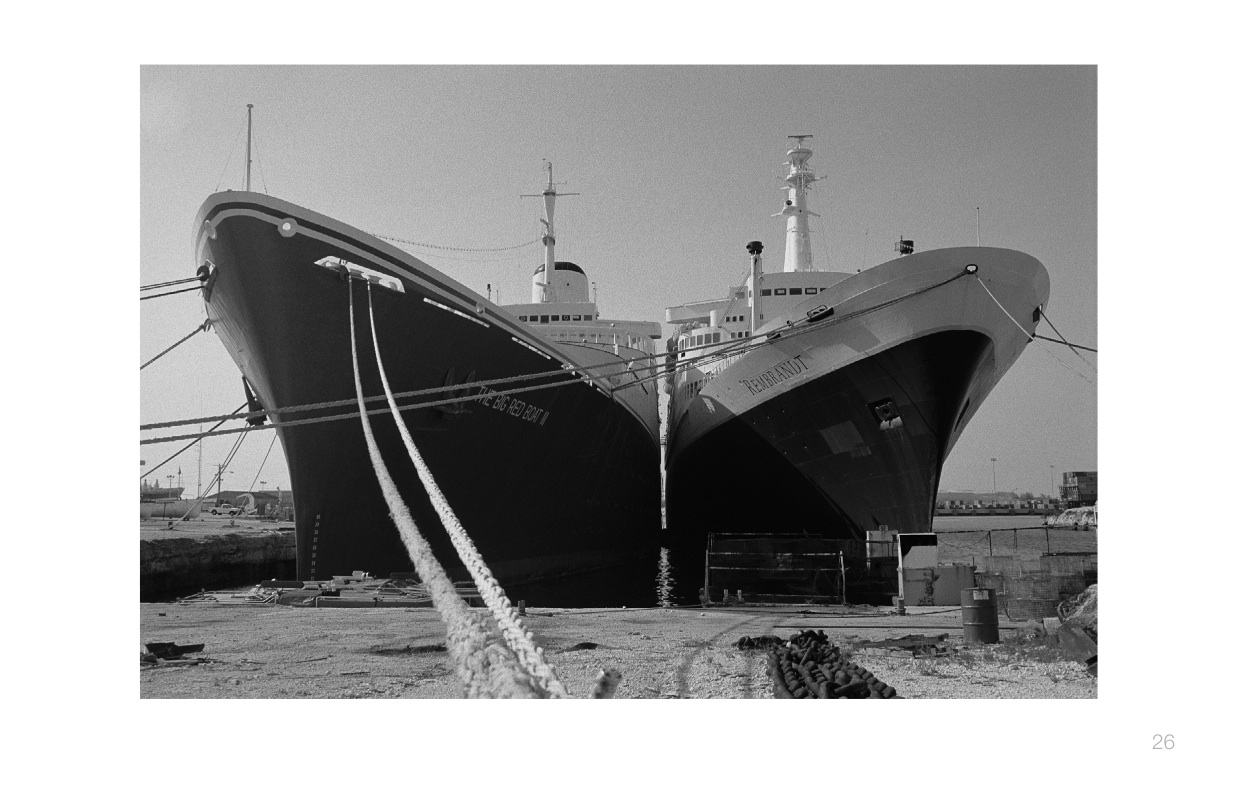
Photo: Laid up liners, Freeport, Bahamas/ Former RMS Transvaal Castle and SS Rotterdam

In Porthole off Hawaii/SS Independence, the vastness of the ocean is framed by a modernist design detail. Unusual for the series, this photograph provides no clue of the subject’s current status; we could have just settled into our stateroom, circa 1950. Are we moving? What’s the destination? The beautiful composition of this close-up creates a formalist portrait of shapes, a distillation of another era’s design, the only uncontrolled element being the ocean, filling three-fourths of the window. But this ship is not sinking—yet.

In Ocean Bows II/SS Oceanic and Queen Elizabeth 2, Bahamas, we see two grand ships, shot in profile, at port but with a regally appropriate gulf between them. Yet Cox shoots Laid Up Liners, Freeport, Bahamas/Former RMS Transvaal Castle and SS Rotterdam docked and tethered dangerously close, angling away like friends too embarrassed to share the shame of their change of station. Once portraits of power, they are now porters of loss. Resembling two enslaved camels or elephants, they are waiting to be made into scrap. But at this moment, shot from below, they still have their faces.

I’m at this exhibition a few weeks after Hurricane Sandy reminded us that triumphs over the ocean are not as secure as we hoped. The sea spits, gulps, swallows. A hurricane moves quickly and violently, while these solemn portraits show the slow sinking gravity of decay. Weather may batter and bash, but economics and fashion submit to entropy. Static locations of luxury and leisure may be dramatically wrecked in a hurricane, but in this show there is no disaster, no climax, only the slow taunt of time. These ships are secure in their final harbor, a hospice offering no future.

In Private Party, Mobile, Alabama/Copa Casino, Former SS Ryndam, the horizontal composition makes it seem as if we’re viewing this almost empty set through the slot of a door, the glowing windows projecting white spots on the stripped floor, the ghosts of those who might have danced and drunk at the “Private Party” announced by a forlorn sign. That party would now be what the title of another photograph hints at: Wake, Hawaii/SS Independence suggests a body being given a wake, truly a burial at sea. We are not simply glancing rearward at the wake caused by a ship while still seaworthy, but projecting into its demise.

One of the most astonishing shots, Sinking Cinema, Mobile, Alabama/Copa Casino, Former SS Ryndam, Flooding shows, in another wide shot, the ship’s screening room canting to the right, moments before the liner sank. The dark water fills from the bottom of the frame, pushing out the light, a post-3D action picture, Titanic coming at you. Where is the photographer? Did he shoot this standing in front of the screen? Was he sinking too? Are we seeing cinema from the point of view of a movie?

Laid up liners, Freeport, Bahamas/ Former RMS Transvaal Castle and SS Rotterdam

It seems that chairs are the last things left behind when the lights go out. Many of these interior shots—of abandoned ballrooms, decks, and hallways—feature chairs as body doubles for the humans who once wandered through these spaces, most of them presumably on holiday. In one shot, The Verandah with Two Chairs, Tampa, Florida/Former MV Gripsholm, one of the two chairs in the foreground gets its own follow spot, highlighting the snazzy stripes of its upholstery; but even that treatment can’t tart up the decayed surroundings. Here’s a picture of faded stars, the shoot long over and the set dressing naked again. Your party has departed.

Many of the photographs emphasize the recycling process. Repurposed, renamed, their elements are reconfigured in a re-use that our electronic age tends to avoid. Could we humans, after fifty years of service, change our name, our purpose, our nationality? These ships represent, perhaps, the middle-aged, struggling to adjust to changing contexts. In Forward Smoking Room. Tampa, Florida/MV Gripsholm, Swedish lounge chairs are piled like corpses in a room stripped of its ceiling, a hose snaking along the floor indicating a fire where once smoke curled. The photograph is brutal and yet beautiful in its concision, filtered through compassion. And in the background, glowing windows.

Cox memorializes without sentimentality. He finds the sense under the sentiment. He does what few contemporary photographers do: looks under the skin, under the metal carapace, for a history and context. He studies before he shoots, and that respect allows the subject to reveal something unseen by others. Cox’s photographs are assertively not snapshots or “captures,” but studies, visions requiring time and sympathy.

I am not looking at these memorials alone. I’m with my partner of thirty years, also a photographer. When I look at recent photos of the two of us, I wonder if we aren’t also two regal wrecks, stiffening our spines to retain or regain our dignity and sex appeal, worrying if we’ll remain current and whether some kind of radical rehab is required. Our parents are dead or ailing, and our own generation has begun glancing around for the wrecking ball. Social media prompt friends to post photos of us “back in the day,” and the well-intentioned responses to past-tense prettiness suggest that we might want to sink back in satisfied memory. But something about the postmodern era we live in resists that; we’re only as good as we are right now.

Martin Cox’s photos are of ships that are stranded, quite literally, for demolition, but they are also stranded through changes making them obsolete. Their context has changed: the world sailing on to something newer, something more now. And so, in our moments of gloom, with us, two men in our fifties who struggle with the transition from analog to digital, from the perfect moment or well-crafted thought to the constant snapping and chat of the wireless and tireless and far too often tedious.

This show’s photographs reveal not so much the awfulness of the subjects’ decay as the magnificent, if mournful, beauty of monochrome. By shooting these liners in black and white, Cox seems to have given them a chance at controlling their own image, the tonality of the photos signifying age, yet also dignity and control. I too look much better these days in black and white, with carefully filtered light. I can only hope that when I am laid up and disassembled, a photographer with such sensibilities will pay his last respects. I appreciate the publicity shot, the grand pose, yet also want to lean in and examine the more subtle damage and decay. Cox’s photographs honor, before moving in for the reveal.

The one time I crossed the ocean on one of these ships was my partner’s fiftieth birthday present to me. We were on the QE 2’s final regularly scheduled crossing from Southampton to New York. At first I didn’t understand the subtle drama of being at sea, between points, not in one place or another but in a void. As the days passed, the menu of distractions—the meals, the pools, the bars, the lectures—seemed excessive when, alone on the deck, I gazed at the sea and nothing else. I was allowed at such moments to be truly adrift in this openness, this emptiness.

And so these two mid-century-born humans, my partner and I, in the midst of their personal century, are wondering just how many seas they might sail in the future. And always the fear: will there be more in the rear-view mirror than off the bow? And will our snapshots of ourselves do us justice, as these photographs of old liners do?


At the Los Angeles Maritime Museum, San Pedro, CA, June 16, 2012-January 6, 2013.


Jeff McMahon, a writer and performer, is associate professor at the School of Theatre and Film at Arizona State University.

Share