
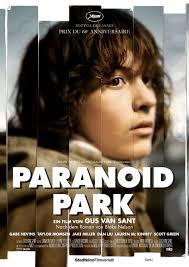
Paranoid Park
Directed by Gus Van Sant
MK2 Productions
Meno Films
Centre National de la
Cinématographie
IN AS MUCH AS the teenage boy at the heart of Gus Van Sant’s new film has nothing funny or articulate to say, Paranoid Park may become this year’s anti-Juno. Lacking the sharp tongue of Juno MacGuff (America’s favorite teenage mom), Van Sant’s Alex keeps a low profile as he skates between his broken home and high school, between his girlfriend Jennifer’s house and the teen-infested skating parks of Portland, Oregon. Jennifer tends to ambush Alex at his locker to complain that he spends too much time with his buddy Jared and too little time with her. Later, he’s dared by another skater (also in search of the perfect half-pipe) to step inside the much mythologized “Paranoid Park.” Van Sant, showing his Pasolini-esque fascination with the urban underbelly, steers Alex swiftly toward the dark side once he gets Paranoid on his mind.

An innocent attempt to bond with an older boy goes horribly awry when the pair jump aboard a freight train in search of beer. A security guard spots them, and when he swings at them with his nightstick, Alex strikes back. The man falls fatally into the path of an oncoming train. There’s blood on the tracks and Alex’s victim struggles like a severed centipede. The “friend” flees, and Alex tosses his board (now a murder weapon) off a bridge and returns home to trashbag his clothes and shower. The screenplay, also by Van Sant (adapted from Blake Nelson’s 2006 novel), follows Alex as he secretly reads about the investigation in the Portland papers and manages to elude a suspicious homicide detective. After a friend encourages him to unburden himself into a journal, Alex does so like a teenage Raskalnikov, but in the end sets fire to these incriminating confessions. Van Sant has nurtured a longstanding affair with the scruffy boy-next-door, especially in baggy, beltless jeans, from River Phoenix in My Own Private Idaho (1991) and his brother Joaquin Phoenix in To Die For (1995), to Ben Affleck in Good Will Hunting (1997) and Ben’s brother Casey in Gerry (2002). Alex, played coolly by newcomer Gabe Nevins, is another case in point. Van Sant is a great deal less interested in a neat resolution to Alex’s conflict than he is in reading the boy’s body language, made especially plain during a spellbound shower scene that melds Psycho and The Birds (what with the bathroom’s avian wallpaper). In an amusing sequence, Jennifer essentially bullies Alex into taking her virginity, which he grudgingly does. Before he can put his pants back on, Jennifer is on her cell-phone, reporting all the dirty details to a girlfriend. (Did she also have her cell’s video cam running? And if not, why not?) When Alex eventually dumps her, Van Sant mutes the girl’s outraged response, in keeping with Alex’s explanation to a friend: “Her and her friends are just drama.” As usual, Van Sant’s handling of Alex’s own drama is unconventional: in casting Paranoid Park, he found most of the non-actors on MySpace.com, and the pairing of Christopher Doyle’s 8-millimeter camerawork with the musical mishmash of Beethoven, Cool Nutz, Elliott Smith, and Nino Rota nearly induces vertigo. Van Sant, recently dubbed the “quintessential gay indie filmmaker” by Out magazine, has been making films for some two decades now and fashioning himself into the Hitchcock of queer cinema. In 1998, he audaciously remade the master’s 1960 classic Psycho, duplicating the original shot-for-shot. Like Warhol and his silk-screen portraitures, Van Sant gave us Hitchcock in the age of mechanical reproduction. But a more important linkage between Hitchcock and Van Sant is their shared obsession with the question of motive. Just as Psycho plumbed the mental depths of Norman Bates, Paranoid Park ponders the inner forces behind Alex’s moves. Van Sant’s last film, Last Days (2005), follows a copy of Kurt Cobain wandering the forest just prior to his suicide, while the chilling Elephant—the second in what fans call the director’s Death Trilogy—explores the notorious crimes at Columbine High. (Milk, an account of Harvey Milk’s murder, is due out next year.) The most shocking part of Elephant, however, is not the boys’ vicious assault on their teachers and classmates, but yet another shower scene in which Alex and Eric (facsimiles of real-life killers Dylan and Eric) kiss each other, saying “I guess this is it. We’re going to die today. I’ve never even kissed anyone, have you?” Elephant returns to the scene of the crime and, by suggesting that internalized homophobia may have been a factor in the boys’ rampage, re-views that dark day from multiple angles. The death that engulfs Alex in Paranoid Park is a great deal less horrific than the massacre in Elephant, but the motif is the same: Van Sant calls our attention to the mysteries of motive, asking not simply “Was the killer good or evil?” or “Was he straight or gay?” but “What good are these questions, anyway?” In Paranoid Park, what are we to make of Alex’s passionate attachments to other guys and his inexplicable struggle to conceal what happened that night in Paranoid? Like Juno, Alex is the teenager that knew too much, but in Van Sant’s more realistic account of adolescent outcomes, he seems destined to buckle under the pressure of this painful knowledge. Colin Carman teaches in the Dept. of English at the University of California, Santa Barbara.