
A bimonthly magazine of
history, culture and politics.

Idaho at Fifteen
Padlock IconThis is a premium subscriber article. If you are already a premium subscriber and are not seeing all of the article, please login. If you are not a premium subscriber, please subscribe for access to all of our content.

0
Published in: September-October 2005 issue.


my-own-private-idahoMy Own Private Idaho
Directed by Gus Van Sant


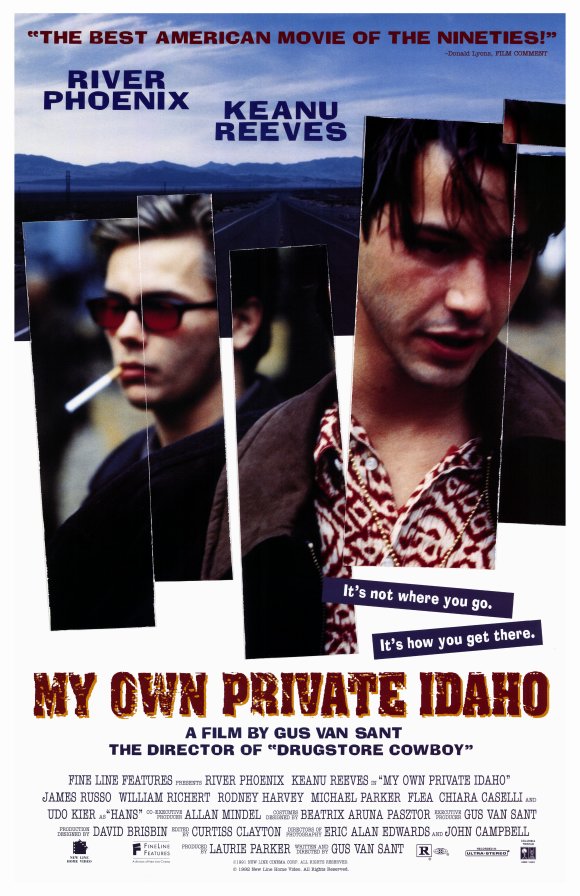
NEAR THE END of Gus Van Sant’s 1991 film My Own Private Idaho, Scott Favor, played by a young Keanu Reeves, looks out from a limousine window to see his friend Mike Waters, played by River Phoenix, asleep on a sidewalk. The scene represents a significant plot shift in the film: Favor—who really is favored by the fates—leaves behind his days of rebelliousness and street hustling and assumes the mantle of privilege he had previously shunned. Watching that scene now, nearly fifteen years after the film’s original release, one can’t escape its irony and poignancy. Just a few years after starring in Idaho, Phoenix died of a drug overdose in front of an L.A. nightclub. Reeves, who was a close friend of Phoenix and who has admitted that the actor’s death affected him deeply, has since gone on to enjoy his fair share of success as an actor.

    Even without an awareness of the friendship between Reeves and Phoenix and how soon it would be cut short, My Own Private Idaho remains a powerful love story of sorts, and stands on its own as an accomplished and important work of art. But it’s hard to watch the film now without thinking about Phoenix’s imminent death, just as one cannot view James Dean’s movies—and there were only three (Rebel Without a Cause, East of Eden, and Giant)—without being haunted by his untimely end. This effect is all the more pronounced because Van Sant’s film resonates with the theme of thwarted youth and lost innocence. (Van Sant explored his feelings about Phoenix’s death, and about the relationship he had with both Phoenix and Reeves, in his 1997 novel Pink, a Kurt Vonnegut-like roman à clef about a Portland-based filmmaker and his many young quirky friends.)

The Criterion Collection’s recent edition of My Own Private Idaho on a special two-disc DVD set gives it the imprimatur it deserves. In addition to Van Sant’s commentary, interviews with cast members, “making of” documentaries, and deleted scenes, the Criterion Collection edition also comes with a booklet containing reprints of articles about the film and interviews with cast members from the time of the its release, as well as recent appreciations by writers such as J. T. Leroy and film critic Amy Taubin.

Despite the wistful quality that the awareness of Phoenix’s death imparts to My Own Private Idaho, the film rings with as much humor as it does sadness. From the brightly colored title cards and the quirky music to the picaresque flow of its narrative, Idaho is a delightful and funny film, and Van Sant’s appropriation of Shakespeare’s The Tragedy of Henry the IV adds a an almost mock-heroic sensibility to the enterprise. William Richert’s Falstaffian performance as Bob Pigeon is a masterful and memorable balance of tragedy and comedy, and Udo Kier’s performance as Hans is equally, if differently, inspired.

What’s most striking upon repeated viewings of the film, though, is Van Sant’s use of the Doppelganger motif. With respect to theme, character, and even the visual language of the film, Van Sant employs mirrored pairings throughout. The central example of this pairing is the strikingly tender relationship between River Phoenix’s Waters and Keanu Reeve’s Favor. Both are beautiful young men who are attempting to come to terms with their origins. Waters is in search of his mother while Favor strives (at least initially) to defy his father. One comes from a broken home, the other is fleeing from his background of privilege. One turns to hustling as a means of survival, the other does it as a vehicle of rebellion. Even before we observe Phoenix, cradled Pièta-like by Reeves in a city park in Portland, Oregon, we see him cradled in similar fashion by the mother he can only dream of, somewhere in the idyllic Idaho of his childhood.

In the interviews included as supplemental material to this DVD edition, Van Sant mentions that the film is about journeys, searching, and “looking for a home.” It seems a misnomer to label Idaho as a “gay” film, because it embraces so much more. One of its best scenes is the conversation that Mike and Scott have as they sit beside a campfire. It’s arguably the closest thing to a gay love scene that Reeves and Phoenix ever did, but ultimately the love they stumble toward articulating is more brotherly than erotic. When Mike confesses “I want to kiss you, man,” Scott responds to his vulnerability with a hesitant but eventually encompassing embrace.

Van Sant’s vagueness with regard to what Idaho is “about” is understandable. In many ways, the actual story told in My Own Private Idaho seems less important than how it’s told. Some of the most stunning information about the characters is almost glossed over, such as the revelation that Mike is the result of an incestuous relationship between his mother and his older brother Richard. As he had in his films before Idaho (such as 1989’s Drugstore Cowboy) and in films since (such as last year’s Elephant), Van Sant brings a level of poetry to his films in which the silence speaks as much, if not more, than the words. What seems most significant in Idaho is the mood of the film. Van Sant’s sweeping vistas of the fields, roads, and skies of the American Northwest; his loving, witty, and humane portrayal of the street hustlers and their pathetic, lonely customers; and his wonderful blend of humor and pathos, of high art and pornography—all combine to create a uniquely elegiac, lyrically beautiful film.

Share

Read More from JIM NAWROCKI